WhereEast and southern Africafrom Ethiopia to the caves of South Africa[3]
Nutcracker Manfound 17 July 1959at Olduvai Gorge, Tanzania; about 1.75 million years old[3]
Diet, P. boiseimostly grasses and sedgesdespite its nickname[3]
Relationship to usa side branchnot an ancestor of Homo sapiens[1]
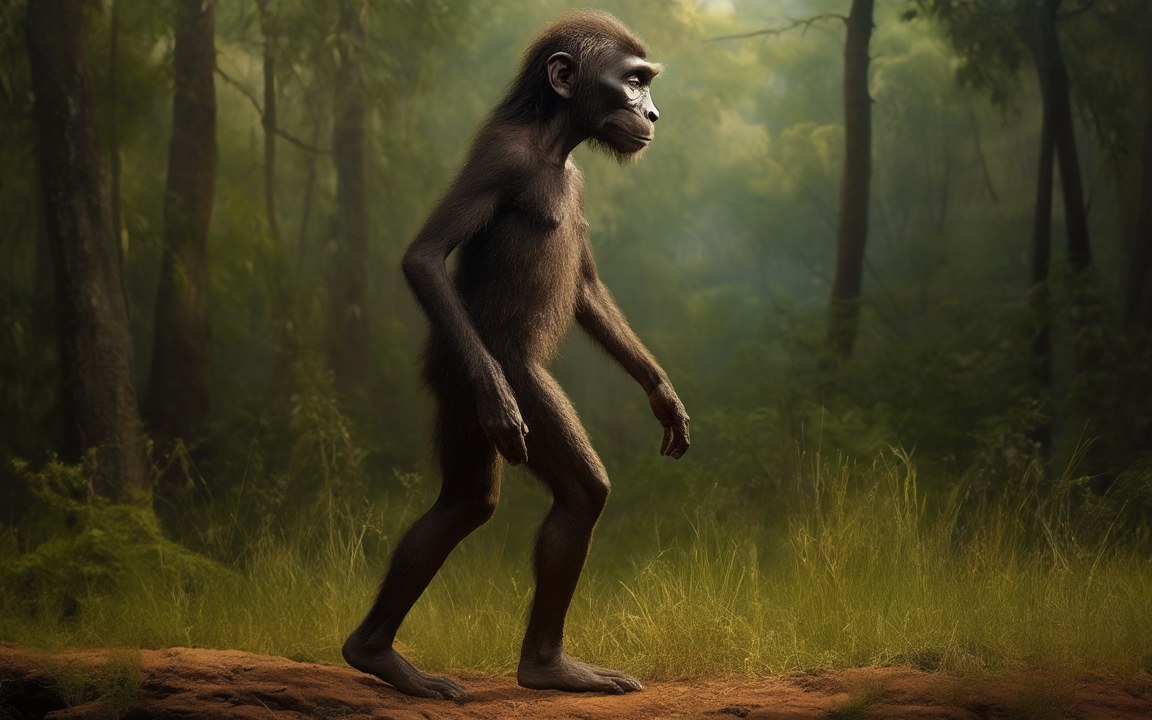
About the pictures. One painting shows Paranthropus boisei only as a small silhouette walking upright along a lakeshore in East Africa about 2 million years ago; the others show places and traces: a lakeshore of the kind it lived beside, the grassy hills of the Cradle of Humankind in South Africa, where Paranthropus robustus lived, and a broken piece of bone at a termite mound, like the bone tools found with its fossils at Swartkrans and Drimolen, which may have been used for digging. Its skulls show a very wide, dish-shaped face, flaring cheekbones and a bony crest, which the silhouette does not show; its foot and footprints show an upright walker. No DNA survives, so the colour of its skin and hair, and how much hair it had, are unknown.
For more than a million years, our ancestors in Africa shared the land with another kind of human relative, one built around its jaws. Paranthropus had a wide, dish-shaped face, flaring cheekbones, a bony crest along the top of its skull to anchor huge chewing muscles, and enormous cheek teeth with thick enamel. It walked upright, it had hands that could have made tools, and it lived alongside early Homo on the same lakeshores. But it was a side branch, and it left no descendants.
Nutcracker Man
The best-known species, Paranthropus boisei, lived in East Africa from about 2.3 to 1.2 million years ago. Its most famous skull was found at Olduvai Gorge in Tanzania on 17 July 1959 by M. Leakey and named in the same year by L. Leakey, who called it Zinjanthropus. It is about 1.75 million years old. Its massive molars earned it the nickname Nutcracker Man.
The nickname is misleading. Microscopic wear on its teeth looks more like that of fruit-eaters than of nut-crackers, so hard foods were rare in its diet. Chemical traces in its enamel show that it mostly ate grasses and sedges, tough plants it ground down with those enormous teeth. Its South African cousin, Paranthropus robustus, had a more varied diet and fell back on hard foods when times were lean. It probably even used pieces of bone to dig into termite mounds: 84 such bone tools have been found at Swartkrans.
Hands and feet
For decades nobody knew what the hand of Paranthropus boisei looked like. In 2025 researchers described one from Koobi Fora in Kenya, just over 1.5 million years old. Its proportions were human-like enough for a precise grip, combined with the grip strength of a gorilla, and its foot was adapted to walking upright. It could have made and used stone tools, although nothing yet shows that it did. Elsewhere, at Nyayanga in Kenya, Paranthropus teeth lie beside some of the oldest known stone tools, about 2.9 million years old, but who made them is still open.
Paranthropus and early Homo did not just live in the same era. A lakeshore surface at Koobi Fora, about 1.5 million years old and described in 2024, preserves a trail of 12 footprints made by Paranthropus boisei and three made by Homo erectus, laid down within hours or days of each other.
New finds
In 2025 researchers recovered proteins from the tooth enamel of four Paranthropus robustus individuals from Swartkrans, about 2 million years old. DNA had not survived, but the proteins showed that two were male and two female, and hinted at genetic variety within the species. In 2026 a jaw about 2.6 million years old from the Afar region of Ethiopia extended the known range of Paranthropus about 1 000 km to the north, suggesting it was more adaptable than once thought.
The end
The last Paranthropus lived about a million years ago. Why it died out is not settled. Suggestions include shrinking grasslands, a drier climate that reduced the roots and tubers it relied on, competition with baboons and with Homo, and in southern Africa the longer dry cycles of a shift in the ice-age rhythm about a million years ago.
Where it sits in deep time
Paranthropus: About 2.9 to 1 million years ago, in the Neogene.
Each step to the right is ten times closer to today, so the last few million years get as much room as the first billion.
23:59:05.1
If Earth's history were one day
Squeeze all of Earth's history, about 4.6 billion years, into 24 hours, starting at midnight. Paranthropus runs from 23:59:05.1 to 23:59:41.1, ending 18.9 seconds before midnight.
On this clock one second is about 52 862 years. All of written history fits into the last tenth of a second.
The last minute, enlarged
23:59:00midnight
How tall
Average heights of Paranthropus boisei men and women, next to a modern person.
Male, average1.37 m
Female, average1.24 m
Modern person, for scale1.7 m
Reconstructions
The dark silhouette of a small, upright human figure walking along the reedy shore of a calm lake at sunrise, reflected in the water, with acacia trees and a distant volcano, an impression of Paranthropus boisei in East Africa about 2 million years ago. AI-generated painting.A wide, grassy wetland at the edge of a shallow East African lake at sunrise, with birds wading in the shining water, acacia trees and a distant volcano, an impression of the kind of lakeshore where Paranthropus boisei lived. No Paranthropus is shown. AI-generated painting.Gently rolling grassy hills with scattered trees, a low outcrop of grey rock with a dark cave opening and a river winding through the valley below, an impression of the Cradle of Humankind in South Africa about 1.8 million years ago. AI-generated painting.A broken piece of animal bone with a worn tip lying at the foot of a reddish-brown termite mound with small holes dug into its side, dry grass around it, an impression of a bone tool used to dig for termites in South Africa about 1.8 million years ago. AI-generated painting.
Questions people ask
Why is Paranthropus boisei called Nutcracker Man?
Because of its enormous jaws and cheek teeth. But the wear on its teeth shows it rarely ate hard foods, and chemical traces show it mostly ate grasses and sedges, tough plants it ground with those huge molars.
Did Paranthropus use tools?
Possibly. The first hand of Paranthropus boisei, described in 2025, combines a human-like precision grip with gorilla-like strength, so it could have made and used tools. Stone tools have been found next to its teeth, but none has been tied to it directly. Its South African relative probably used bones to dig for termites.
Did Paranthropus live at the same time as Homo erectus?
Yes. A 1.5-million-year-old lakeshore at Koobi Fora in Kenya preserves a trail of Paranthropus footprints and three Homo erectus prints, made within hours or days of each other.
Is Paranthropus a human ancestor?
No. It was a side branch of the human family that lived alongside early members of our own genus, Homo, but did not lead to us.
Has Paranthropus DNA been found?
No, DNA has not survived. In 2025, though, researchers recovered proteins from the tooth enamel of four Paranthropus robustus individuals about 2 million years old, enough to tell two were male and two female.