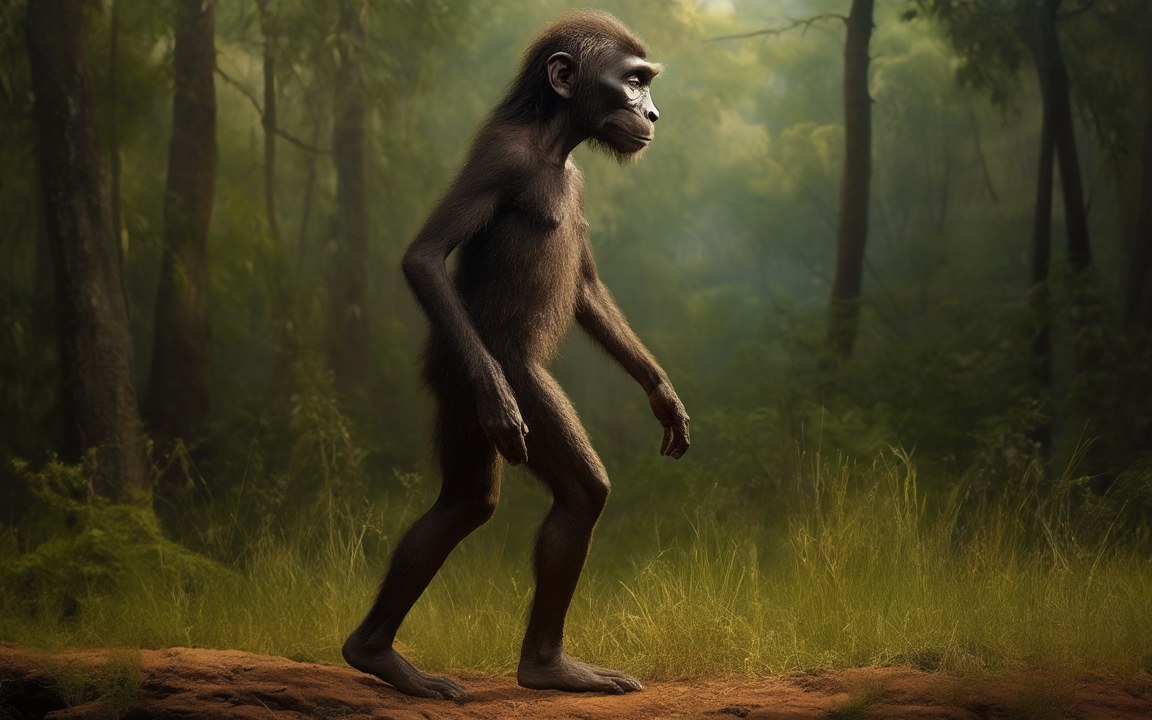
A small, slender figure covered in dark hair walking upright through a grassy woodland, seen from the side, with long arms and a projecting jaw, an impression of Australopithecus afarensis, the species of Lucy.

Human RelativesNeogene

Australopithecus afarensis

Lucy's species: small-brained, about a metre tall, and already walking on two legs

About 3.85 to 2.95 million years ago Reconstruction, not a photograph
Lived about 3.85 to 2.95 million years ago [1]
Where East Africa Ethiopia, Kenya and Tanzania [1]
Height males about 151 cm, females about 105 cm on average [1]
Weight males about 42 kg, females about 29 kg on average [1]
Brain usually under 500 cm³ Lucy's about 365 to 417 cm³ [2]
Lucy found 24 November 1974 at Hadar, Ethiopia; about 3.2 million years old [2]
Named 1978 by Johanson, White and Coppens [2]
Laetoli footprints about 3.66 million years old made in wet volcanic ash in Tanzania [4]
Diet mainly plants leaves, fruit, seeds, roots, nuts and insects [1]

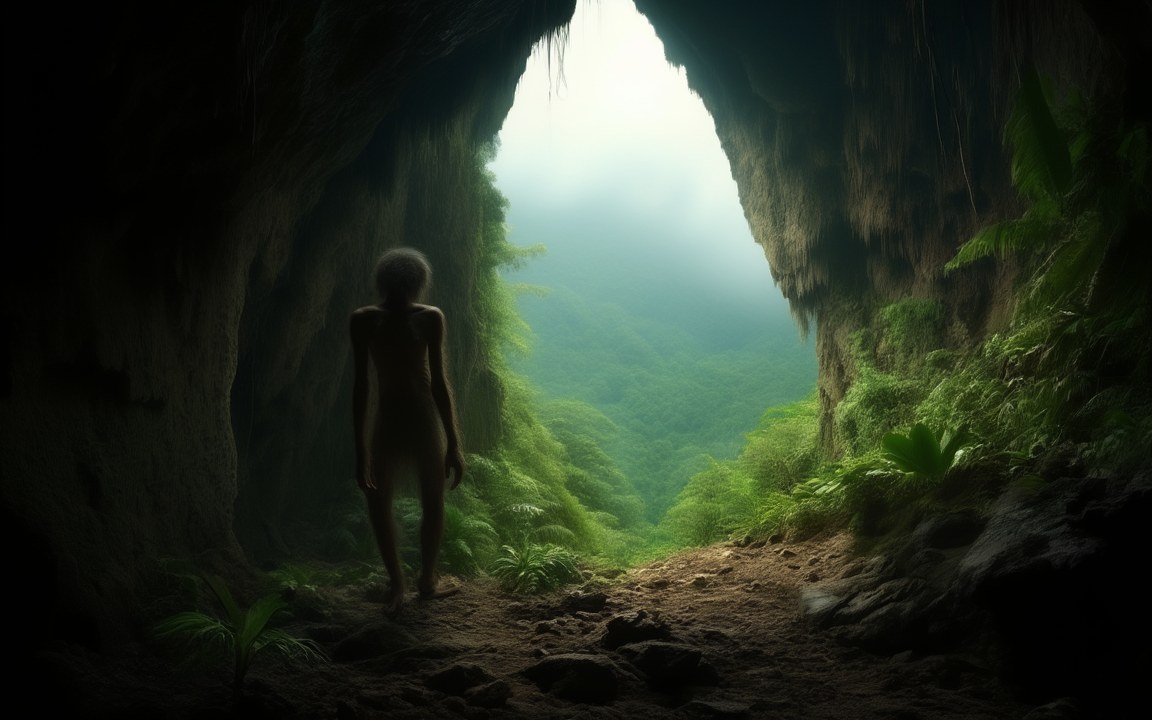
About the pictures. Three paintings based on Lucy's skeleton, the Laetoli footprints and other fossils of her species: a small, upright figure about a metre tall walking through grassy woodland; three figures crossing grey volcanic ash, as three individuals did at Laetoli, with a fourth faint in the distance; and a river plain with no figures, an imagined view of Hadar in Ethiopia, where Lucy lived. The long arms, small head and projecting jaw come from the bones. No DNA survives from fossils this old, so skin colour and how much body hair they had are unknown; the dark, all-over hair is a guess, and the soft tissue of the faces, the volcano and the plants are imagined.

About 3.2 million years ago, a small female lived in what is now the Afar region of Ethiopia. When her bones were found in 1974, she became the most famous fossil of an early human relative: Lucy. Her species, Australopithecus afarensis, lived in East Africa for about 900 000 years. Its brain was only about a fifth larger than a chimpanzee’s, but it walked upright on two legs.

Lucy

Lucy was found on 24 November 1974 at Hadar by the palaeoanthropologist Johanson and the graduate student Gray. She was an adult, about 105 cm tall and weighing about 28 kg. Four years later Johanson, White and Coppens named her species. Its males appear to have been much larger, averaging about 151 cm and 42 kg against about 105 cm and 29 kg for females, though the size of that gap is debated.

In 2023 a researcher at the University of Cambridge used scans of Lucy’s bones to rebuild 36 muscles in each of her legs in three dimensions. Muscle made up about 74 per cent of the mass of her thigh, compared with about 50 per cent in people today, and her knees could straighten as fully as ours: she could stand as upright as we can.

Walking and climbing

Lucy’s species walked upright as a matter of course, but it had not given up the trees. Its arms were long and strong and its fingers curved, which would have helped with climbing. On the ground it was no sprinter. A 2024 study simulated how fast Lucy could run and found a top speed of about 5 m per second, well below a modern human sprinter, at a much higher energy cost.

Its brain was small, usually under 500 cm³, and organised more like a chimpanzee’s than ours. But a 2020 study of fossil braincases found that the brain grew slowly over a long childhood, as human brains do.

Footprints in the ash

The most vivid evidence of their walking is at Laetoli in Tanzania. About 3.66 million years ago, early humans walked across a layer of fresh, damp volcanic ash, and their prints hardened and were buried. At Site G, three individuals left a trail about 24 m long, discovered in 1976 and excavated by Leakey’s team by 1978. More prints of two individuals were found nearby in 2015, including one who may have stood about 165 cm tall.

A third set of five prints, at Site A, has a strange cross-stepping pattern. A 2021 study argued that it was made by a different kind of human relative living alongside Lucy’s species, though not everyone agrees.

Our ancestor?

Lucy’s species has long been considered a likely ancestor of later humans, including our own genus, Homo. That picture is being questioned. In 2025 a team led by Haile-Selassie described new jaws and teeth from Ethiopia confirming a second species, Australopithecus deyiremeda, that lived alongside Lucy’s between 3.5 and 3.3 million years ago, ate leaves, fruit and nuts and climbed more. They suggested that an older species, Australopithecus anamensis, may be the common root of the later branches instead.

No stone tools have been firmly linked to Lucy’s species. Cut marks on animal bones about 3.4 million years old from Dikika in Ethiopia have been read as butchery, but that interpretation is disputed. The species disappears from the fossil record about 2.95 million years ago, perhaps evolving into later forms rather than simply dying out.

Where it sits in deep time

Australopithecus afarensis: About 3.85 to 2.95 million years ago, in the Neogene.

Australopithecus afarensis

Earth forms, 4.57 billion years agoToday

Each step to the right is ten times closer to today, so the last few million years get as much room as the first billion.

If Earth's history were one day

Squeeze all of Earth's history, about 4.6 billion years, into 24 hours, starting at midnight. Australopithecus afarensis runs from 23:58:47 to 23:59:04.2, ending 55.8 seconds before midnight.

On this clock one second is about 52 862 years. All of written history fits into the last tenth of a second.

How tall

Average heights of males and females of Lucy's species, next to a modern person.

On these averages males were much larger than females, a bigger gap than in people today, though how large the difference really was is debated.

Reconstructions

A small, slender figure covered in dark hair walking upright through a grassy woodland, seen from the side, with long arms and a projecting jaw, an impression of Australopithecus afarensis, the species of Lucy. AI-generated painting.
Three small, dark-haired figures with projecting jaws walking upright across a flat plain of grey volcanic ash, a smoking volcano in the haze behind them and another figure faint in the distance, an impression of Australopithecus afarensis at Laetoli. AI-generated painting.
A river winding through a green floodplain between tall, shady trees, open grassy ground and a shallow lake glinting in the hazy distance, an impression of the landscape at Hadar in Ethiopia 3.2 million years ago, where Lucy lived. AI-generated painting.

Questions people ask

How tall was Lucy?

About 105 cm, just over a metre, and she weighed about 28 kg, though estimates of her weight range from about 25 to 37 kg. Males of her species were much bigger, averaging about 151 cm and 42 kg.

How old is Lucy?

About 3.2 million years. Her skeleton was found at Hadar in Ethiopia on 24 November 1974.

Who made the Laetoli footprints?

Most likely members of Lucy's species, about 3.66 million years ago, walking across fresh volcanic ash that later hardened. A separate set of five prints at the same site may belong to a different kind of human relative, but not all scientists agree.

Is Lucy our ancestor?

Possibly, but it is debated. Her species has long been seen as a likely ancestor of later humans. A 2025 study confirmed a second species living alongside it, Australopithecus deyiremeda, and suggested that an older species, Australopithecus anamensis, may be the common root instead.

Could Lucy climb trees?

Yes. Her species walked upright on two legs, but it also had long, strong arms and curved fingers that would have helped it climb.

Sources

  1. Smithsonian Human Origins: Australopithecus afarensis
  2. Wikipedia: Australopithecus afarensis
  3. Wikipedia: Laetoli footprints
  4. Jungers (2016), on Masao et al., New footprints from Laetoli provide evidence for marked body size variation in early hominins, eLife 5
  5. Discover (2022), Mysterious hominin left its mark with 3.66-million-year-old footprint (McNutt et al. 2021, Nature 600)
  6. ESRF (2020), Lucy had an ape-like brain but prolonged brain growth like humans (Gunz et al., Science Advances)
  7. University of Cambridge (2023), First hominin muscle reconstruction shows Lucy could stand as erect as we can (Wiseman)
  8. Archaeology Magazine (2024), Early human ancestors were poor runners (Bates et al., Current Biology)
  9. Natural History Museum (2025), Australopithecus afarensis may not be our human ancestor (Haile-Selassie et al., Nature)