
A wet woodland of tall, broad-crowned trees with ferns, a grassy clearing and small pools among the roots in soft morning light, an impression of the spring-fed woodland at Aramis in Ethiopia where Ardipithecus lived 4.4 million years ago.

Human RelativesNeogene

Ardipithecus

A possible early human relative from Ethiopia, with a big toe that could grip branches and legs that could walk

About 5.8 to 4.4 million years ago Reconstruction, not a photograph
Lived about 5.8 to 4.4 million years ago A. kadabba 5.8 to 5.2, A. ramidus about 4.4; the Australian Museum gives 4.4 to 4.2 for A. ramidus [2]
Where Afar Depression, Ethiopia Aramis in the Middle Awash valley, and As Duma [4]
Ardi partial female skeleton found in 1994 about 125 pieces, announced in 2009 [3]
Height about 120 cm Ardi only [1]
Weight about 50 kg published estimates run from about 32 to 51 kg [9]
Brain about 300 to 350 cm³ similar to a female chimpanzee's or bonobo's [3]
Femur length about 312 mm estimated for A. ramidus; an average chimpanzee's is 300 mm [14]
Feet grasping big toe, no arch more rigid than a chimpanzee's foot [3]
Fossils over 110 specimens of A. ramidus about 35 individuals at Aramis, 9 more at As Duma [3]
How it moved disputed walking and climbing, in proportions studies from 2009 to 2025 disagree on [10]

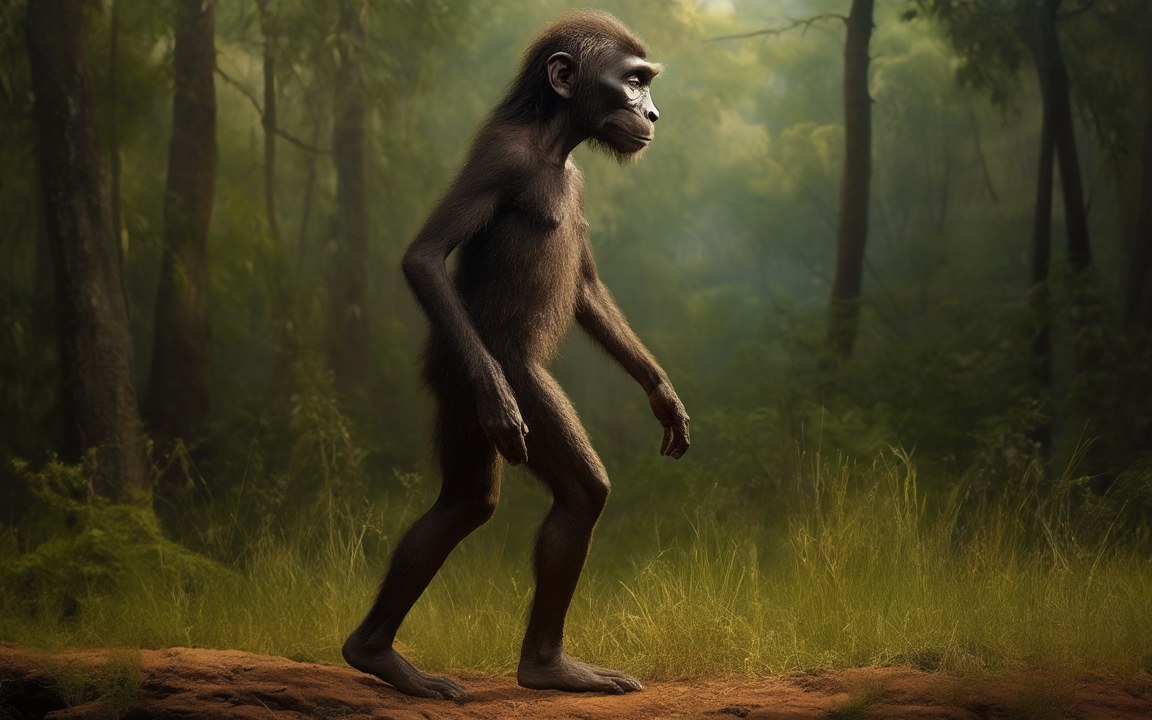
About the pictures. The paintings show a wet woodland with pools among the roots, following her discoverers' reading of Aramis; a 2010 study argued for far fewer trees, and the exact plants are imagined. A spiral-horned antelope stands for the kudu found at the site, its coat and the tight curl of its horns guessed. Ardipithecus itself appears only in silhouette: climbing along a branch, and walking upright across a clearing with a slim build and a long stride. The skeleton had flat feet and a big toe that could grip. No skin, hair or DNA survives, so the shaggy outline in the tree and any colour of skin or hair are guesses.

Ardipithecus lived in the Afar Depression of Ethiopia between about 5.8 and 4.4 million years ago, more than a million years before Lucy, and may be an early member of the human family. Most of what is known comes from one partial skeleton of the species Ardipithecus ramidus, a female nicknamed Ardi. Her brain was about the size of a female chimpanzee’s and her big toe could grip branches, yet her pelvis and leg bones point to walking upright on the ground. That mix puts her at the centre of the question of how walking on two legs began, and the studies of her bones disagree.

Fifteen years to rebuild her

A team led by White found the first fossils of the species at Aramis, in the Middle Awash valley, between 1992 and 1994, and named it from Afar words: ardi for ground or floor, ramid for root. Ardi was found in 1994, in about 125 pieces, in such poor condition that excavating, rebuilding and analysing her took 15 years. She was announced only in 2009.

She stood about 120 cm tall and is usually said to have weighed about 50 kg, though published estimates start at about 32 kg. Her canine teeth are small and diamond-shaped, with no sign of sharpening, and differ little between the sexes. Some researchers read that as little aggression between males, an inference the fossils cannot confirm.

What kind of climber?

In 2009 her discoverers described a species that clambered carefully along branches on flat palms and, on the ground, walked upright in a way more primitive than Australopithecus. They found none of the features typical of hanging below branches, vertical climbing or knuckle-walking, and concluded that the last common ancestor of humans and chimpanzees probably differed substantially from any living African ape. Her pelvis combines short, broad upper blades, like those of Lucy’s species, with a large lower part suggesting massive climbing muscles, and with such flat feet she probably could not walk or run far.

Later studies moved her closer to the African apes. In 2019 Prang found her foot most like those of chimpanzees and gorillas. A 2021 study of her hand, across 53 primate species, found it most similar to those of chimpanzees, bonobos and orangutans, and suited to hanging and climbing. In 2025 Prang’s team reported that her ankle bone also resembles those of chimpanzees and gorillas, with added features for a stronger push-off in walking. Prang called this a correction of the first interpretation, not a claim that humans evolved from chimpanzees.

Others disagree, in both directions. In 2011 Sarmiento and Meldrum argued from her proportions that she mostly went on all fours on the ground and climbed little. A 2019 study of fossils from Gona, led by Simpson, found an ankle and big toe better suited to upright walking than previously recognised, though he still called Ardipithecus “a lousy biped”. The Smithsonian notes that the pelvis was rebuilt from crushed fragments and, to some scientists, only suggests upright walking.

Woodland or savanna

Her discoverers describe a largely woodland home, and the fossils found with her include fig, palm and hackberry, leaf-eating monkeys, kudu and peafowl. The Smithsonian takes this as evidence against the old idea that upright walking began as grasslands spread. In 2010 Cerling’s team challenged it: carbon isotopes and microscopic grass fossils suggested that dense trees covered only 5 to 25 per cent of the area, so Ardi may have lived in a thin wooded strip within a savanna. White’s team answered that no reliable method can estimate savanna there, and that shallow groundwater and springs laid down the fossils, with no sign of an ancient river or lake.

An older species and an uncertain branch

Ardipithecus kadabba is known from far less: 11 specimens from at least five individuals in the Smithsonian’s count, most of them 5.6 to 5.8 million years old. The only evidence of upright walking is one toe bone, 5.2 million years old, found about 16 km from the rest. Its canines still project beyond the tooth row, and in 2008 Wood and Lonergan cited them in doubting its place on the human line.

The discoverers of Ardipithecus ramidus think it was ancestral to Australopithecus. Sarmiento argued that the genus shares no feature exclusive to humans, while later studies of its hand, skull base and tooth roots argue for the human line. There is no evidence of any cultural traits, and nothing is known of its skin or hair.

Where it sits in deep time

Ardipithecus: About 5.8 to 4.4 million years ago, in the Neogene.

Ardipithecus

Earth forms, 4.57 billion years agoToday

Each step to the right is ten times closer to today, so the last few million years get as much room as the first billion.

If Earth's history were one day

Squeeze all of Earth's history, about 4.6 billion years, into 24 hours, starting at midnight. Ardipithecus runs from 23:58:10 to 23:58:37, ending about a minute before midnight.

On this clock one second is about 52 862 years. All of written history fits into the last tenth of a second.

How tall

Ardi's estimated height next to a modern person.

Ardi is the only individual with a body size estimate. Males were probably not much bigger, judging by their canine teeth.

Reconstructions

A wet woodland of tall, broad-crowned trees with ferns, a grassy clearing and small pools among the roots in soft morning light, an impression of the spring-fed woodland at Aramis in Ethiopia where Ardipithecus lived 4.4 million years ago. AI-generated painting.
The dark silhouette of a small figure with a shaggy outline climbing along a thick branch high in a great tree, framed by green leaves and bright light, an impression of Ardipithecus in the woodland at Aramis 4.4 million years ago. AI-generated painting.
A slender, grey-brown antelope with thin white vertical stripes on its flanks, large ears and long, ringed horns curling into a scroll, standing in a sunlit forest glade, an impression of an ancient kudu in the woodland at Aramis 4.4 million years ago. AI-generated painting.
The small, dark silhouette of a slender figure walking upright on two legs across a mossy clearing in a misty woodland, great trees and shafts of morning light around it, an impression of Ardipithecus in Ethiopia 4.4 million years ago. AI-generated painting.

Questions people ask

How old is Ardi?

About 4.4 million years, more than a million years older than Lucy. Fossils from Aramis are dated by their position between two layers of volcanic rock.

How tall was Ardi?

About 120 cm. Her weight is less certain: it is usually given as about 50 kg, but published estimates run from about 32 to 51 kg. She is the only individual of her species with a body size estimate.

Did Ardipithecus walk upright?

Probably, at least some of the time, but less efficiently than Lucy's species. Its discoverers describe upright walking on the ground combined with careful climbing. Its feet were flat, with a big toe that could grip. Other researchers argue that it mostly went on all fours on the ground, and that the pelvis, rebuilt from crushed fragments, only suggests walking.

Is Ardi a human ancestor?

Possibly. Her discoverers think her species was ancestral to Australopithecus, but others disagree, and some question whether it belongs on the human line at all. The Australian Museum concludes that, even if not a direct ancestor, it must have been closely related to one.

Did Ardi live in a forest or a savanna?

That is debated. Her discoverers reconstruct a largely woodland habitat fed by springs and groundwater. A 2010 study by Cerling and colleagues argued for grass and shrubs, with dense trees on only 5 to 25 per cent of the land.

What does Ardipithecus mean?

Ardi means ground or floor in the Afar language of Ethiopia, and pithecus is Latinised Greek for ape. The species name ramidus comes from the Afar word for root.

Sources

  1. Smithsonian Human Origins: Ardipithecus ramidus
  2. Smithsonian Human Origins: Ardipithecus kadabba
  3. Australian Museum: Ardipithecus ramidus
  4. Wikipedia: Ardipithecus
  5. Wikipedia: Ardipithecus kadabba
  6. White et al. (2009), Ardipithecus ramidus and the paleobiology of early hominids, Science 326, 75–86
  7. Sarmiento & Meldrum (2011), Behavioral and phylogenetic implications of a narrow allometric study of Ardipithecus ramidus, Homo 62, 75–108
  8. Prang (2019), The African ape-like foot of Ardipithecus ramidus and its implications for the origin of bipedalism, eLife 8, e44433
  9. Prang et al. (2021), Ardipithecus hand provides evidence that humans and chimpanzees evolved from an ancestor with suspensory adaptations, Science Advances 7, eabf2474
  10. Prang et al. (2025), Ardipithecus ramidus ankle provides evidence for African ape-like vertical climbing in the earliest hominins, Communications Biology 8, 1454
  11. Washington University in St. Louis (2025), Analysis of 4.4-million-year-old ankle exposes how earliest ancestors moved, evolved
  12. Case Western Reserve University (2019), New findings shed light on origin of upright walking in human ancestors (Simpson et al., Journal of Human Evolution 129)
  13. Science News (2010), Contested evidence pushes Ardi out of the woods (Cerling et al. and White et al., Science 328)
  14. Williams et al. (2026), Earliest evidence of hominin bipedalism in Sahelanthropus tchadensis, Science Advances 12, eadv0130