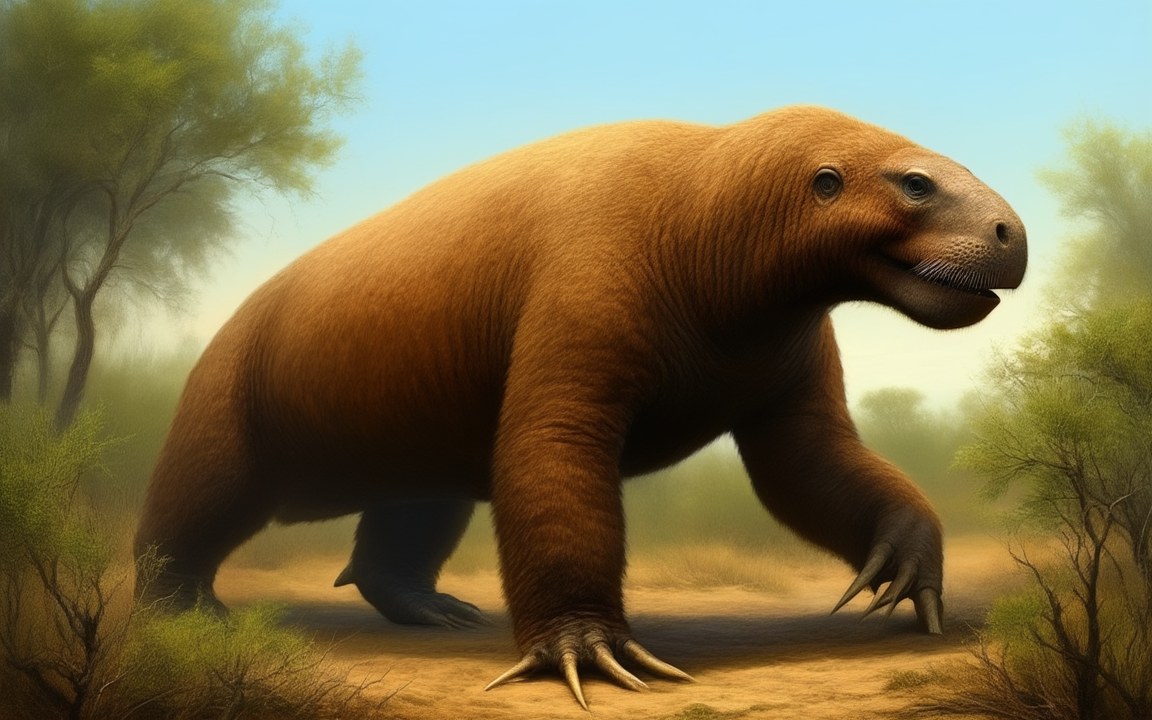
A giant ground sloth with thick reddish-brown fur walking on all fours across sandy ground between thorny shrubs, long curved claws on its feet, an impression of Megatherium.

Lost GiantsPleistocene

Megatherium

A ground sloth as heavy as an elephant that probably reared on its hind legs to strip the trees

About 400 000 to 12 000 years ago Reconstruction, not a photograph
Lived about 400 000 to 12 000 years ago the species M. americanum; the genus goes back about 3.6 million years [1]
Length about 6 m [1]
Weight about 3.7 to 4 tonnes about as much as an Asian elephant, from volume-based studies [1]
Older weight estimate about 6 tonnes from 1998, now treated as a high-end figure [2]
Range the Pampas Argentina, Uruguay, Paraguay, southern Bolivia and southern Brazil [1]
Diet leaves, twigs and fruit a browser, probably with a grasping upper lip [1]
Fur probably dense, about 3 cm deep from body-temperature modelling in 2025, assuming a metabolism like that of living sloths and armadillos [2]
Body temperature about 31 °C estimated from the chemistry of one tooth [2]
Found 1787, on the Luján River, Argentina named by Cuvier in 1796 [1]
Closest living relatives three-toed sloths from ancient DNA [1]

About the pictures. One painting shows the reconstruction walking on all fours, and the other shows large prints in river mud, after fossil trackways attributed to it in Argentina. The massive body, about 6 m long, and the long claws come from skeletons, and the dense coat from a 2025 model that calculated fur about 3 cm deep. The feet are simplified: the skeleton has claws on three fingers of each hand and hind feet turned inwards. No skin or hair of Megatherium survives, so the colour and texture of the fur, the face and the landscape are imagined.

Megatherium was a sloth, but nothing like the slow, small animals that hang from trees in the rainforests today. It lived on the ground, on the open plains of the Pampas in what are now Argentina and Uruguay, and it weighed about as much as an Asian elephant. Its name means “great beast”. It vanished about 12 000 years ago, along with most of South America’s other giants.

A giant browser

The skeleton is about 6 m long, with a huge body, massive hind legs and a thick tail. Volume-based estimates put its weight at about 3.7 to 4 tonnes. Its fingers ended in long claws on the three middle digits, and its hind feet were turned inwards, so that it walked on their outer edges and heels.

Its narrow snout is thought to have carried a thick, grasping upper lip, much like a black rhinoceros has, used to strip leaves and twigs from branches. Chemical analysis of its bones supports a diet of plants. An older suggestion that it also ate meat has little support.

To reach higher branches, Megatherium is widely thought to have reared up on its hind legs, propped on its tail like a tripod. Some fossils have injuries to the collarbone, which a 2022 study read as signs that it leaned against tree trunks with its forelimbs while doing so.

Furry after all

Some older reconstructions showed Megatherium almost hairless, like an elephant. A study published in 2025 tested this with a model of its body temperature, combined with chemical measurements from a fossil tooth that point to a body temperature of about 31 °C. Assuming a metabolism like that of living sloths and armadillos, the answer was that, in the cool, dry climate of the Pampas, it needed a dense coat about 3 cm deep all year round. Thinner fur would have left it cold; much thicker fur would have overheated it. Whether its metabolism really was that slow is still uncertain.

No skin or hair of Megatherium has survived, so this coat is calculated rather than seen. Well-preserved fur is known only from smaller ground sloths, such as Mylodon.

Found on a riverbank

The first skeleton was dug from the bank of the Luján River in Argentina in 1787 and shipped to Madrid. In 1796 the French anatomist Cuvier named it from drawings of the skeleton, which he never saw in person.

What killed the giant sloths

Megatherium disappeared about 12 000 years ago, in the same wave of extinctions that took more than 80 per cent of South America’s large mammals. A large study published in Science in 2025, based on more than 400 fossils and ancient DNA, found that ground sloths had grown to their greatest sizes during the ice ages and then declined rapidly from about 15 000 years ago. The authors concluded that changes in climate do not explain that collapse and that it points to people, although the cause of the South American extinctions as a whole is still debated, with hunting and climate change both proposed.

There is direct evidence that humans hunted it. At Campo Laborde, in the Argentine Pampas, archaeologists found the butchered bones of a Megatherium about 12 600 years old, the only confirmed kill site of a giant ground sloth in the Americas.
Where it sits in deep time

Megatherium: About 400 000 to 12 000 years ago, in the Pleistocene.

Megatherium

Earth forms, 4.57 billion years agoToday

Each step to the right is ten times closer to today, so the last few million years get as much room as the first billion.

If Earth's history were one day

Squeeze all of Earth's history, about 4.6 billion years, into 24 hours, starting at midnight. Megatherium runs from 23:59:52.4 to 23:59:59.77, ending 0.23 seconds before midnight.

On this clock one second is about 52 862 years. All of written history fits into the last tenth of a second.

How big

Body length of Megatherium next to the height of a person.

Reconstructions

A giant ground sloth with thick reddish-brown fur walking on all fours across sandy ground between thorny shrubs, long curved claws on its feet, an impression of Megatherium. AI-generated painting.
Large rounded marks pressed into wet grey mud along the edge of a calm river at sunset, golden grassland and distant hills beyond, an impression of giant ground sloth footprints on the plains of ancient Argentina. AI-generated painting.

Questions people ask

How big was Megatherium?

About 6 m long and about 3.7 to 4 tonnes, roughly the weight of an Asian elephant. Some older estimates put it at around 6 tonnes, but recent volume-based studies give lower figures.

Could Megatherium stand up?

Probably, at least to feed. It mostly walked on all fours, but it is widely thought to have reared up on its hind legs, braced by its thick tail, to pull down branches. Injuries to the collarbone of some fossils suggest it leaned against trees while doing so.

Did Megatherium have fur?

Probably. A 2025 study modelled its body heat, assuming a metabolism like that of living sloths and armadillos, and concluded it needed a dense coat about 3 cm deep all year round in the cool, dry Pampas. No skin or hair of Megatherium has survived, so this is calculated, not seen.

Why did the giant ground sloth go extinct?

It disappeared about 12 000 years ago, together with most of South America's large mammals. A large study published in Science in 2025 found that ground sloths declined rapidly from about 15 000 years ago, which climate does not explain, and concluded that this points to humans, although the debate is not settled. At Campo Laborde in Argentina people butchered a Megatherium.

Is Megatherium related to modern sloths?

Yes. Ancient DNA shows its closest living relatives are the three-toed sloths, which live in trees and are tiny by comparison.

Sources

  1. Wikipedia: Megatherium
  2. Deak et al. (2025), Metabolic skinflint or spendthrift? Insights into ground sloth integument and thermophysiology, Journal of Mammalian Evolution 32, 1
  3. Boscaini et al. (2025), The emergence and demise of giant sloths, Science 388, 864–868
  4. Sci.News (2025), New research sheds light on emergence and demise of giant sloths
  5. Politis et al. (2019), Campo Laborde: a Late Pleistocene giant ground sloth kill and butchering site in the Pampas, Science Advances 5, eaau4546
  6. Delsuc et al. (2019), Ancient mitogenomes reveal the evolutionary history and biogeography of sloths, Current Biology 29, 2031–2042