Named1935, by von Koenigswaldfrom teeth sold as dragon bones in Hong Kong[1]
Dietforest plants and fruitlater more bark and twigs[4]
Closest living relativesorangutansa shared ancestor 12 to 10 million years ago[5]
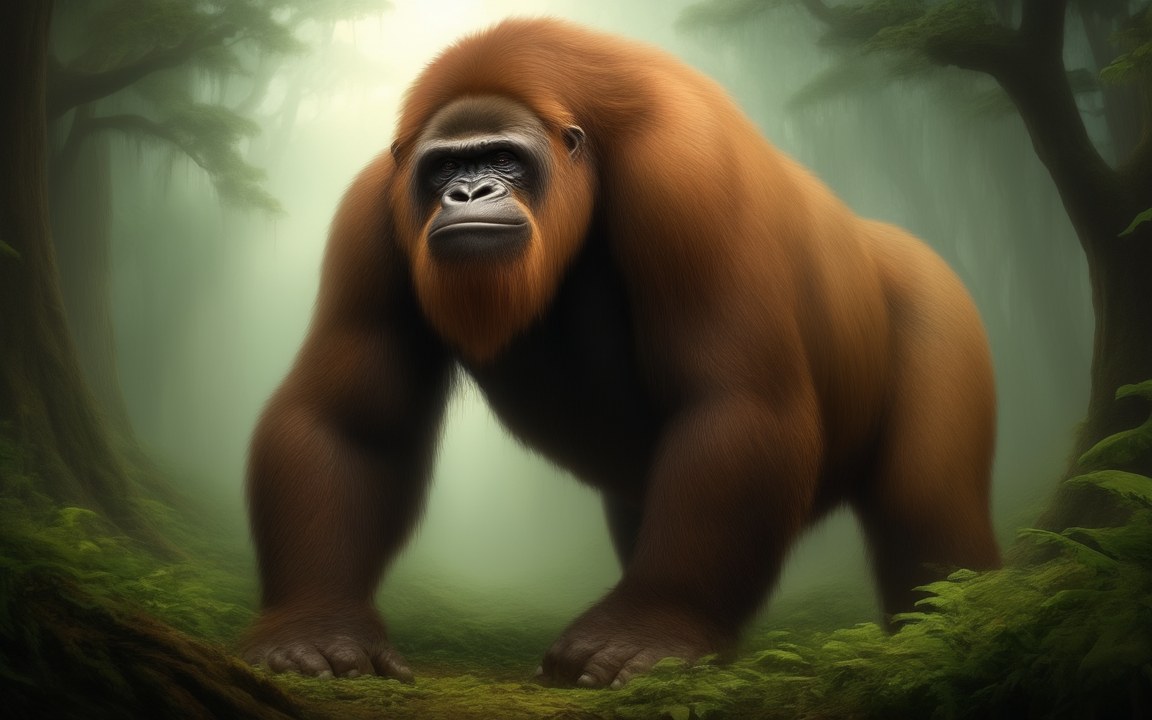
About the pictures. Only jaws and teeth of Gigantopithecus have ever been found, so everything about the ape in these paintings is inferred. One shows it on all fours in a misty forest, one sitting and chewing a branch with fruit on the trees behind, and one crossing a stream on its fists and feet. The reddish hair and heavy build are borrowed from its closest relatives and are guesses, and so are its height, its posture and the shape of its face above the jaw; the seated ape looks much like a living orangutan for that reason. The fourth painting shows no animal, only the limestone towers of Guangxi, where many of its fossils come from.
Gigantopithecus was the largest ape that has ever lived. It roamed the forests of southern China for around two million years and died out a few hundred thousand years ago. For all its fame, not a single bone of its body below the head has ever been found. Everything known about it comes from more than a thousand teeth and four lower jaws, which is why estimates of its size vary so widely.
Dragon bones from a drugstore
The story begins in a pharmacy. In 1935 the palaeontologist von Koenigswald bought two enormous molars in a Hong Kong drugstore, where fossil teeth were sold as “dragon bones”. He named a new ape from them. The first jaw turned up only in 1956, found by a farmer at Liucheng in Guangxi, and excavations there over the next few years produced more than 1 000 teeth. Most finds since then have come from caves in the same karst region.
The teeth are remarkable. Its molars are the largest of any ape, with the thickest enamel in absolute terms and broad, flat grinding surfaces suited to tough plant food. Chemical traces in the enamel show that it ate forest plants, and plant fragments stuck to the teeth suggest fruit was important.
How big?
Scaled up from its teeth and jaws, Gigantopithecus is usually put at about 200 to 300 kg, more than an average male gorilla, though the authors of that figure concede that no reliable estimate is possible without more complete remains. Its height is another matter. Estimates have ranged from 1.85 m to 3.7 m, and the famous figure of three metres still appears in news reports. Without a single leg or arm bone, nobody knows how it stood or moved, and one assessment calls a standing height above about 2.3 m unreasonable. Reconstructions usually give it the shape of a gorilla and the reddish hair of an orangutan, but both are informed guesses.
Its closest living relatives are the orangutans. In 2019 researchers recovered proteins from the enamel of a 1.9-million-year-old molar and found that the two lineages split about 12 to 10 million years ago.
The fall of a specialist
For decades it was not clear when or why Gigantopithecus disappeared. In 2024 a Chinese, Australian and US team published an answer in Nature. They collected 157 dates, using six different methods, from 22 caves in Guangxi: 11 caves with Gigantopithecus and 11 of similar age without it. The ape vanished between 295 000 and 215 000 years ago.
Before that, it lived in a rich and varied forest. From about 700 000 years ago the seasons became stronger, and the structure of the forest changed. Wear on the teeth shows that Gigantopithecus fell back on less nutritious foods such as bark and twigs, and its teeth point to chronic stress. Its numbers dwindled. Orangutans living in the same region adapted their size, behaviour and habitat and survived. One of the lead authors called Gigantopithecus “the ultimate specialist”. Another stressed that the forest was still there when it died out: it was the kind of forest that had changed. Nelson, who was not involved, told Scientific American she would like more data and that the story still comes down to the ape losing its forest.
Not Bigfoot
Because it was a giant ape, Gigantopithecus is often brought into stories about Bigfoot and the yeti. There is nothing to connect them. It lived only in southern China and perhaps nearby Southeast Asia, and it died out more than 200 000 years ago.
Where it sits in deep time
Gigantopithecus: Gone 295 000 to 215 000 years ago, in the Pleistocene.
Each step to the right is ten times closer to today, so the last few million years get as much room as the first billion.
23:59:18.4
If Earth's history were one day
Squeeze all of Earth's history, about 4.6 billion years, into 24 hours, starting at midnight. Gigantopithecus runs from 23:59:18.4 to 23:59:55.9, ending 4.1 seconds before midnight.
On this clock one second is about 52 862 years. All of written history fits into the last tenth of a second.
The last minute, enlarged
23:59:00midnight
How big
Published height estimates for Gigantopithecus, all scaled up from teeth and jaws, next to a person.
Pei, 19573.7 m
Simons and Ettel, 19702.7 m
Willoughby, 19781.85 m
Person, for scale1.7 m
Without a single limb bone, every height is a guess. One assessment calls a standing height above about 2.3 m unreasonable.
Reconstructions
A huge ape with long reddish-brown hair, a dark face and a ginger beard, standing on its knuckles in a misty green forest and seen from a low angle, an impression of Gigantopithecus. AI-generated painting.A large ape with long orange-red hair, looking much like a living orangutan, sitting on the forest floor chewing a stripped branch, red fruits on the tree trunks behind it in a misty green forest, an impression of the extinct giant ape Gigantopithecus. AI-generated painting.Steep, forested limestone towers rising out of a misty green valley, a river winding between them and a dark cave mouth in one cliff, an impression of the karst hills of Guangxi in southern China, where Gigantopithecus lived about 400 000 years ago. AI-generated painting.A huge, heavily built ape with long reddish-brown hair and a dark face with a deep jaw, walking on its fists and feet across a shallow stream among ferns in a green forest, an impression of the extinct giant ape Gigantopithecus. AI-generated painting.
Questions people ask
How big was Gigantopithecus?
It is usually put at about 200 to 300 kg, more than a male gorilla, but that is a rough figure. Its height is unknown, because only teeth and jaws have been found. Estimates have ranged from 1.85 m to 3.7 m, and one assessment calls a standing height above about 2.3 m unreasonable.
When did Gigantopithecus go extinct?
Between 295 000 and 215 000 years ago, according to a 2024 study that dated sediments and fossils in 22 caves in southern China using six different methods. That is earlier than previously thought.
Why did Gigantopithecus go extinct?
From about 700 000 years ago the seasons in southern China became stronger and the forest changed. Gigantopithecus fell back on less nutritious food such as bark and twigs and showed signs of chronic stress, while orangutans adapted. The researchers called it the ultimate specialist.
Is Gigantopithecus related to orangutans?
Yes. Proteins recovered from the enamel of a 1.9-million-year-old tooth show that it shared a common ancestor with orangutans about 12 to 10 million years ago.
Is Gigantopithecus Bigfoot?
No. Some Bigfoot and yeti enthusiasts point to it, but it lived only in southern China and perhaps nearby Southeast Asia, and it died out more than 200 000 years ago.