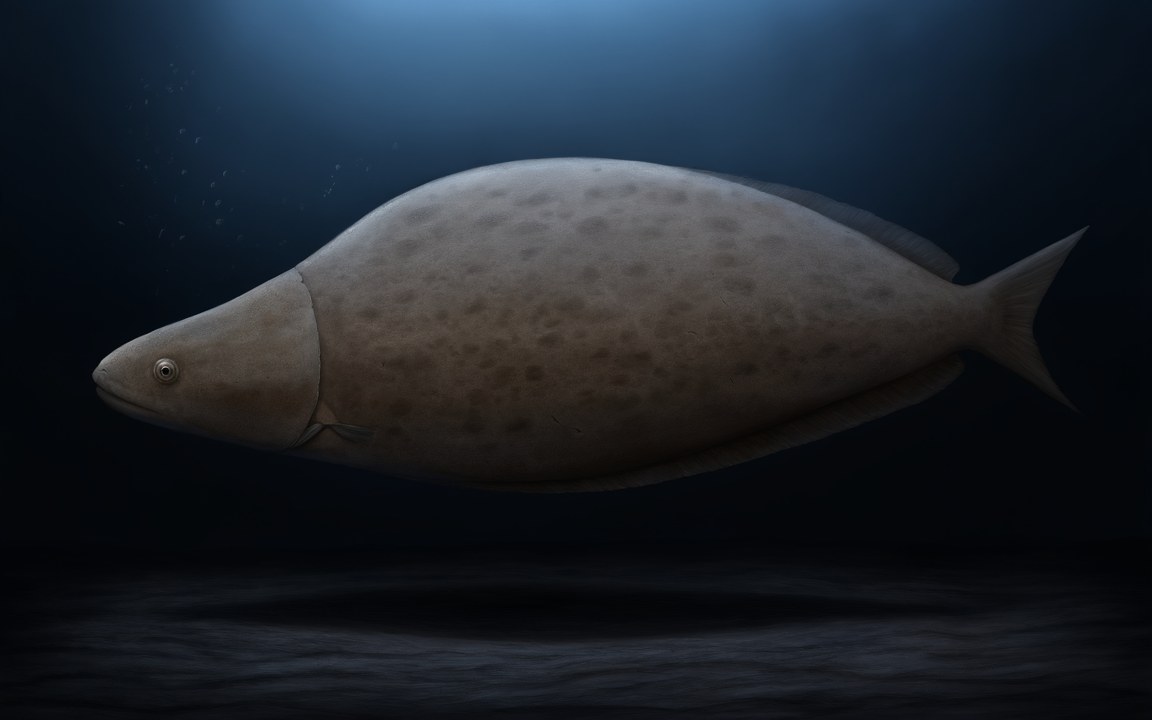
A huge, deep-bodied grey fish with a blunt, smooth armoured head, a large round eye and a crescent-shaped tail gliding above a dark seafloor in dim blue water, an impression of Dunkleosteus in a Late Devonian sea about 360 million years ago.

Lost GiantsDevonian

Dunkleosteus

An armoured fish with blades for teeth, top predator of the Devonian seas

About 382 to 359 million years ago Reconstruction, not a photograph
Lived about 382 to 359 million years ago the Late Devonian [1]
Length about 3.4 m for a typical adult; the largest about 4.1 m; error margins allow up to about 3.8 and 4.5 m [4]
Weight about 950 to 1 200 kg for a typical adult [1]
Skull 60 to 70 cm long [1]
Teeth none bony blades with pointed front cusps instead [5]
Bite up to about 7 500 newtons a 2009 model; a 2025 study says it needs recalculating [1]
Fossils mainly Ohio, USA also Morocco, Poland, Belgium, Russia and Canada [1]
Named 1956 in honour of the palaeontologist Dunkle; first fossils found in 1867 [1]
Extinct about 359 million years ago when every armoured placoderm fish vanished [6]

About the pictures. One painting shows a reconstructed fish. It follows a 2024 reconstruction in the short, deep, thick body, the smooth armour, the probably scaleless skin and the crescent-shaped tail, but simplifies the armour to one cap over the head. Everything behind the armour is inferred from related fish, and the mottled colour and long, low fins are imagined. The mouth is closed, so the bony blades it had instead of teeth do not show. Most of its fossils come from the Cleveland Shale, laid down about 360 million years ago over a lifeless seabed. The other painting imagines a Late Devonian coast with early forests; trees such as Archaeopteris reached about 24 m, but the exact plants are guesses.

Dunkleosteus was a fish in armour. Its head and the front of its body were covered in bony plates, and instead of teeth it had sharp bony blades that sliced against each other like shears. It hunted in the seas of the Late Devonian, more than 360 million years ago, and for a long time it was described as a ten-metre monster. Recent studies have cut it down to about 3.4 m for a typical adult, still a formidable predator, but a very different animal from the one in older books.

Armour and blades

Dunkleosteus belonged to the placoderms, a group of armoured fish that flourished in the Devonian. Most of what survives is that armour: the bony head shield and the plates around the front of the body. The plate at the back of the head was 5 to 8 cm thick; the rest of the armour was thinner, about 1 to 2.5 cm. Its surface was smooth and unornamented.

Its jaws worked through a four-part linkage of bones. Models published in 2007 and 2009 found it could snap its mouth open in about 20 milliseconds and estimated bite forces of up to about 7 500 newtons at the blades. A 2025 study found that significantly more of the skull was made of cartilage than had been assumed, and argued that those bite forces, and the idea that it sucked in prey as it opened its mouth, need to be re-examined.

How big, really?

Because only the armoured front of the body fossilises well, its total length has always been an estimate. Older figures of 5 to 10 m often gave no method at all, and the largest estimate with a stated method, from 2017, compared the size of its mouth with the mouths of sharks. In 2023 the palaeontologist Engelman showed that arthrodires, the group of placoderms it belonged to, had proportionally larger mouths than sharks, so such methods overestimated the length of complete arthrodire fossils at least twice. Using a new measure, the distance from the eye to the back of the gill cover across nearly a thousand species of fish, he estimated about 3.4 m for a typical adult and about 4.1 m for the largest known.

What it lost in length it gained in bulk. Engelman’s 2024 reconstruction gives it a short, very deep, almost cylindrical body, a head making up about 18 per cent of its length, and a crescent-shaped tail like a tuna’s, built for fast swimming. Its eyes, often drawn small, were in fact fairly large, about 8 cm across in one specimen. A typical adult would have weighed about a tonne.

Life in a Devonian sea

Most fossils of Dunkleosteus terrelli come from the Cleveland Shale of Ohio, rock laid down in an offshore sea whose surface waters held oxygen but whose bottom had none, and no animals living on it. Dunkleosteus was a hunter of the open water. Teeth thought to belong to Orodus, a fast-swimming relative of sharks, have been found with its remains, and masses of fish bone suggest it coughed up the hard parts of its meals.

The end of the armoured fish

Dunkleosteus, and every other placoderm, disappeared during the crises at the end of the Devonian, ending with the Hangenberg event about 359 million years ago. No placoderm has been confirmed from the period that followed. Why the crisis happened is still debated: candidates include a lack of oxygen in the oceans, glaciation and falling sea levels, volcanic eruptions and damage to the ozone layer.

Placoderms as a group are gone, but they were probably not a dead end. They are thought to sit at the base of the family tree of all jawed animals, with sharks, bony fish and the four-limbed animals, including humans, arising from among them, although one 2016 analysis kept them as a separate branch.
Where it sits in deep time

Dunkleosteus: About 382 to 359 million years ago, in the Devonian.

Dunkleosteus

Earth forms, 4.57 billion years agoToday

Each step to the right is ten times closer to today, so the last few million years get as much room as the first billion.

If Earth's history were one day

Squeeze all of Earth's history, about 4.6 billion years, into 24 hours, starting at midnight. Dunkleosteus runs from 21:59:34 to 22:06:51, ending 1 h 53 min before midnight.

On this clock one second is about 52 862 years. All of written history fits into the last tenth of a second.

How big

Length estimates for Dunkleosteus over the years, next to a person.

Many older figures gave no method. The 2017 estimates compared its mouth with a shark's, but its mouth was proportionally larger, so that method overestimated its length.

Reconstructions

A huge, deep-bodied grey fish with a blunt, smooth armoured head, a large round eye and a crescent-shaped tail gliding above a dark seafloor in dim blue water, an impression of Dunkleosteus in a Late Devonian sea about 360 million years ago. AI-generated painting.
A calm green-blue sea beside a low shore lined with tall, straight-trunked trees with narrow, pointed crowns under a hazy sky, an impression of a Late Devonian coast with some of the first forests about 360 million years ago, the world of Dunkleosteus. AI-generated painting.

Questions people ask

How big was Dunkleosteus really?

About 3.4 m long for a typical adult and about 4.1 m for the very largest, according to studies published in 2023 and 2024. Older figures of 5 to 10 m mostly gave no method, and the main method that did, comparing its mouth with a shark's, is now shown to overestimate.

Did Dunkleosteus have teeth?

No true teeth. Its jaws carried bony, blade-like plates that sliced against each other, with pointed cusps at the front.

How strong was its bite?

Computer models published in 2007 and 2009 gave bite forces of about 4 400 to 7 500 newtons. A 2025 study found that more of its skull was cartilage than assumed and argued that those figures need to be worked out again.

Why did Dunkleosteus go extinct?

It and all other placoderms, the armoured fish, disappeared in the crises at the end of the Devonian, ending with the Hangenberg event about 359 million years ago. Low oxygen in the oceans, glaciation, volcanism and damage to the ozone layer have all been proposed.

Is Dunkleosteus related to sharks?

Distantly. Placoderms are thought to sit at the base of the family tree of jawed animals, with sharks, bony fish and the animals with limbs, including humans, arising from among them.

Sources

  1. Wikipedia: Dunkleosteus
  2. Engelman (2023), A Devonian fish tale: a new method of body length estimation, Diversity 15, 318
  3. Engelman (2023), Giant, swimming mouths: oral dimensions of extant sharks do not accurately predict body size in Dunkleosteus, PeerJ
  4. Engelman (2024), Reconstructing Dunkleosteus terrelli, Palaeontologia Electronica 27, a45
  5. Engelman et al. (2025), Functional anatomy, jaw mechanisms, and feeding behavior of Dunkleosteus terrelli, The Anatomical Record
  6. Wikipedia: Hangenberg event
  7. Wikipedia: Placoderm
  8. Wikipedia: Cleveland Shale
  9. Wikipedia: Archaeopteris