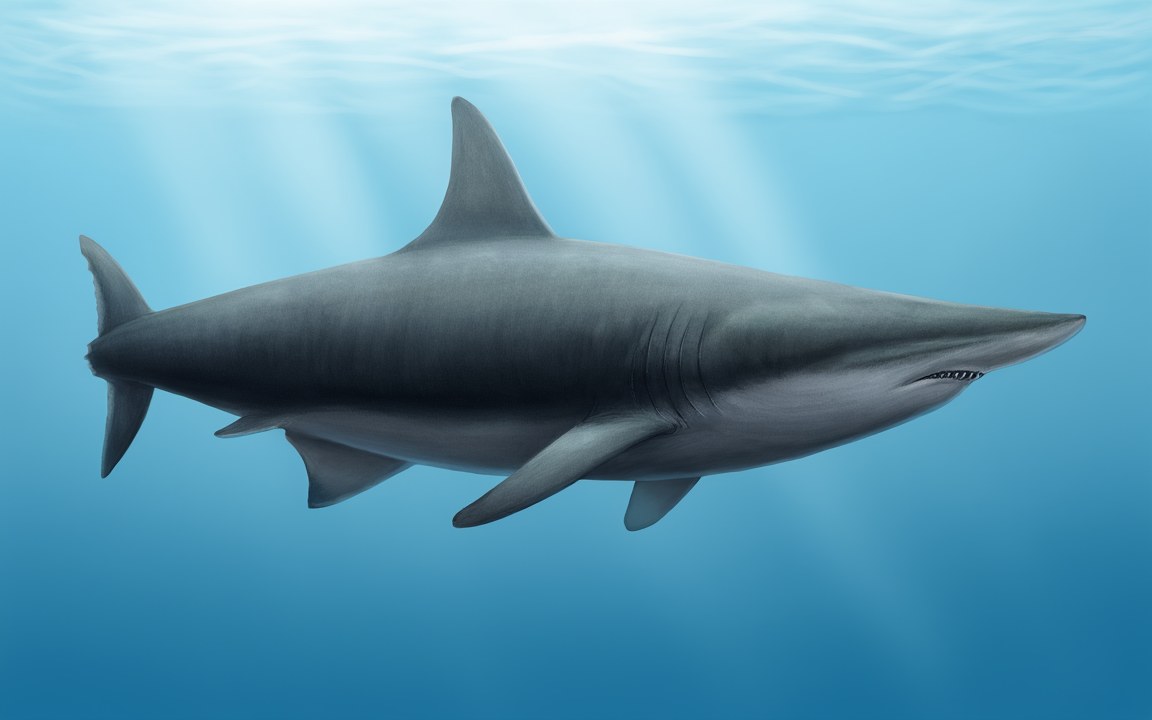
A long, slender grey shark with a tall dorsal fin and a crescent tail swimming through clear blue water under shafts of sunlight, its mouth slightly open to show triangular teeth, a reconstruction of the extinct giant shark megalodon.

Lost GiantsNeogene

Megalodon

The giant shark known from its teeth, and slimmer and stranger than the films suggest

About 23 to 3.6 million years ago Reconstruction, not a photograph
Lived about 23 to 3.6 million years ago some studies start it later, around 15 million years ago [1]
Typical length about 10.5 m the most common size in the fossil record, juveniles and adults together [1]
Largest possibly about 24 m estimates range from 14 to 24 m [2]
Weight about 30 tonnes for a 16.4 m individual; perhaps 94 tonnes at 24 m [2]
Teeth over 18 cm measured along the slant [1]
Body temperature about 27 °C warmer than the water around it [5]
Ate whales, seals, turtles, fish and sharks a versatile generalist [1]
Named 1835, by Agassiz megalodon means "big tooth" [1]
Extinct about 3.6 million years ago [7]

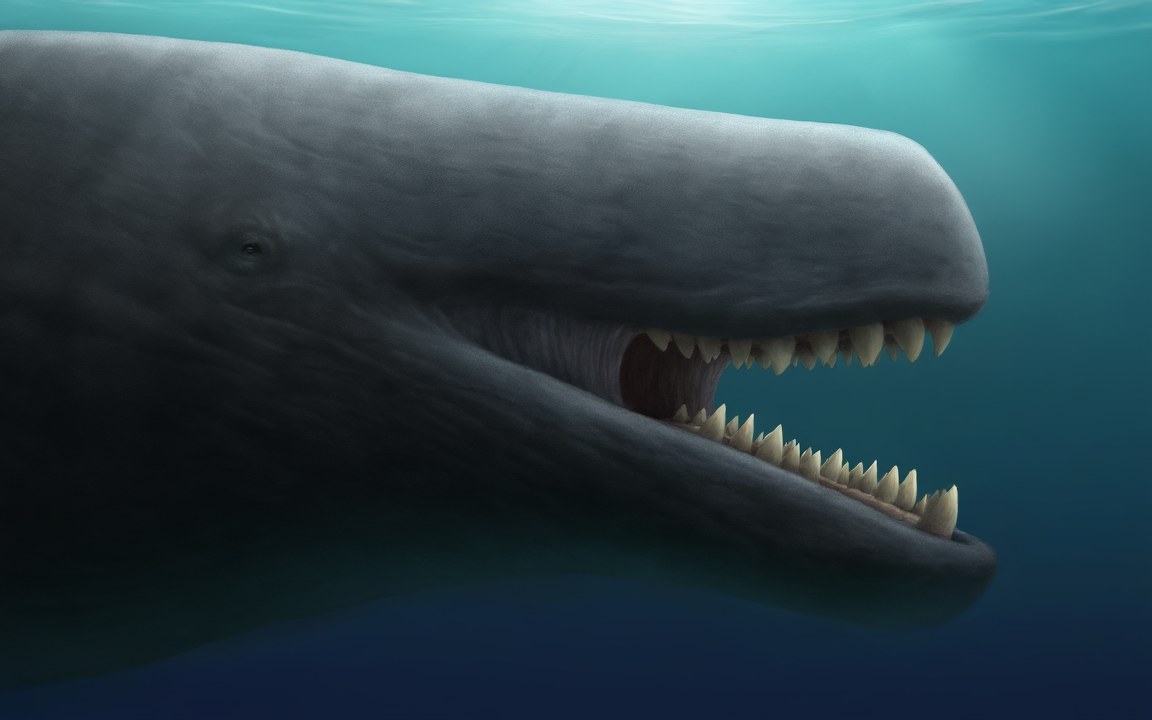
About the pictures. Two paintings, a side view and a view from straight above, follow recent studies that make megalodon more slender than a scaled-up great white shark. Two more, a close view of the open mouth and a view at the waterline at sunset, show the stockier body of older reconstructions, and the real teeth were broader than those in the open mouth. Another painting shows a single serrated tooth in the sand of a shallow seabed, the kind of tooth that can exceed 18 cm along the slant. The last imagines a young shark about 4 m long, the estimated size at birth, in a coastal bay, one reading of nursery sites that not all researchers accept. Only teeth, vertebrae and scales have ever been found, so the shape of the head and fins, the colour and the shading are all guesses, as the researchers who proposed the slender body point out themselves; the seagrass, sunset and light are imagined too.

Megalodon was one of the largest predatory fish that ever lived, and almost everything about it has been worked out from its teeth. Sharks’ skeletons are made of cartilage, which rarely fossilises, so what survives are its teeth, a few columns of vertebrae, scales and bite marks on the bones of its prey. It swam in warm seas around the world for millions of years and disappeared about 3.6 million years ago.

Built from teeth and backbones

Its teeth are huge, triangular and finely serrated, some more than 18 cm along the slant. That is where its name comes from: megalodon means “big tooth”. For decades it was reconstructed as a giant great white shark, with the same stocky body simply scaled up to fit the teeth.

Its backbones tell a different story. A column of vertebrae found in Belgium measures 11.1 m on its own, but a white-shark-shaped body built around those vertebrae came out at only 9.2 m in total. In 2024 a team led by Sternes concluded that megalodon must have been longer and more slender than a white shark. A larger study in 2025 found its proportions closest to those of the lemon shark and the porbeagle, while stressing that practically every detail of the body form, from the snout to the fins, remains uncertain.

In 2026 researchers reported the rediscovery of a set of vertebrae from Denmark, thought lost after a museum move in 1989. The largest is about 23 cm across, the largest shark vertebra known.

How big?

The most common length in the fossil record, counting juveniles and adults, is about 10.5 m. Estimates for the largest individuals vary with the method and the fossils used: 20.2 m in a 1996 study, 14.2 to 15.3 m in 2019, about 20 m in 2021. The 2025 study proposed a possible maximum of about 24.3 m and 94 tonnes, which its authors describe as a working hypothesis. Because the slender body weighs less for its length, a 16.4 m animal comes out at about 30 tonnes.

The same study estimated that newborn megalodons were already 3.6 to 3.9 m long, and that adults cruised at a leisurely 2.1 to 3.5 km per hour. A growth model based on the Danish vertebra suggests a lifespan of up to about 96 years and a possible ceiling of about 28 m, which the authors themselves call highly tentative.

A warm-bodied hunter

Chemical clues in its teeth show that megalodon kept its body at about 27 °C, warmer than the surrounding water, as some living sharks such as makos do. Keeping that warm takes a great deal of food.

It ate whatever it could catch. Bite marks on fossil whale bones show it attacked small whales, and a 2025 study of zinc in its teeth found that it fed at several levels of the food chain, from fish to marine mammals, with a diet that varied by region. The Danish vertebrae came with scales and gill rakers from a basking shark that may have been its last meal. Young megalodons are thought to have grown up in warm coastal nursery areas, eating mainly fish and small whales, although the 2025 study argues that newborns that large had less need of them.

Why it vanished

Megalodon died out about 3.6 million years ago. There is no single accepted cause. The great white shark may have competed with it for the same prey. Many of the small baleen whales it hunted disappeared around the same time. Falling sea levels as the climate cooled may have destroyed its coastal nurseries, and a warm body needs a lot of food. Several of these pressures are thought to have combined.

Despite occasional claims, it is not still alive. Its youngest reliable fossils are 3.6 million years old, and a 2013 television programme that suggested otherwise was fiction dressed up as a documentary, using invented evidence and an actor playing a scientist.
Where it sits in deep time

Megalodon: About 23 to 3.6 million years ago, in the Neogene.

Megalodon

Earth forms, 4.57 billion years agoToday

Each step to the right is ten times closer to today, so the last few million years get as much room as the first billion.

If Earth's history were one day

Squeeze all of Earth's history, about 4.6 billion years, into 24 hours, starting at midnight. Megalodon runs from 23:52:45 to 23:58:52, ending about a minute before midnight.

On this clock one second is about 52 862 years. All of written history fits into the last tenth of a second.

How big

Published length estimates for megalodon, all extrapolated from teeth or vertebrae, next to a person.

No complete skeleton exists. The 24.3 m figure is a working hypothesis based on the largest known vertebrae.

Reconstructions

A long, slender grey shark with a tall dorsal fin and a crescent tail swimming through clear blue water under shafts of sunlight, its mouth slightly open to show triangular teeth, a reconstruction of the extinct giant shark megalodon. AI-generated painting.
A large, triangular brown shark tooth with serrated edges standing on its base in rippled pale sand between tall seagrass in green, sunlit water, small fish beyond, an impression of a shed megalodon tooth on the floor of a shallow sea. AI-generated painting.
Looking straight down through clear blue water at a long, slim, dark grey shark with wide pectoral fins, long dark shadows falling on the seabed far below, an impression of a megalodon seen from above. AI-generated painting.
A slender grey shark with a long pointed snout, a tall dorsal fin and a tail with a long upper lobe gliding over pale sand and seagrass in green, sunlit shallow water, an impression of a young megalodon about four metres long in a coastal bay. AI-generated painting.
Close view of a huge grey shark swimming towards the viewer through dark blue water, its wide mouth open to show rows of pointed, triangular teeth, a small black eye above it and shafts of sunlight behind its dorsal fin, an impression of the head and teeth of the extinct giant shark megalodon. AI-generated painting.
A huge grey shark just below the surface of a calm sea at sunset, the tip of its dorsal fin breaking the water against an orange sky and its body and long fins dark in the blue water beneath, an impression of megalodon at the waterline. AI-generated painting.

Questions people ask

How big was megalodon?

The most common length in the fossil record, juveniles and adults together, is about 10.5 m. The largest are estimated at anything from about 14 to 24 m, depending on the method. A 2025 study proposed a possible maximum of 24.3 m and about 94 tonnes, but every figure is extrapolated from teeth or vertebrae, because no skeleton has been found.

When did megalodon go extinct?

About 3.6 million years ago, according to a 2019 study that rejected younger fossils as poorly dated or washed out of older rocks. Earlier estimates put the end at about 2.6 million years ago.

Why did megalodon go extinct?

No single cause is accepted. Candidates include competition with the great white shark, the decline of the small whales it hunted, changes in sea level that removed its nurseries, and the high energy cost of keeping its body warm. It was probably a combination.

Is megalodon still alive?

No. Its youngest reliable fossils are about 3.6 million years old, and a 2013 television programme that claimed otherwise was fiction presented as a documentary.

Was megalodon related to the great white shark?

Not closely. Megalodon belonged to an extinct family, the Otodontidae, whose line split from the great white's more than 100 million years ago. The similar shape of their teeth is probably convergent.

Sources

  1. Wikipedia: Megalodon
  2. Shimada et al. (2025), Reassessment of the possible size, form, weight, cruising speed, and growth parameters of the extinct megatooth shark, Otodus megalodon, Palaeontologia Electronica 28, a12
  3. Shimada et al. (2026), Rediscovery of the associated gigantic vertebrae of the extinct megatooth shark, Otodus megalodon, from the Upper Miocene Gram Formation in Denmark, Palaeontologia Electronica 29, a27
  4. DePaul University (2024), on Sternes et al., Palaeontologia Electronica 27: a more slender megalodon
  5. DePaul University (2023), on Griffiths et al., PNAS 120: megalodon was warm-bodied
  6. ScienceDaily (2025), Megalodon: the broad diet of the megatooth shark (McCormack et al., Earth and Planetary Science Letters)
  7. Boessenecker et al. (2019), The Early Pliocene extinction of the mega-toothed shark Otodus megalodon: a view from the eastern North Pacific, PeerJ 7, e6088
  8. ScienceDaily (2026), Scientists rediscover lost Megalodon fossils, and reveal a 79-foot giant (Hone, The Conversation)
  9. Wikipedia: Megalodon: The Monster Shark Lives