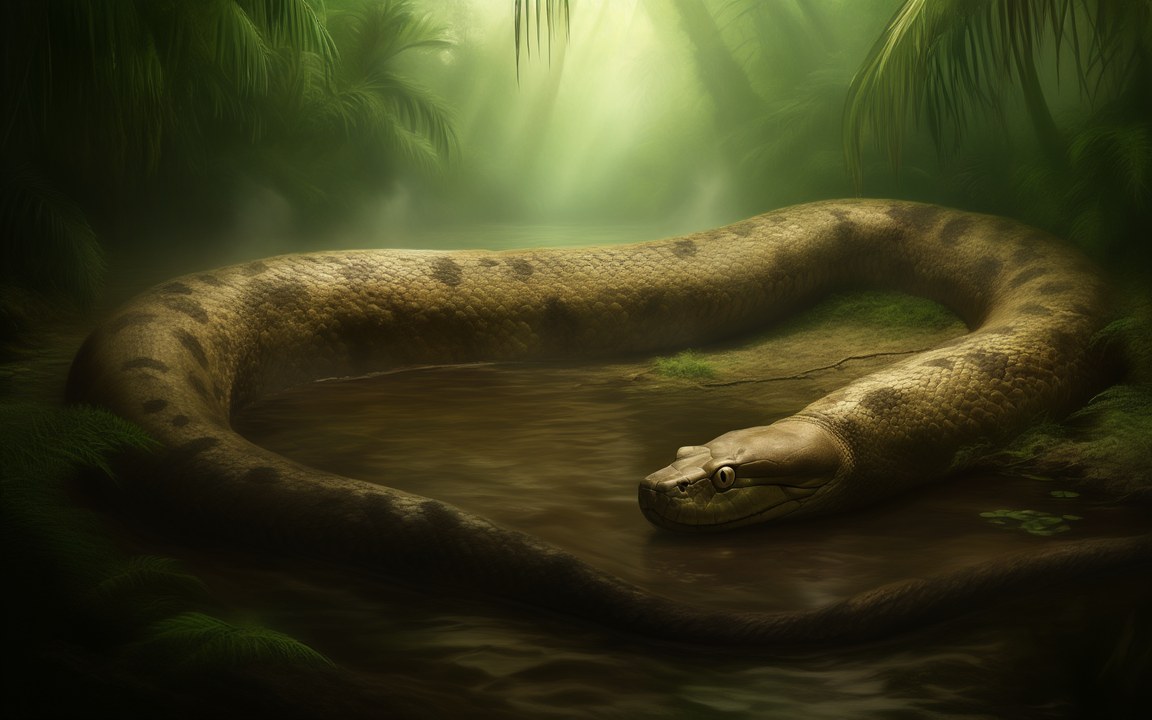
Lived about 60 to 58 million years ago the Palaeocene, a few million years after the dinosaurs [1] Length about 12.8 m give or take 2.2 m; a later estimate from the skull gives 14.3 m [1] Weight about 1 135 kg the 2009 mean, within a range of 652 to 1 819 kg; a 2016 study argued for no more than 730 kg [1] Thickness about hip height at the widest part of the body [4] Fossils 186 fossils from 30 individuals from the Cerrejón coal mines, Colombia [1] Named 2009 "titanic boa" from Cerrejón [1] Ate mainly fish judging from its skull [1] Home hot, wet rainforest with large rivers about 4 m of rain a year [2] Relatives boas and anacondas [1] About the pictures. Two paintings show the snake: coiled around a pool in a palm swamp and swimming down a wide river seen from above. The third shows only the river forest, with palms, banana-like plants and floating ferns of the kinds found as fossils at Cerrejón. The heavy body and its length are scaled from vertebrae, and the colour and scale pattern are guesses borrowed from living anacondas. Its skulls have been found but not yet fully described, so the shape of the head and its scales are also uncertain, and the mist and light are imagined.
About 60 million years ago, only a few million years after the asteroid that ended the age of dinosaurs, a giant snake lived in the rivers and swamps of what is now northeastern Colombia. Titanoboa was a boa, a relative of today’s anacondas, but far larger: about 12.8 m long, and so thick that at its widest its body would have come up to a person’s hips. It is probably the heaviest snake ever found.
Found in a coal mine
Titanoboa’s fossils come from the Cerrejón coal mines in La Guajira. The rocks there were laid down in a hot, wet coastal plain covered in rainforest and crossed by large rivers, about 5 degrees north of the equator. They hold the oldest known record of a rainforest in the South American tropics, with palms, plants related to beans and bananas, and floating ferns, and the rainfall has been estimated at about 4 m a year.
Expeditions from 2002 onwards recovered 186 fossils from about 30 individual snakes. The species was described in Nature in 2009, from a single vertebra as its type specimen. The name means “titanic boa from Cerrejón”.
How big?
A snake’s length can be estimated from the size and shape of its vertebrae, by comparison with living boas. The 2009 study arrived at about 12.8 m, give or take 2.2 m, and a mean weight of about 1 135 kg, within a range of 652 to 1 819 kg, which the press release called conservative. In 2011 the team found three partial skulls, and a 2013 conference abstract scaled one of them, about 40 cm long, up to a snake of about 14.3 m. Other researchers have argued for a lighter animal, no more than 730 kg.
In 2024 researchers in India described Vasuki indicus, a different kind of snake that lived about 47 million years ago. Estimated at 10.9 to 15.2 m, it may have been as long as Titanoboa, but its vertebrae are smaller, so Titanoboa probably remains the heaviest snake on record. Another study found that some vertebrae once counted as Titanoboa belonged to a separate aquatic snake about 8 m long from the same rocks.
What it ate
When it was first described, Titanoboa was imagined as a giant anaconda that fed on the crocodile relatives in its swamps. Its skulls tell a different story. The 2013 abstract described adaptations for eating fish, such as many teeth loosely attached to the jaw, and the rivers held lungfish and other fish. Bigger prey cannot be ruled out, but fish seem to have been its staple.
A thermometer made of snake
Because snakes depend on the warmth of their surroundings, the team that described Titanoboa argued that a snake this large could only have lived with an average temperature of at least 30 to 34 °C. Other researchers disagreed. Some pointed out that such a large snake might actually have trouble getting rid of heat, and others that fossil leaves from the same rocks suggest temperatures 6 to 8 °C lower, although leaf estimates from wet riverside forests are thought to run low. The question is still open.
Nothing is known about how or when Titanoboa died out. It has been found in only one place and one slice of time.
Where it sits in deep time
Titanoboa: About 60 to 58 million years ago, in the Paleogene.
Titanoboa
1 billion100 million10 million1 million100 00010 0001 000
Earth forms, 4.57 billion years agoToday
Each step to the right is ten times closer to today, so the last few million years get as much room as the first billion.
If Earth's history were one day
Squeeze all of Earth's history, about 4.6 billion years, into 24 hours, starting at midnight. Titanoboa runs from 23:41:05 to 23:41:43, ending 18 minutes before midnight.
On this clock one second is about 52 862 years. All of written history fits into the last tenth of a second.
How big
Length estimates for Titanoboa next to a person.
- Estimate from the skull 14.3 m
- Estimate from the vertebrae 12.8 m
- Person, for scale 1.7 m
At its widest, its body would have reached about to a person's hips.
Questions people ask
How big was Titanoboa?
About 12.8 m long, give or take 2.2 m, based on its vertebrae, and a later estimate from a skull gives 14.3 m. The 2009 study that described it estimated its weight at about 1 135 kg, while a 2016 study argued for no more than 730 kg.
Is Titanoboa the biggest snake ever?
By weight, probably. In 2024 researchers described Vasuki indicus from India, estimated at 10.9 to 15.2 m long, so it may have been as long. Its vertebrae are smaller than Titanoboa's, so Titanoboa was probably the heavier snake.
What did Titanoboa eat?
Mostly fish, judging from its skull. It was first imagined as a crocodile-eater like an anaconda, and larger prey such as crocodile relatives and turtles is still possible.
When and where did Titanoboa live?
About 60 to 58 million years ago, in a hot, wet rainforest with large rivers in what is now La Guajira in northeastern Colombia. Its fossils come from the Cerrejón coal mines.
Does Titanoboa prove the tropics were hotter?
The team that described it argued that a snake so large needed a minimum average temperature of 30 to 34 °C. Other researchers disputed that reasoning, pointing out that such a big snake might overheat and that fossil leaves suggest lower temperatures.