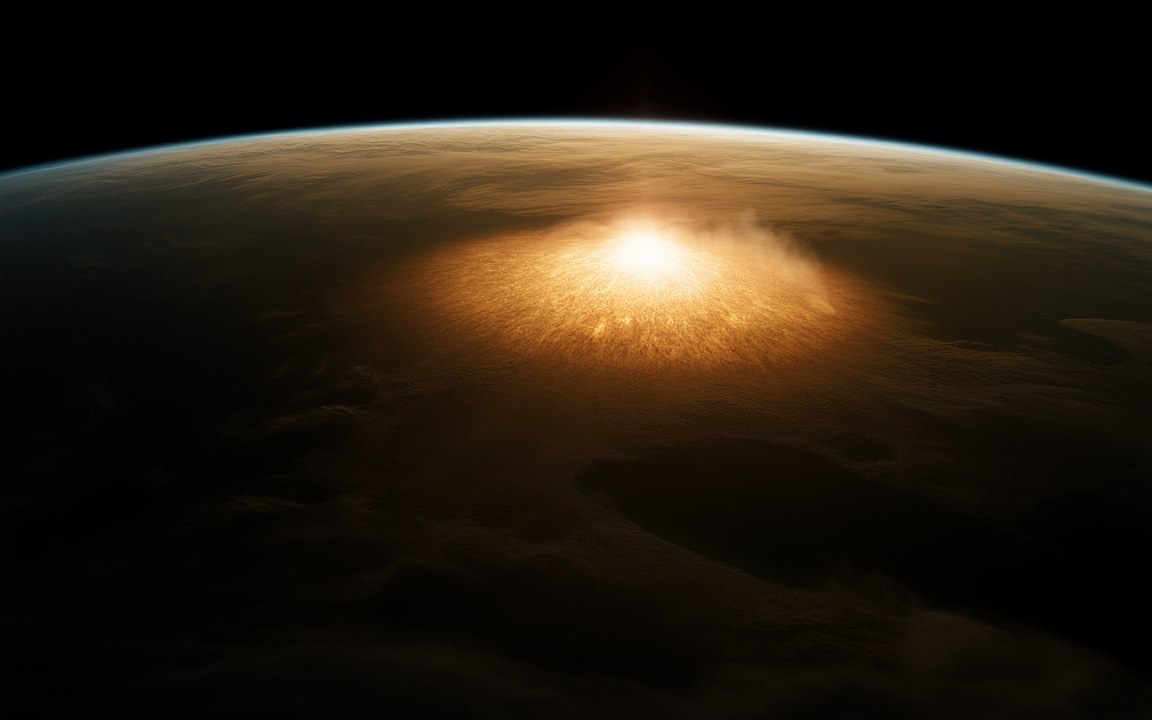
About 66 million years ago an asteroid roughly 10 km across struck the sea off what is now the Yucatán Peninsula in Mexico. It blasted out a crater about 200 km wide, set off earthquakes and tsunamis, and threw so much dust and debris into the sky that it changed the climate of the whole planet. About three quarters of all species died out, among them every dinosaur except the birds. The crater is still there, but nobody can see it: it lies buried under about a kilometre of younger rock.
The first day
In 2016 a drilling expedition working from a lift boat in the Gulf of Mexico drilled to 1 335 m below the seafloor, into the crater’s inner ring of hills, bringing up 835 m of core. That core is a record of the first day after the impact, and in 2019 the team read it almost hour by hour.
Within minutes the rock at the centre, thrown upwards by the impact, collapsed outwards into a ring of hills about 80 km across, topped with melted rock. Within tens of minutes that ring was buried under about 40 m of shattered debris. Within about an hour the sea came back and poured over the ring, and within hours the crater was a flooded basin. Before the day was out, a tsunami that had bounced off the crater’s rim swept back across it, followed by charcoal from wildfires on land. Elsewhere, the waves were more than 100 m high, and the earthquake is estimated at magnitude 9 to 11.
The core also showed what the ring of hills is made of: granite from deep below the surface, shattered and shocked, lifted up in a matter of minutes.
What hit Earth
The asteroid itself vaporised, but traces of it are mixed into the thin layer of clay found all over the world at the boundary between the Cretaceous and the period that followed. In 2024 a team measured ruthenium isotopes in that clay and found they matched carbonaceous asteroids that formed beyond the orbit of Jupiter, unlike the stony asteroids behind most impacts of the last 500 million years. In 2026 nickel isotopes in boundary clay from Denmark, Spain and Italy narrowed it further, most likely to a rare dry type called a CO chondrite.
That matters for how the extinction happened. CO chondrites contain little water or sulfur, so the darkness and cold that followed were probably caused more by dust than by sulfur gases. A 2025 study estimated the sulfur released from measurements in the crater and in boundary layers, about 67 billion tonnes give or take 39, roughly five times less than earlier models had assumed.
Finding the crater
The idea of an impact and the crater itself were found separately. In 1980 Alvarez and colleagues proposed that an asteroid had caused the extinction, based on unusually high levels of iridium in the boundary clay. The crater had already been noticed: in 1978 Penfield and Camargo, working for the Mexican oil company Pemex, saw a huge circular pattern in magnetic surveys, about 180 km across, which Penfield took for an impact feature. Pemex rejected that reading, and it was only in 1991 that a team led by Hildebrand identified it as the impact crater.
A crater that fed the sea
The heat of the impact kept water circulating through the shattered rock for a very long time. A 2026 study dated minerals formed by this hot water and found the system lasted at least 8 million years, about four times longer than previously thought. A 2025 study found that these fluids enriched the waters of the Gulf of Mexico for at least 700 000 years, and life returned to the crater itself surprisingly fast.