Tropical sea surfaceabout 40 °Cand up to 50 to 60 °C on land[5]
Famous survivorLystrosaurusa beaked, tusked plant-eater about 1 m long[3]
Recoveryabout 10 million yearsbut much faster in some refuges[1]
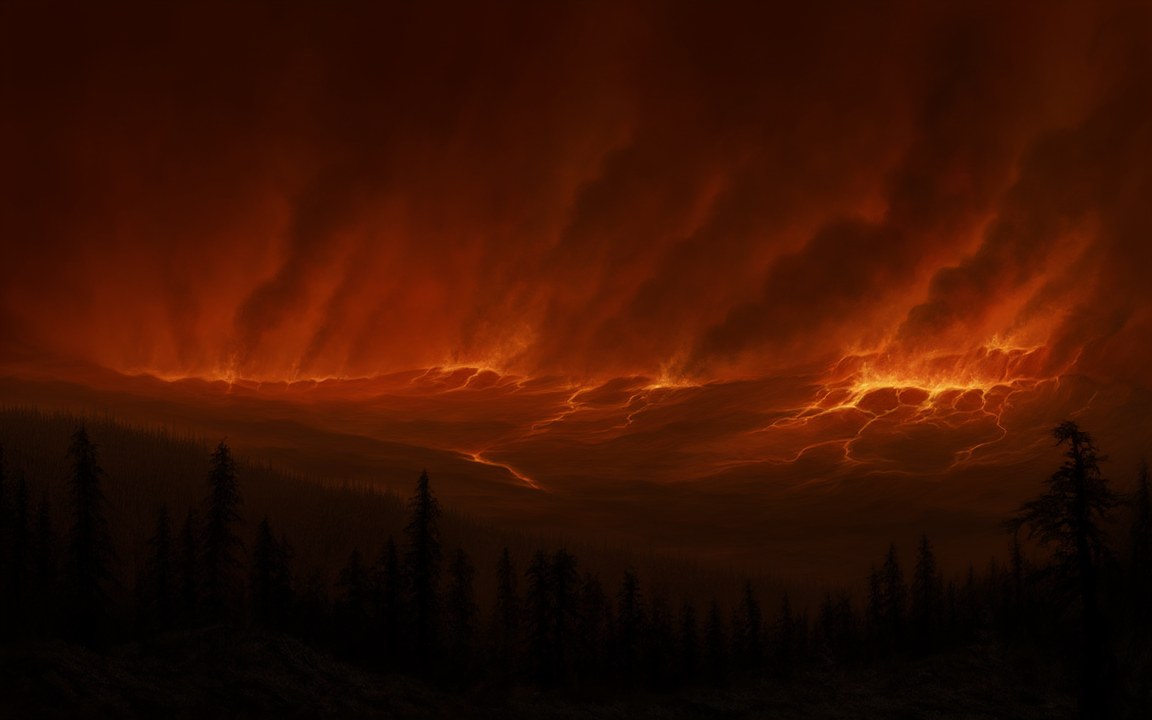
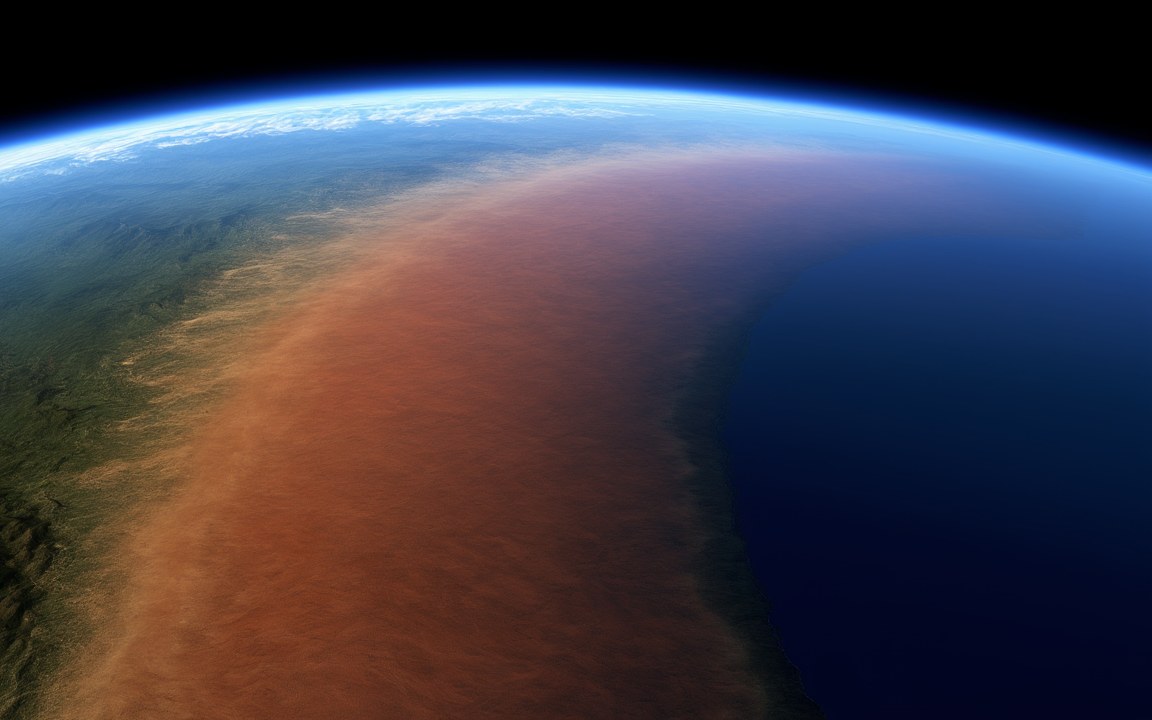
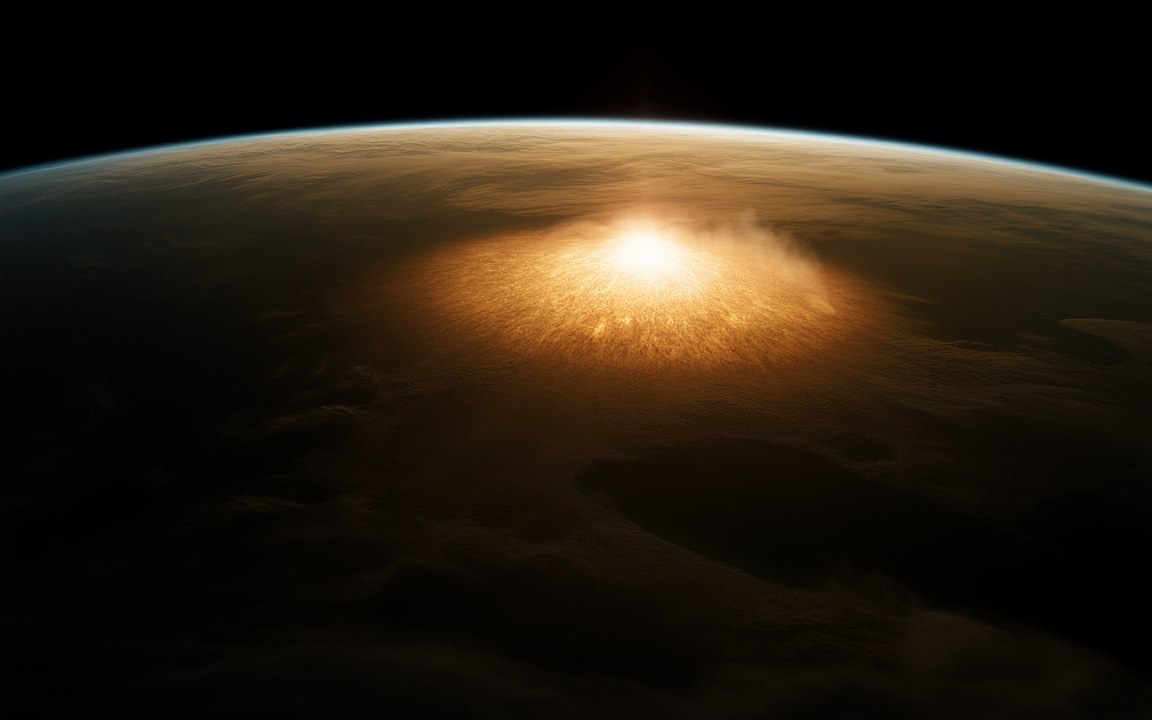
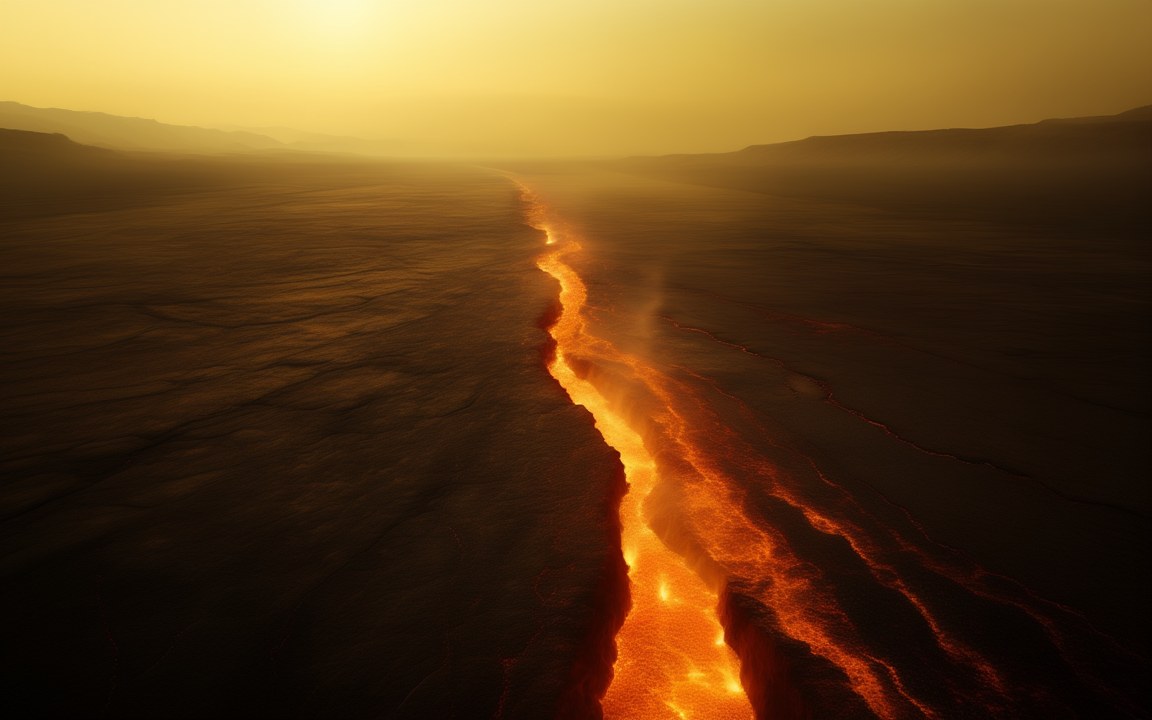
About the pictures. Four views of the end of the Permian. Two show the Siberian Traps, known from their flood basalts: glowing fissures behind a dying forest, and from above, a plain of black lava split by a long crack. A burning forest draws on layers of charcoal in rocks of that time. A hot, bare landscape after the extinction shows Lystrosaurus, one of the few large survivors, drawn hairless with leathery skin as mummified specimens show. The colours of the sky and the animal are imagined. The trees are generic conifer shapes, not a reconstruction of Siberian forests, which were dominated by the extinct Cordaites. The bare landscape is one regional view: some places kept their forests.
About 252 million years ago, at the end of the Permian period, life on Earth came closer to being wiped out than at any other time we know of. Most species in the sea and most land vertebrates disappeared. Trilobites, which had lived for more than 250 million years, vanished altogether. Geologists call it the end-Permian mass extinction; it is better known as the Great Dying. Its cause was not an asteroid but a volcano, or rather a vast field of them, in what is now Siberia.
The worst extinction
Recent estimates put the losses at about 81 per cent of species in the sea and about 70 per cent of land vertebrate species, along with eight or nine whole orders of insects. Older figures of 90 to 96 per cent of marine species are still often quoted, but one analysis argues that they mixed in a separate extinction 7 to 10 million years earlier. Almost every group of sea creatures was hit: radiolarians lost about 99 per cent of their genera and brachiopods about 96 per cent.
Precise dating of volcanic ash beds at Meishan in China puts the extinction between 251.94 and 251.88 million years ago. In the sea, the main pulse took only about 60 000 years, give or take 48 000. On land the collapse was more ragged. A 2025 study of a 671 m drill core from an ancient tropical peatland in southwest China found no single hammer blow, and the collapse in the Sydney Basin of Australia came at least 600 000 years before the one recorded in China.
The Siberian Traps
The cause was one of the largest volcanic events of the last 500 million years. Over about 2 million years, the Siberian Traps poured out an estimated 4 million cubic kilometres of lava, spreading across millions of square kilometres. The most dangerous phase came when the magma began to push sideways into layers of coal and salt beneath the surface, baking them and releasing enormous quantities of greenhouse gases.
Carbon dioxide in the air rose from about 400 to about 2 500 parts per million. The planet heated dramatically. The surface of the tropical oceans reached about 40 °C and parts of the land 50 to 60 °C, hot enough to leave an equatorial “dead zone” for millions of years. The oceans lost oxygen and became more acidic. A study published in 2024 argued that the warming set off much longer and stronger El Niño events, bringing about a decade of drought followed by years of flooding, and life on land died tens of thousands of years before life in the sea.
The survivors
Among the few large land animals that made it through was Lystrosaurus, a plant-eater about 1 m long with a beak and two tusk-like teeth, a distant relative of mammals. It lived before and after the extinction, may have sheltered in burrows, and in some of the earliest Triassic rock layers it makes up as much as 90 to 95 per cent of the land vertebrate fossils. Mummified specimens described in 2022 show it had hairless, leathery skin.
A slow recovery, with exceptions
Recovery is usually said to have taken about 10 million years, and the rock record shows a gap of millions of years with no coal at all. But the picture is changing. A 2025 study found a refuge in the Turpan-Hami Basin of northwestern China where conifer forests and ferns survived with about 1 000 mm of rain a year, and where Lystrosaurus and other animals appeared within 75 000 years of the extinction. Another 2025 study, from North China, found that rivers and wetlands sheltered life and that the land recovered there much faster than once thought.
The remains of the Siberian Traps can still be seen today as the step-like Putorana Plateau. The name “trap” comes from the Swedish word for stairs.
Where it sits in deep time
The Great Dying: About 252 million years ago, in the Permian.
Each step to the right is ten times closer to today, so the last few million years get as much room as the first billion.
22:40:34
If Earth's history were one day
Squeeze all of Earth's history, about 4.6 billion years, into 24 hours, starting at midnight. The Great Dying runs from 22:40:34 to 22:40:35, ending 1 h 19 min before midnight.
On this clock one second is about 52 862 years. All of written history fits into the last tenth of a second.
Reconstructions
Glowing orange cracks of lava running across a dark landscape under a sky full of red smoke and fire, with black silhouettes of tall trees in the foreground, an impression of the Siberian Traps eruptions behind the Great Dying. AI-generated painting.A stocky, grey, hairless animal the size of a pig, with a short beaked face, a tusk pointing down and almost no tail, walking across cracked red ground among dead trees under an orange sky, an impression of Lystrosaurus after the end-Permian extinction. AI-generated painting.A forest of tall trees burning under a dark, smoky orange sky, flames glowing between the trunks and reflected in a shallow stream in the foreground, an impression of the wildfires at the end of the Permian about 252 million years ago. AI-generated painting.Seen from low above, a vast, dark plain of cooled black lava split by a long, glowing orange crack of fresh lava running to the horizon under a smoky red sky, an impression of the Siberian Traps eruptions about 252 million years ago. AI-generated painting.
Questions people ask
What caused the Great Dying?
The eruption of the Siberian Traps, an enormous flood of lava in what is now Siberia. The gases it released, especially as magma baked through buried coal and salt, drove extreme global warming, starved the oceans of oxygen and made them more acidic. A 2024 study proposed that the warming also set off long, intense El Niño events that brought years of drought and flooding.
How much life died?
About 81 per cent of species in the sea and about 70 per cent of land vertebrate species, according to recent estimates. Older figures of 90 to 96 per cent are still widely quoted but may include an earlier extinction 7 to 10 million years before. Trilobites vanished completely.
How long did the extinction take?
In the oceans it took about 60 000 years, give or take 48 000. On land the collapse was staggered: in some regions it began tens or even hundreds of thousands of years before the extinction in the sea.
What was Lystrosaurus?
A plant-eating relative of mammals about 1 m long, with a beak and two tusk-like teeth. It lived before and after the extinction, and in some of the earliest Triassic rock layers it makes up most of the land vertebrate fossils. Mummified specimens show it had hairless, leathery skin.
How long did life take to recover?
Often quoted as about 10 million years for the world as a whole. But some places recovered far faster: a 2025 study found a refuge in northwestern China where forests survived and animals such as Lystrosaurus appeared within 75 000 years.