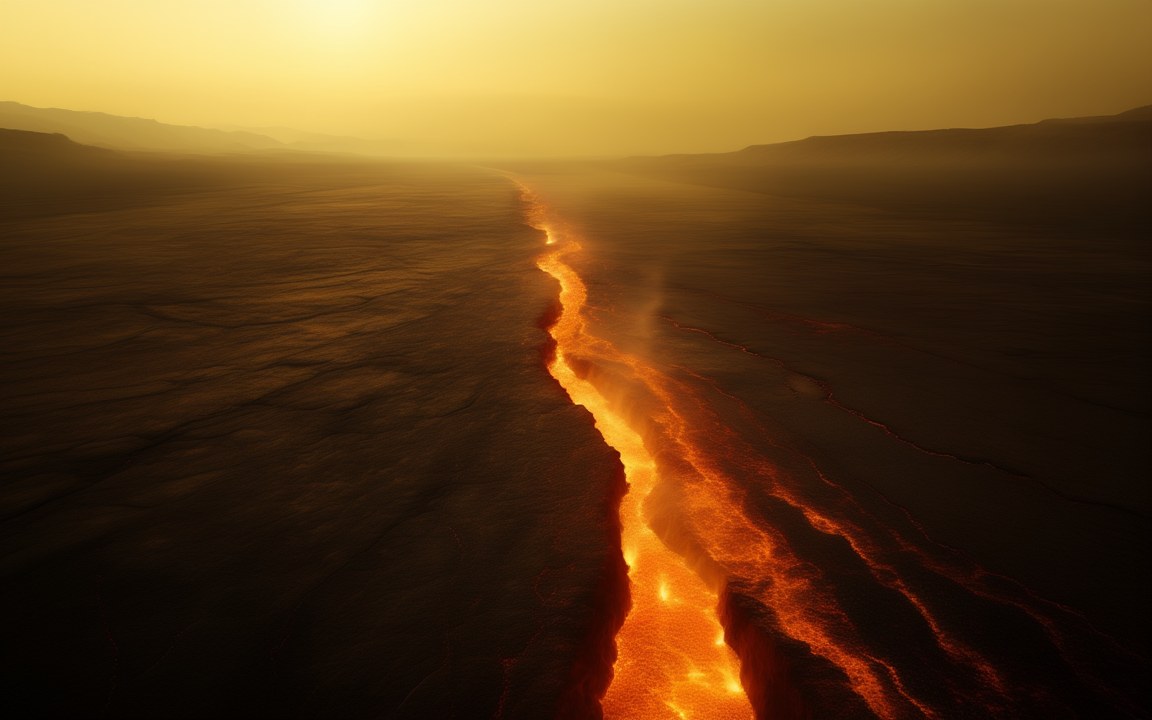
Seen from low above, a long, glowing crack pouring orange lava across a flat, dark plain of cooled lava under a hazy yellow sky, an impression of the Deccan Traps flood-basalt eruptions in India about 66 million years ago.

Lost WorldsCretaceous

Deccan Traps

Lava that flooded western India as the age of dinosaurs ended, and an argument still running over how much it mattered

About 66.3 to 65.6 million years ago Reconstruction, not a photograph
Erupted about 66.3 to 65.6 million years ago 600 000 to 800 000 years; other estimates say about 1 million [1]
Main phase began about 250 000 years before the boundary from uranium-lead dating of zircon [25]
Volume about 1 million km³ one dating study counts more than 1.1 million km³ [1]
Area up to 1.5 million km² originally about half the size of modern India; about 500 000 km² remains [1]
Thickness more than about 2 km [1]
Longest flows up to 1 000 km [8]
Commonest lobe thickness 8 to 17 m 8 m where thin lobes abound, 17 m where sheet lobes dominate; 75 to 80 m is rare [9]
Source the Réunion hotspot a mantle plume that India passed over; the model has been challenged [1]
India at the time an island continent first contact with Asia about 55 million years ago [5]
Name from the Swedish for stairs after the step-like hills; Deccan comes from Sanskrit for southern [1]

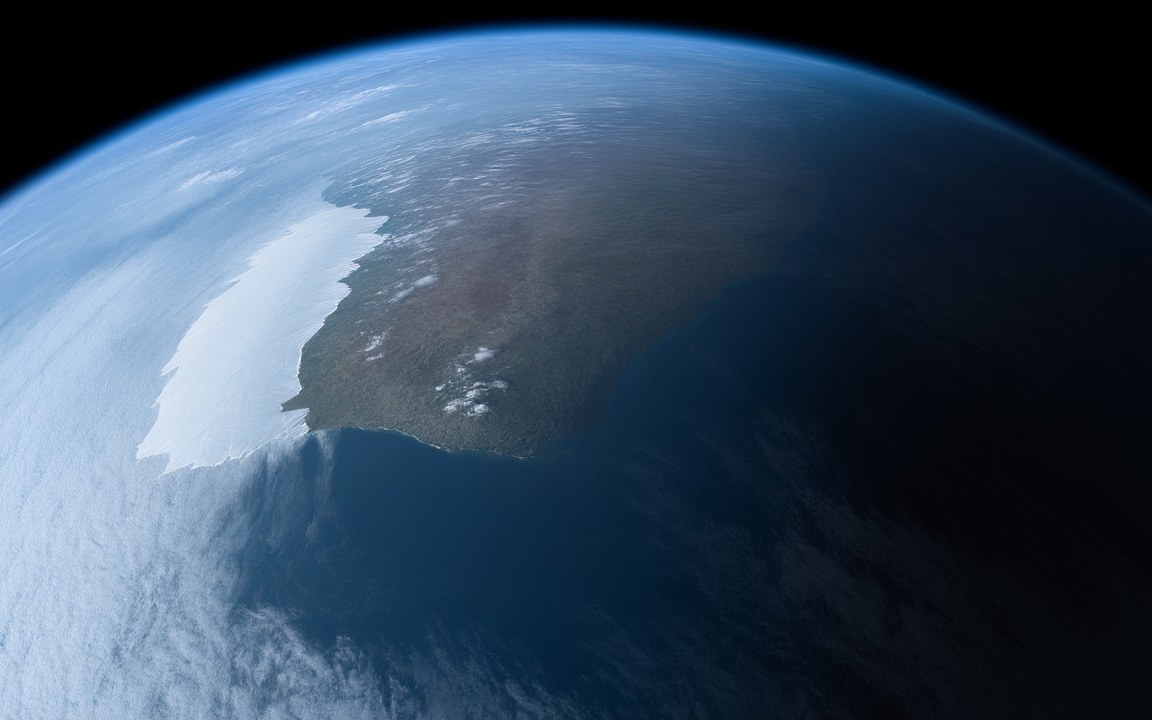
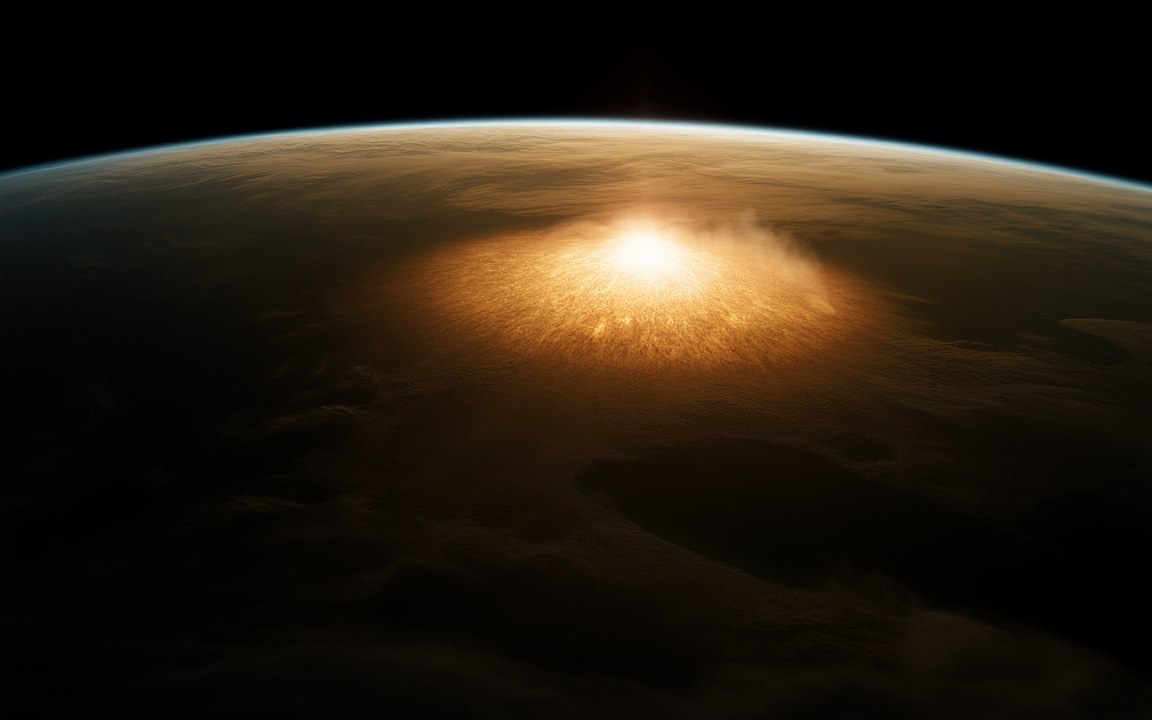
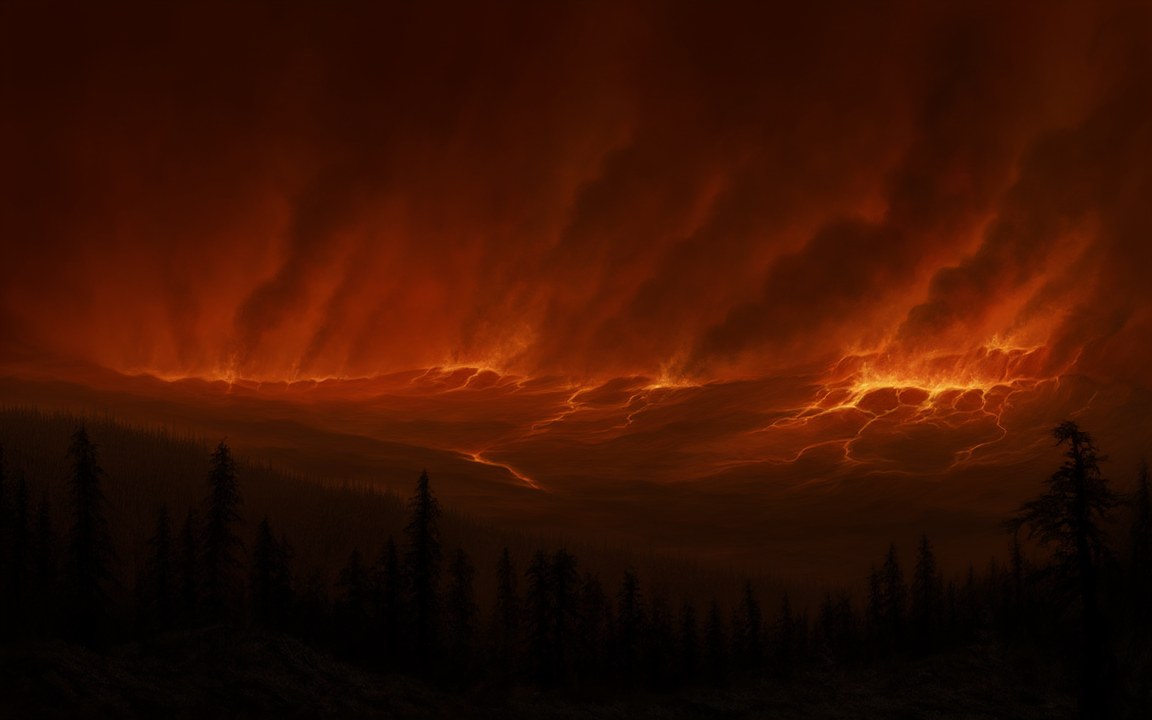
About the pictures. Painted as a long fissure pouring lava over a plain of older flows; as the front of a lava flow at dusk with palms on the horizon; as a long-necked sauropod beside a lake on old, red-weathered lava during a quiet spell; and as India from space, an island continent under a thin haze. Fissures and flat sheets follow flood basalts elsewhere and the lava layers of the Western Ghats, and the palms and titanosaurs follow fossils from between and beneath the flows. The dinosaur is a general sauropod rather than a particular Indian species, with imagined colouring and slim legs, and the sky and trees are imagined. The view from space is not a map: the lava covered only part of India, and the outline of the land is imagined.

About 66 million years ago, sheet after sheet of lava flooded western India. The Deccan Traps hold about 1 million km³ of basalt in a pile more than about 2 km thick, and may once have covered 1.5 million km², about half the size of modern India. They were already erupting when the Chicxulub asteroid struck Mexico 66.04 million years ago, and they carried on afterwards, which has made them both rival and possible accomplice in explaining the extinction that ended the age of dinosaurs.

Lava without a mountain

There was no great cone. Flood basalts erupt from long fissures, and the runny lava spreads for hundreds of kilometres beneath a solid crust that keeps it hot. Ash is rare, because the lava holds little dissolved gas. Deccan flows ran up to 1 000 km. In a 2021 compilation, individual lobes were most often 8 m thick in some formations and 17 m in others, with 75 to 80 m rare. Today the Western Ghats are not true mountains but the steep edge of a plateau, and the stepped hills gave the rocks their name, from the Swedish for stairs.

Life between the flows

Red, brown or green layers called boles lie between many flows, attributed either to chilling by the next flow or to erosion of the last. Lake beds between the lavas hold frogs, snakes, gar, palms and small mammals such as Deccanolestes. Under the lavas, the Lameta Formation of about 70 to 66 million years ago preserves titanosaurs such as Isisaurus and predators such as Rajasaurus. In 2023 Dhiman and colleagues described 92 titanosaur clutches with 256 eggs from Dhar District. From the same formation comes Sanajeh, a 3.5 m snake found coiled around an egg beside a hatchling about 0.5 m long.

An island on the move

By then India was crossing the ocean as an island. It left Antarctica and Australia together with Madagascar about 125 million years ago, and the two parted 84 to 92 million years ago. One modelling study suggests that the plume now under Réunion thinned India’s base by about 130 km and let it reach about 20 cm a year.

Impact, volcanoes or both

Most researchers treat the impact as the main cause. In 2010 Schulte and colleagues pointed to a single layer of impact debris found worldwide at the boundary, matching the onset of extinction. In 2020 Hull and colleagues found support for major gas release beginning and ending distinctly before the impact, and Chiarenza and colleagues modelled dinosaur habitat: an impact winter suppressed it, while volcanic warming improved it and may have softened the blow. A 2024 study from the western United States found a cooling of about 5 °C, lasting under 10 000 years, about 30 000 years before the boundary, with temperatures recovered before the extinction. A 2025 study of New Mexico fossils found dinosaurs still diverse in the last few hundred thousand years, evidence against a long decline.

The volcanic case is led by Keller, who holds that the impact predates the extinction and that Deccan volcanism was the likely main cause, possibly made worse by the impact. In 2020 her team matched mercury spikes in Tunisia and Israel to eruption pulses and warming, and called volcanism a primary driver. Callegaro and colleagues found the most sulfur in lavas from within 100 000 years before the extinction, pointing to repeated volcanic winters that stressed life before the impact. At Seymour Island in Antarctica, Petersen and colleagues found 7.8 ± 3.3 °C of warming at the onset of Deccan volcanism and two extinction pulses, one with each event. A 2023 model from Dartmouth College suggested that Deccan gases alone could have been enough, with no spike in emissions at the impact.

Even the timing is contested. In one 2019 issue of Science, a team dating zircon found four high-volume pulses, one starting tens of thousands of years before the impact, and favoured both causes together. Another, dating with argon, found that the lava did not come in three discrete large pulses and that about 75 per cent of it erupted after the boundary. Renne and colleagues argued in 2015 that seismic waves from the impact may have set off the largest eruptions, about 70 per cent of the volume, an idea other authors have dismissed as superficial. A proposed second crater off western India, called Shiva, is unlikely to be real.
Where it sits in deep time

Deccan Traps: About 66.3 to 65.6 million years ago, in the Cretaceous.

Deccan Traps

Earth forms, 4.57 billion years agoToday

Each step to the right is ten times closer to today, so the last few million years get as much room as the first billion.

If Earth's history were one day

Squeeze all of Earth's history, about 4.6 billion years, into 24 hours, starting at midnight. Deccan Traps runs from 23:39:06 to 23:39:19, ending 21 minutes before midnight.

On this clock one second is about 52 862 years. All of written history fits into the last tenth of a second.

Reconstructions

Seen from low above, a long, glowing crack pouring orange lava across a flat, dark plain of cooled lava under a hazy yellow sky, an impression of the Deccan Traps flood-basalt eruptions in India about 66 million years ago. AI-generated painting.
The curved Earth seen from space, with a dark, isolated landmass in the deep blue ocean under a thin haze of volcanic gas, an impression of India as an island continent covered by the Deccan lava flows about 66 million years ago. AI-generated painting.
A long-necked sauropod dinosaur standing among palms and leafy trees beside a shallow lake on a plain of dark, weathered lava, an impression of a quiet spell between the Deccan Traps eruptions in India about 66 million years ago. AI-generated painting.
The glowing front of a lava flow creeping across a dark, flat plain at dusk under a dim red sky, smoke and steam drifting low and palms silhouetted on the horizon, an impression of a Deccan lava flow about 66 million years ago. AI-generated painting.

Questions people ask

What are the Deccan Traps?

One of the largest volcanic features on Earth: about 1 million cubic kilometres of basalt lava in west-central India, in layers together more than about 2 km thick, erupted around the end of the Cretaceous.

Did the Deccan Traps kill the dinosaurs?

Probably not on their own, though the question is not closed. The prevailing view is that the Chicxulub impact triggered the extinction and the eruptions played a minor part at most. A minority, notably Keller, consider volcanism a primary driver, and other researchers argue that both contributed.

How big were the Deccan Traps?

They may originally have covered as much as 1.5 million square kilometres, about half the size of modern India. About 500 000 square kilometres of lava can be seen today, and individual flows ran up to 1 000 km.

Why are they called traps?

From the Swedish word for stairs, after the step-like hills formed by the stacked lava flows. Deccan comes from a Sanskrit word meaning southern.

What caused the Deccan Traps?

The usual explanation is a deep mantle plume, the hotspot now under Réunion in the Indian Ocean, which India passed over as it moved north. High helium isotope ratios in the lavas and the timing of India's fast plate motion support it, but the plume model has been challenged.

Did the asteroid set off the Deccan eruptions?

That was proposed in 2015. Argon dates suggested the eruptions changed style within about 50 000 years of the impact, with about 70 per cent of the lava coming afterwards, perhaps because seismic waves opened paths for magma. Other researchers have dismissed the idea, and it remains unproven.

Sources

  1. Wikipedia: Deccan Traps
  2. Wikipedia: Flood basalt
  3. Wikipedia: Intertrappean Beds
  4. Wikipedia: Lameta Formation
  5. Wikipedia: Insular India
  6. Wikipedia: Madagascar
  7. Wikipedia: Gerta Keller
  8. Deccan Volcanism project, UC Berkeley: Background
  9. Self, Mittal & Jay (2021), Thickness characteristics of pāhoehoe lavas in the Deccan Province, Western Ghats, India, and in continental flood basalt provinces elsewhere, Frontiers in Earth Science 8
  10. Chimote (2020), The Deccan Traps, India (Part 2): its geomorphology and stratigraphy, Deposits Magazine
  11. Dhiman et al. (2023), New Late Cretaceous titanosaur sauropod dinosaur egg clutches from lower Narmada valley, India, PLOS ONE 18, e0278242
  12. Wilson et al. (2010), Predation upon hatchling dinosaurs by a new snake from the late Cretaceous of India, PLOS Biology 8, e1000322
  13. Indian Institute of Science (2021), Tracking the movement of the Indian plate since the last mass extinction (Paul & Ghosh, Geology)
  14. Schulte et al. (2010), The Chicxulub asteroid impact and mass extinction at the Cretaceous-Paleogene boundary, Science 327, 1214–1218
  15. Hull et al. (2020), On impact and volcanism across the Cretaceous-Paleogene boundary, Science 367, 266–272
  16. Chiarenza et al. (2020), Asteroid impact, not volcanism, caused the end-Cretaceous dinosaur extinction, PNAS 117, 17084–17093
  17. O'Connor et al. (2024), Terrestrial evidence for volcanogenic sulfate-driven cooling event ~30 kyr before the Cretaceous-Paleogene mass extinction, Science Advances 10, eado5478
  18. Flynn et al. (2025), Late-surviving New Mexican dinosaurs illuminate high end-Cretaceous diversity and provinciality, Science 390, 400–404
  19. Keller et al. (2020), Mercury linked to Deccan Traps volcanism, climate change and the end-Cretaceous mass extinction, Global and Planetary Change 194, 103312
  20. Callegaro et al. (2023), Recurring volcanic winters during the latest Cretaceous: sulfur and fluorine budgets of Deccan Traps lavas, Science Advances 9, eadg8284
  21. ScienceAlert (2023), report on Callegaro et al.
  22. Petersen, Dutton & Lohmann (2016), End-Cretaceous extinction in Antarctica linked to both Deccan volcanism and meteorite impact via climate change, Nature Communications 7, 12079
  23. Cox & Keller (2023), A Bayesian inversion for emissions and export productivity across the end-Cretaceous boundary, Science 381, 1446–1451
  24. Sci.News (2023), report on Cox & Keller
  25. Schoene et al. (2015), U-Pb geochronology of the Deccan Traps and relation to the end-Cretaceous mass extinction, Science 347, 182–184
  26. Schoene et al. (2019), U-Pb constraints on pulsed eruption of the Deccan Traps across the end-Cretaceous mass extinction, Science 363, 862–866
  27. Sprain et al. (2019), The eruptive tempo of Deccan volcanism in relation to the Cretaceous-Paleogene boundary, Science 363, 866–870
  28. Renne et al. (2015), State shift in Deccan volcanism at the Cretaceous-Paleogene boundary, possibly induced by impact, Science 350, 76–78
  29. Deccan Volcanism project, UC Berkeley: Background on Deccan geochronology (cites Richards et al. 2015, GSA Bulletin 127, 1507–1520)