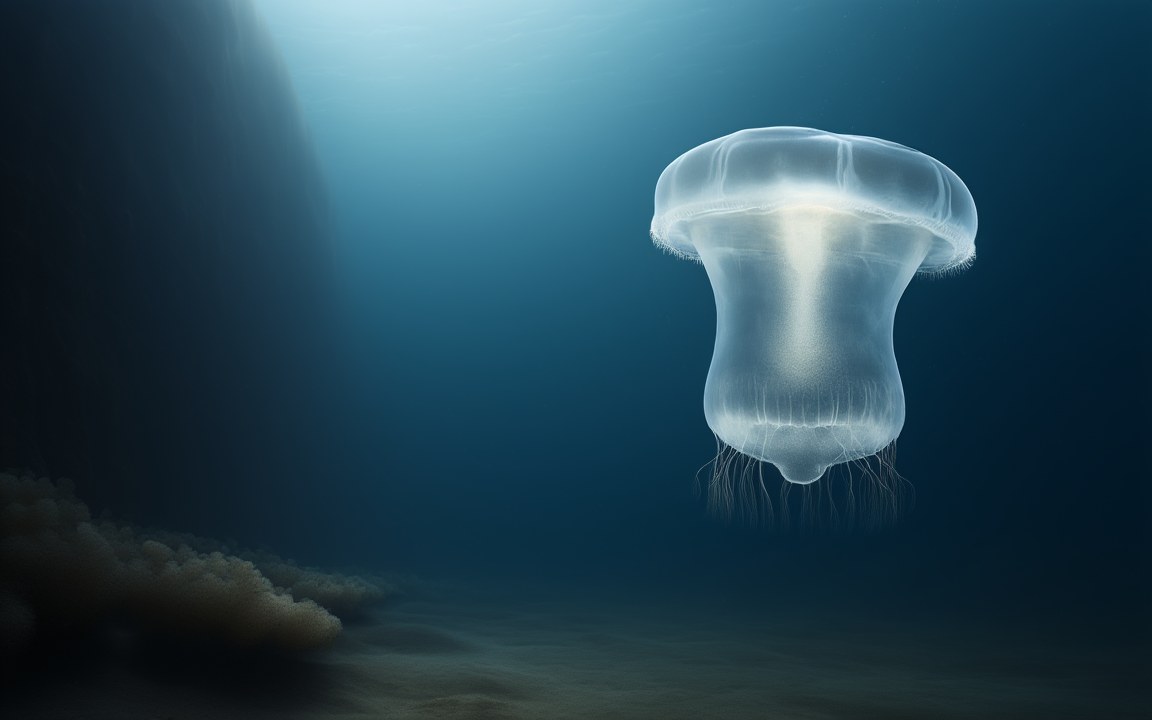
A single tall, glassy jellyfish with a flared, mushroom-like cap over a narrower bell and a short fringe of tentacles, drifting in dim blue water above a dark seafloor at the foot of an underwater cliff, a loose impression of Burgessomedusa, the oldest known swimming jellyfish, about 505 million years ago.

Lost WorldsCambrian

Cambrian explosion

The burst, about 539 million years ago, when many of the main kinds of animals appear in the fossil record

About 539 to 519 million years ago Reconstruction, not a photograph
Began about 538.8 million years ago a 2023 study argues for later than 533 million; a 2024 study disagrees [1]
Lasted 13 to 25 million years [1]
Burgess Shale 508 to 505 million years old Yoho National Park, Canada [2]
Burgess Shale found 1909, by Walcott who collected more than 65 000 specimens [2]
Chengjiang fossils no more than about 518 million years old Yunnan, China; found in 1984 [3]
Anomalocaris about 38 to 60 cm long 38 cm leaves out the arms and tail fan; the Natural History Museum gives 60 cm [4]
Anomalocaris eyes over 24 000 lenses in one eye of an Australian specimen; the eyes were about 3 cm wide [4]
First trilobites about 530 million years ago other accounts say about 521 million [1]
Forerunners the Ediacaran biota about 580 to 543 million years ago [1]

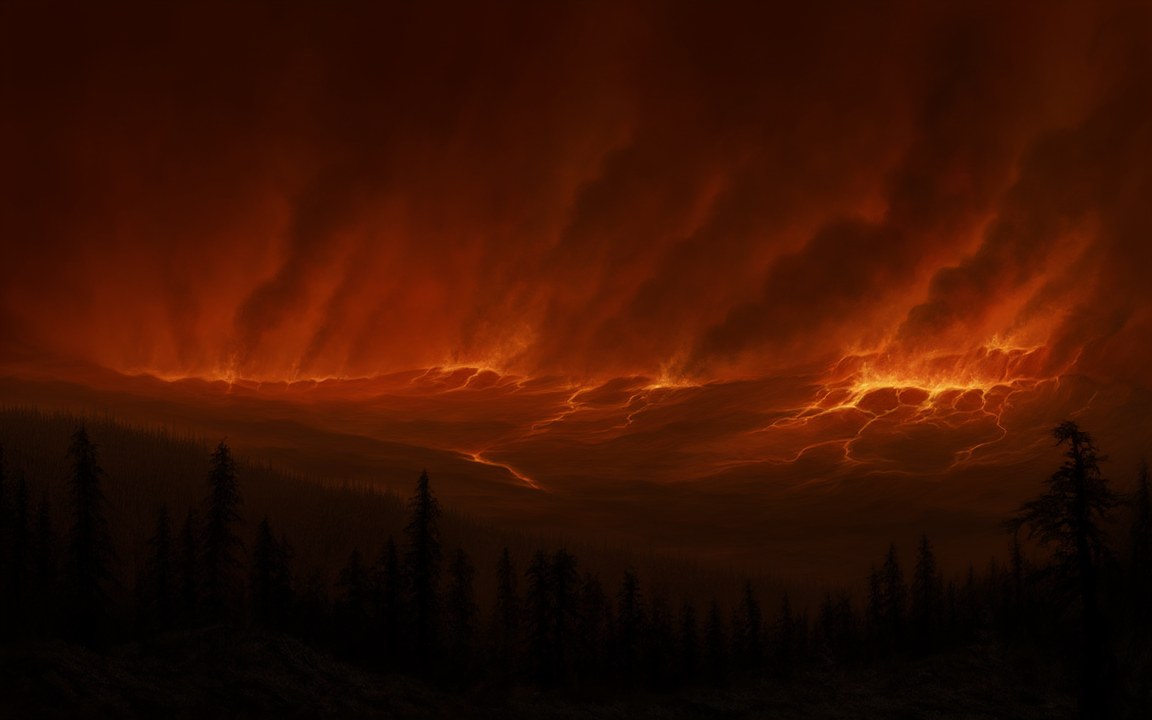
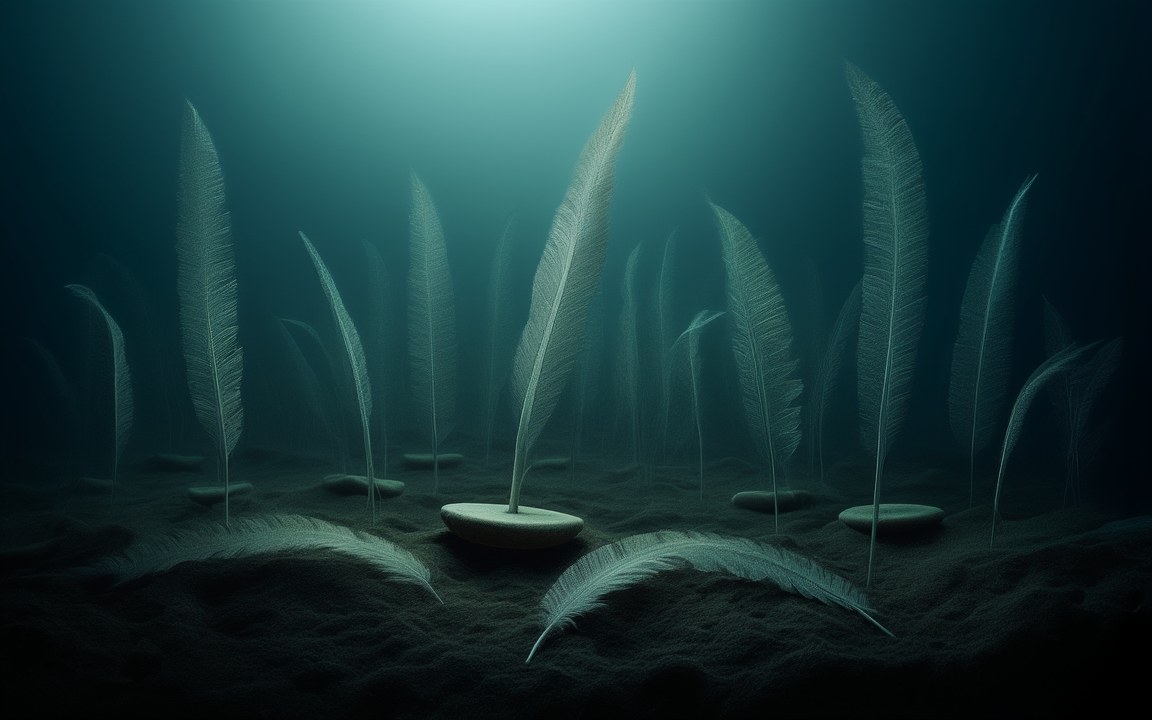
About the pictures. Four views of the Cambrian world. A bare shore about 510 million years ago shows land before plants. The seafloor at the foot of an underwater cliff, as at the Burgess Shale about 508 million years ago, carries sponges, which were diverse there, in imagined shapes. Trails crossing the seabed stand for trace fossils, which record how animals moved; one, Treptichnus pedum, marks the start of the Cambrian. The jellyfish is a loose impression of Burgessomedusa, about 505 million years old, described in 2023 as the oldest unequivocal swimming jellyfish. Its fossils show a box-shaped bell up to 20 cm high, narrower and squarer than the flared bell painted, with over 90 short tentacles. Every colour is imagined, as are the light and the depth of the water.

For most of Earth’s history, life was small and simple. Then, starting around 539 million years ago, the fossil record fills with animals: creatures with shells, legs, eyes, guts and jaws, including early relatives of many of the main groups of animals alive today. In geological terms it happened in a flash, over perhaps 13 to 25 million years. This is the Cambrian explosion, and what set it off is still one of the great open questions in the history of life.

Darwin’s problem

The sudden appearance of complex animals worried Darwin. In On the Origin of Species, in 1859, he called the abrupt appearance of trilobites in the oldest fossil-bearing rocks then known a difficulty “of the gravest nature” for his theory, and put it down to gaps in the fossil record. He was partly right. Older life has since been found, including the strange soft-bodied Ediacaran organisms of about 580 to 543 million years ago. But the burst of animal diversity in the Cambrian remains real.

Windows into the Cambrian

Most fossils preserve only hard parts. A few rare sites preserve soft bodies too, and they have transformed what we know. The most famous is the Burgess Shale in Yoho National Park, British Columbia, about 508 to 505 million years old. It was discovered by the palaeontologist Walcott in 1909, and by 1924 he had collected more than 65 000 specimens. From the 1960s a new generation of researchers re-examined them and reinterpreted many of the animals. The fossils formed at the foot of an underwater cliff about 160 m high, below the depth reached by storm waves, where animals were buried rapidly by mud carried down in currents.

An even older window opened in China in 1984, when the palaeontologist Hou found soft-bodied fossils at Chengjiang in Yunnan, no more than about 518 million years old. They were laid down in a shallow, muddy sea near a river delta and include about 185 species described by 2006, among them some of the earliest fish-like animals. In 2019 researchers reported the Qingjiang site, with more than 20 000 specimens, where about half of the species were new.

Anomalocaris

A top predator of these seas was Anomalocaris, a swimming animal about 38 to 60 cm long, depending on the estimate. It had a pair of spiny arms in front of its head, flaps along its sides for swimming, a fan-shaped tail, and large compound eyes on stalks; one eye from Australia has more than 24 000 lenses. Its parts, and those of its close relatives, were found separately long before anyone realised they belonged together: an arm was first taken for a shrimp, a round mouth for a jellyfish and a body for a sponge.

It was long imagined crushing trilobites in its arms. A 2023 study modelled those arms and found them flexible and their spines too fragile for that. They were built for speed, so Anomalocaris more likely snatched fast, soft-bodied animals in open water.

When and why

The start of the Cambrian is officially dated to about 538.8 million years ago. A 2023 study of volcanic crystals in rocks in Nevada argued it was younger than 533 million years, which would squeeze the early burst into an even shorter time. Not everyone agrees: a 2024 study of the same formation found no need to move the date.

Why it happened is unresolved. A rise in oxygen in the oceans was long the favourite trigger, but a 2025 study found that oxygen in the deep ocean was still swinging up and down between about 485 and 380 million years ago, long after the explosion. Another 2025 study analysed more than 170 trace fossils: by about 545 million years ago tracks were becoming smoother, with fewer abrupt turns, a sign that small animals were gaining control of their movement, so some of the groundwork was laid before the Cambrian began.
Where it sits in deep time

Cambrian explosion: About 539 to 519 million years ago, in the Cambrian.

Cambrian explosion

Earth forms, 4.57 billion years agoToday

Each step to the right is ten times closer to today, so the last few million years get as much room as the first billion.

If Earth's history were one day

Squeeze all of Earth's history, about 4.6 billion years, into 24 hours, starting at midnight. Cambrian explosion runs from 21:10:07 to 21:16:22, ending 2 h 43 min before midnight.

On this clock one second is about 52 862 years. All of written history fits into the last tenth of a second.

Reconstructions

A single tall, glassy jellyfish with a flared, mushroom-like cap over a narrower bell and a short fringe of tentacles, drifting in dim blue water above a dark seafloor at the foot of an underwater cliff, a loose impression of Burgessomedusa, the oldest known swimming jellyfish, about 505 million years ago. AI-generated painting.
Looking down through shallow water at a smooth, sandy seafloor crossed by long, curving trails with ladder-like scratch marks, an impression of trails left by small animals crawling over the floor of a Cambrian sea about 510 million years ago. AI-generated painting.
A bare coast of reddish sand and grey water channels with rippled sand and low, barren hills, not a single plant anywhere, an impression of the empty land about 510 million years ago, before plants grew on land. AI-generated painting.
A dim, blue-green seafloor at the foot of a dark underwater cliff, scattered with pale yellow and ochre sponges shaped like tubes, mounds and branching bushes, an impression of a Cambrian sponge meadow 508 million years ago. AI-generated painting.

Questions people ask

When was the Cambrian explosion?

It began around 538.8 million years ago, at the base of the Cambrian period, and its fastest phase was over by about 521 million years ago. A 2023 study of volcanic crystals in Nevada argued that the Cambrian began later than 533 million years ago, which would make the explosion even quicker; a 2024 study found no need to move the date.

How long did the Cambrian explosion last?

About 13 to 25 million years, depending on where the start and end are drawn. That is short in geological terms, which is why it is called an explosion.

What was Anomalocaris?

A swimming predator about 38 to 60 cm long, depending on the estimate, with a pair of spiny grasping arms in front of its head, flaps along its sides and large compound eyes; one eye from Australia has more than 24 000 lenses. A 2023 study found its arms flexible and their spines too fragile to crack trilobites, so it probably hunted soft-bodied animals in open water.

What is the Burgess Shale?

A layer of rock about 508 to 505 million years old in Yoho National Park, British Columbia, famous for fossils that preserve soft parts such as guts, limbs and eyes. It was discovered by Walcott in 1909 and is a World Heritage Site.

What caused the Cambrian explosion?

Nobody knows for certain. A simple rise in oxygen used to be the favourite explanation, but a 2025 study found that deep-ocean oxygen was still swinging up and down between about 485 and 380 million years ago, long after the explosion. Trace fossils also suggest that small animals were already moving in a more controlled way by about 545 million years ago.

Sources

  1. Wikipedia: Cambrian explosion
  2. Wikipedia: Burgess Shale
  3. Wikipedia: Maotianshan Shales
  4. Wikipedia: Anomalocaris
  5. Nelson et al. (2023), Cambrian explosion condensed: high-precision geochronology of the lower Wood Canyon Formation, Nevada, PNAS
  6. Natural History Museum (2023), Cambrian apex predator probably preferred soft-bodied prey (Bicknell et al., Proceedings of the Royal Society B)
  7. Natural History Museum (2025), Complex animals living millions of years before the Cambrian Explosion revealed by seabed tracks
  8. Stanford University (2025), Oxygen levels fluctuated wildly long after the Cambrian explosion (Ostrander et al., Science Advances)
  9. Parks Canada: Burgess Shale guided hikes
  10. Runnegar et al. (2024), Tulaneia amabilia, a new erniettomorph from the Wood Canyon Formation, Nevada and the age of the Ediacaran-Cambrian transition in the Great Basin, Journal of Paleontology 98, 929-951
  11. Monastersky (1993), Mysteries of the Orient, Discover
  12. Moon, Caron & Moysiuk (2023), A macroscopic free-swimming medusa from the middle Cambrian Burgess Shale, Proceedings of the Royal Society B 290, 20222490
  13. Royal Ontario Museum (2023), Researchers identify oldest known species of swimming jellyfish
  14. Wikipedia: Cambrian
  15. Wikipedia: Paleobiota of the Burgess Shale