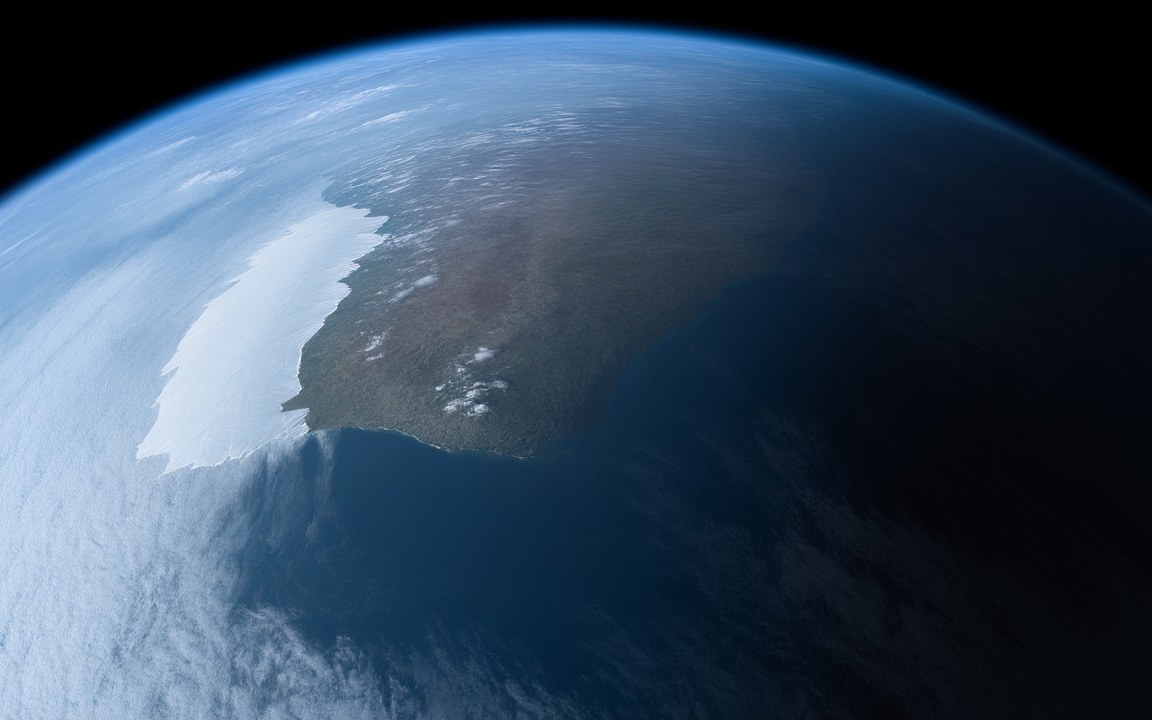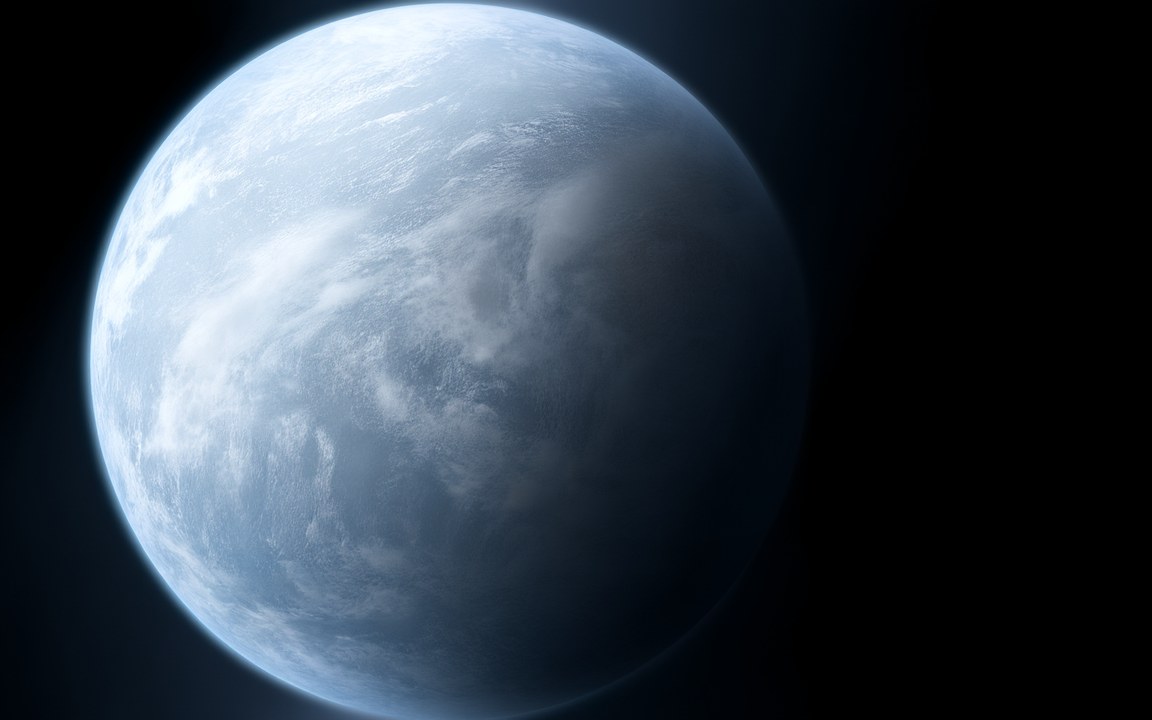
A pale globe seen from space, its whole surface white and blue-grey with ice and thin cloud from pole to pole and half of it in shadow, an impression of Snowball Earth.

Lost WorldsCryogenian

Snowball Earth

The times, about 700 million years ago, when ice may have reached the equator and covered the whole planet

About 717 to 635 million years ago Debated: hard snowball or slushball Reconstruction, not a photograph
Glaciations two: the Sturtian and the Marinoan in the Cryogenian period [1]
Sturtian about 717 to 659 million years ago lasting 57 to 59 million years [3]
Marinoan about 639 to 635 million years ago about 4 million years, by a 2025 estimate [5]
Ice hundreds of metres thick a slowly flowing "sea glacier" over the oceans [3]
At the equator as cold as Antarctica today [1]
Evidence glacial rocks on 22 ancient continents and microcontinents some laid down near the equator [3]
Named 1992, by Kirschvink [1]
Trigger carbon dioxide below about 200 ppm for the Sturtian, according to a 2024 study [4]
Ended by volcanic carbon dioxide building up to roughly 1 to 10% of the air [3]

About the pictures. Painted as the hard-snowball version of the idea. The globe shows ice and thin cloud from pole to pole. On the surface, a dark volcano sends a column of ash through a flat ice plain, since ash beds show that eruptions continued. Bare blue ice cracked and pitted with dark dust follows models of the equator, where ice slowly evaporated. The last view is the end of a glaciation, with dark open sea and steam between breaking sheets of ice. Whether the whole ocean really froze is still debated, and some models keep a band of open water in the tropics. The look of the ice comes from model predictions, and the colours, light and shore are imagined.

About 700 million years ago, ice may have covered the entire planet. Glaciers reached the sea near the equator, the oceans froze into ice hundreds of metres thick, and seen from space the Earth would have been a white and grey ball. It happened at least twice, in two great glaciations of a period that geologists have named the Cryogenian, from the Greek for “cold” and “birth”. How complete the freeze was is still argued over, but the evidence that ice reached the tropics is hard to dismiss.

Ice at the equator

A key clue came in 1964, when the geologist Harland showed from magnetic data that rocks deposited by glaciers in Svalbard and Greenland had formed in the tropics. Glacial deposits of this age are now known from 22 ancient continents and microcontinents. Many of them are capped directly by layers of carbonate rock, known as cap carbonates, along with banded iron formations and sharp swings in the chemistry of carbon. The name “snowball Earth” was coined by Kirschvink in 1992, and in 1998 a team led by Hoffman set out the case in detail from rocks in Namibia.

There were two such glaciations. The Sturtian began about 717 million years ago and lasted 57 to 59 million years. After a warmer interval of perhaps 9 to 19 million years came the Marinoan, which ended about 635 million years ago. In 2025 a study that mapped rocks in Namibia with drones and dated layers of volcanic ash concluded it lasted only about 4 million years.

How to freeze a planet

Ice reflects sunlight. Once it spreads far enough towards the equator, the planet reflects so much of the Sun’s heat that it cools further, and the ice spreads further still. A 2024 study traced what pushed the Earth over that edge the first time: the amount of carbon dioxide coming out of mid-ocean ridges had fallen to an all-time low, while a huge field of fresh volcanic rock in Canada was being weathered by rain, a process that pulls carbon dioxide out of the air. Its level in the air dropped below about 200 parts per million, and the volcanic supply stayed low for the whole glaciation.

A world of ice

In the hard-snowball picture, the oceans were covered by a sea glacier several hundred metres thick that flowed slowly towards the equator. The equator was as cold as Antarctica is today. In the tropics the ice did not melt so much as evaporate straight into the dry air, leaving behind dust that darkened its surface. Volcanoes kept erupting through it.

Not everyone accepts a frozen ocean. In the slushball or waterbelt models, a band of open water survived near the equator. A 2026 study of about 2 600 annual layers in rocks from islands off Scotland found that they recorded seasons, solar cycles and El Niño-like swings during the Sturtian. In models most such cycles die out under complete ice but can resume if about 15 per cent of the ocean is free of it, which the authors see as a short-lived exception within a frozen world. Another 2026 study suggested that the long Sturtian may have been a series of freezes and thaws.

How it ended

Under the ice, rain and rock weathering no longer removed carbon dioxide, but volcanoes kept adding it. It built up, perhaps to between 1 and 10 per cent of the air, until the planet was warm enough for the ice to give way. Once the tropics opened, models suggest the ice could have retreated in only about 2 000 years, leaving a layer of meltwater on the sea that may have reached 40 to 60 °C at the surface.

Life survived. Fossil stromatolites, layered structures built by microbes, suggest that it carried on in shallow water at least, and the proposed refuges include meltwater ponds, holes melted by dark dust and hot springs on the seafloor.
Where it sits in deep time

Snowball Earth: About 717 to 635 million years ago, in the Cryogenian.

Snowball Earth

Earth forms, 4.57 billion years agoToday

Each step to the right is ten times closer to today, so the last few million years get as much room as the first billion.

If Earth's history were one day

Squeeze all of Earth's history, about 4.6 billion years, into 24 hours, starting at midnight. Snowball Earth runs from 20:13:56 to 20:39:48, ending 3 h 20 min before midnight.

On this clock one second is about 52 862 years. All of written history fits into the last tenth of a second.

Reconstructions

A pale globe seen from space, its whole surface white and blue-grey with ice and thin cloud from pole to pole and half of it in shadow, an impression of Snowball Earth. AI-generated painting.
A flat, endless plain of white ice under a high, pale sun and a deep blue sky, broken only by a dark volcano sending a column of black smoke into the air, an impression of the surface of Snowball Earth. AI-generated painting.
A vast, flat plain of hard blue ice cracked by thin white fractures and pitted with dark dust, stretching to the horizon under a deep blue sky and a small, bright sun, an impression of standing on the ice near the equator during Snowball Earth about 700 million years ago. AI-generated painting.
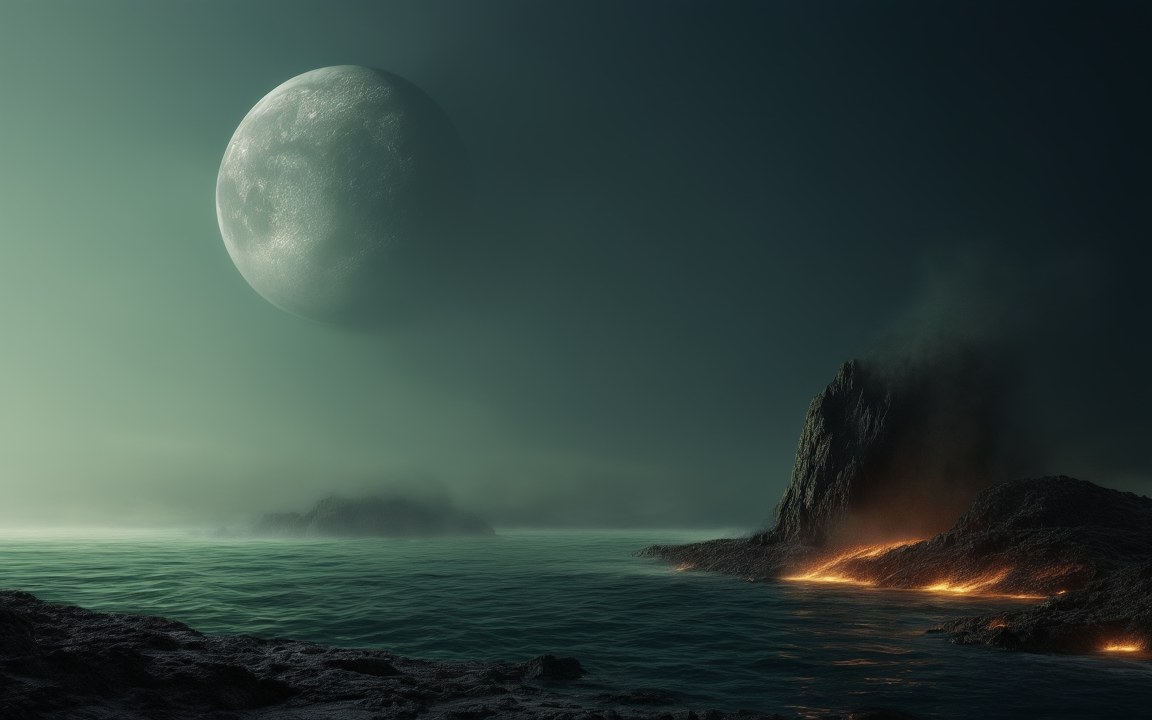
Dark open sea spreading between broken, melting sheets of grey ice under a hazy white sky, with a bare, gravelly shore in the foreground, an impression of the end of a Snowball Earth glaciation about 635 million years ago. AI-generated painting.

Questions people ask

When was Snowball Earth?

In two great glaciations during the Cryogenian period. The Sturtian lasted from about 717 to 659 million years ago, and the shorter Marinoan ended about 635 million years ago; a 2025 study put its length at about 4 million years.

Was the whole Earth really frozen?

That is still debated. In the hard-snowball model the whole ocean froze over. In the slushball or waterbelt models a band of open water survived in the tropics. A 2026 study of annual layers in Scottish rocks suggests about 15 per cent of the ocean may have opened briefly within an otherwise frozen world.

What caused Snowball Earth?

For the Sturtian, a 2024 study pointed to record-low volcanic carbon dioxide from mid-ocean ridges combined with the weathering of a huge field of volcanic rock in Canada, which drew carbon dioxide out of the air until it fell below about 200 parts per million. Once ice spread far enough, it reflected so much sunlight that the cooling fed itself.

How did Snowball Earth end?

Volcanoes kept releasing carbon dioxide, which could no longer be removed by rain and rock weathering under the ice. It built up to perhaps 1 to 10 per cent of the air until the planet warmed enough for the ice to melt, possibly very quickly once the tropics opened.

How did life survive Snowball Earth?

Probably in refuges: meltwater ponds on the ice, holes melted by dark dust, ice-free valleys and hot springs on the seafloor. Fossil stromatolites, layered structures built by microbes, suggest that life in shallow water at least carried on.

Sources

  1. Wikipedia: Snowball Earth
  2. Wikipedia: Cryogenian
  3. Hoffman et al. (2017), Snowball Earth climate dynamics and Cryogenian geology-geobiology, Science Advances 3, e1600983
  4. University of Sydney (2024), Geoscientists discover what turned Earth into a giant snowball (Dutkiewicz et al., Geology)
  5. Phys.org (2025), Marinoan glaciation spanned 4 million years (Tasistro-Hart et al., PNAS)
  6. ScienceDaily (2026), Snowball Earth was not completely frozen, new study reveals (Griffin et al., Earth and Planetary Science Letters)
  7. Science X (2026), Snowball Earth may hide a far stranger climate cycle (Minsky et al., PNAS)