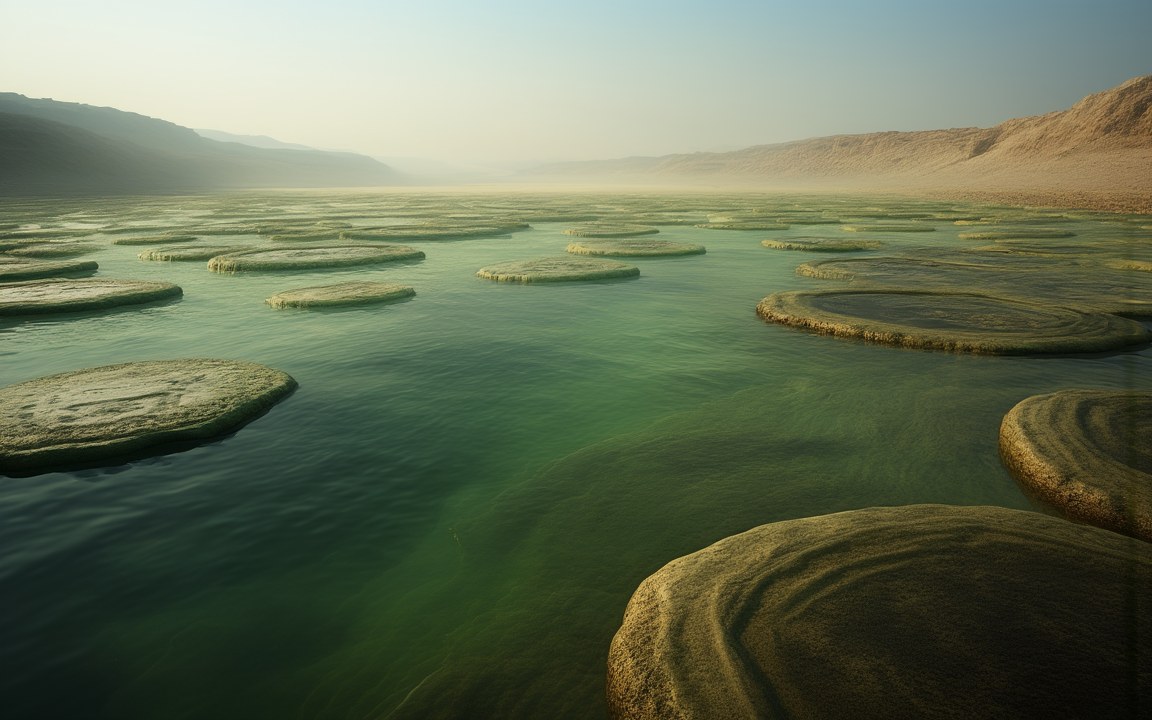
For roughly the first half of Earth’s history the air held almost no oxygen. Then, beginning between about 2.46 and 2.43 billion years ago, free oxygen started to build up in the atmosphere for the first time. It was released by cyanobacteria, microbes living in mats and mounds in shallow seas, and the change is known as the Great Oxidation Event. The name suggests a single moment, but it was a long, uneven shift that played out over some 400 million years. It altered the chemistry of the air, the oceans and the rocks, and by one estimate more than 2 500 of the roughly 4 500 known minerals were laid down as a direct result of it.
Read in sulfur and rust
The clearest evidence is in sulfur. When ultraviolet sunlight breaks up sulfur-bearing molecules in the air, it leaves an unusual pattern of isotopes, which happens only if the ultraviolet reaches deep into the atmosphere. The pattern runs through rocks older than about 2.4 to 2.3 billion years and then disappears, which is read as the arrival of oxygen and of an ozone layer that blocked the ultraviolet. Drill cores from Russia’s Kola Peninsula pin the switch between 2 501.5 and 2 434 million years ago, and lavas in South Africa dated to 2 426 million years give another anchor.
Other clues agree. Grains of pyrite and uraninite, minerals that oxygen destroys, were washed into sediments until about 2.4 billion years ago and then vanish. Fossil soils older than that have little iron, a sign of weathering without oxygen. Red beds, sandstones coloured by rusted iron, appear around 2 billion years ago.
A long wait for oxygen
Cyanobacteria evolved at least 2.45 to 2.32 billion years ago and probably as early as 2.7 billion, so oxygen was being made long before it accumulated. It was used up by gases and minerals from volcanoes and from weathering rock. Exhausting these sinks took 50 million years or longer. Another proposed factor is nickel: as the crust cooled, less of it reached the oceans, which may have weakened the methane-producing microbes that need it and let the oxygen-makers win.
Banded iron formations belong to this story but do not date it. These rocks of thin silver-to-black iron oxide layers, alternating with chert that is often red, mostly formed between about 2 800 and 2 500 million years ago. Cloud proposed that they formed where iron-rich deep water welled up into sunlit shallows in which cyanobacteria were making oxygen. The Hamersley Range in Western Australia, laid down between 2 470 and 2 450 million years ago, originally covered about 150 000 km² and is more than 900 m thick. Such rocks now supply most of the iron ore mined.
Two hundred million unsteady years
The rise was not a single step. Oxygen seems to have oscillated for about 200 million years, until about 2 250 million years ago, before staying. A 2026 review stresses how uncertain the levels are: across the event, estimates span up to four orders of magnitude, and it is not even clear where the event should be said to end. The usual end point is about 2 060 million years ago, when a long swing in the chemistry of carbon, the Lomagundi excursion, came to a close. It is often read as a time of heavy burial of organic matter and perhaps an oxygen overshoot.
Ice, then famine
Methane was a powerful greenhouse gas in the young atmosphere, and oxygen probably turned much of it into carbon dioxide and water, which trap less heat. The Huronian glaciations followed, between 2.45 and 2.22 billion years ago. Glacial rocks of the Makganyene Formation in South Africa were laid down about 11° from the equator. On the Kola Peninsula, glacial deposits lie about 60 m above the rocks that record oxygen, so the oxygen came first. These ice ages are about 1.7 billion years older than the Cryogenian ones known as Snowball Earth, and whether any of them froze the whole planet is unclear.
The event closed with a collapse. Sulfate minerals from the Belcher Group in subarctic Canada, about 2 018 million years old, show that the productivity of life fell by more than 80 per cent, probably because nutrients such as phosphorus ran short. Even then, the deep ocean stayed largely without oxygen until about 580 million years ago.