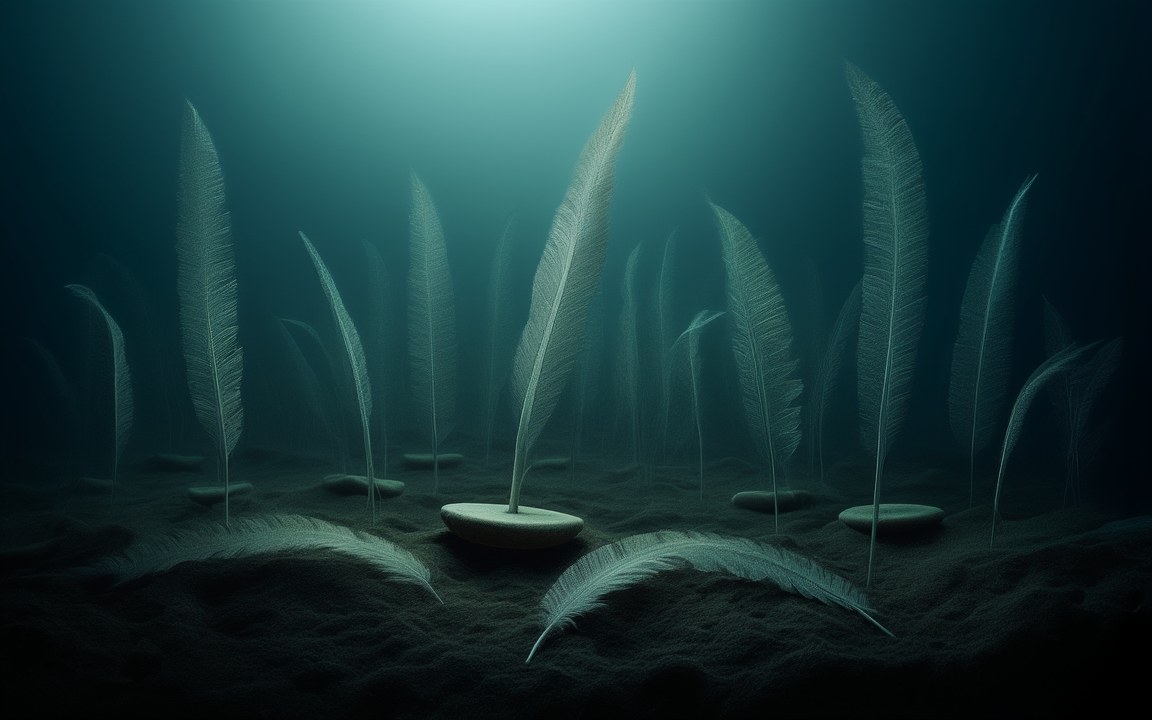
Feather-shaped fronds standing up from round discs anchored in the mud of a dim, blue-green deep sea floor, an impression of a meadow of Ediacaran fronds about 565 million years ago.

Lost WorldsEdiacaran

Ediacaran biota

Fronds, ribbed ovals and tiny worms that covered the sea floor before the Cambrian animals arrived

About 575 to 538.8 million years ago Reconstruction, not a photograph
Lived about 575 to 538.8 million years ago some put the first appearance at about 600 million years ago [1]
Assemblages Avalon, White Sea and Nama about 575 to 565, 560 to 550 and 550 to 542 million years ago [1]
Among the largest the frond Trepassia, up to 1.85 m long Dickinsonia reached about 1.4 m, but was at most a few millimetres thick [5]
Early bilaterian Ikaria, 2 to 7 mm long the largest the size of a grain of rice, 555 million years ago [11]
Fronds Charnia, 1 to 66 cm lived in water too deep for photosynthesis [3]
Found in at least 52 rock formations named after the Ediacara Hills, South Australia [1]
First found 1868, Newfoundland discs of Aspidella, at first taken for jellyfish [6]
Feeding probably absorbing nutrients from seawater the most widely accepted idea for the quilted forms; Dickinsonia seems to have grazed microbial mats with its underside [1]
Animal evidence cholesterol in Dickinsonia reported in 2018 from Russian fossils, and questioned since [2]
Disappeared by 538.8 million years ago at the start of the Cambrian; the cause is debated [1]

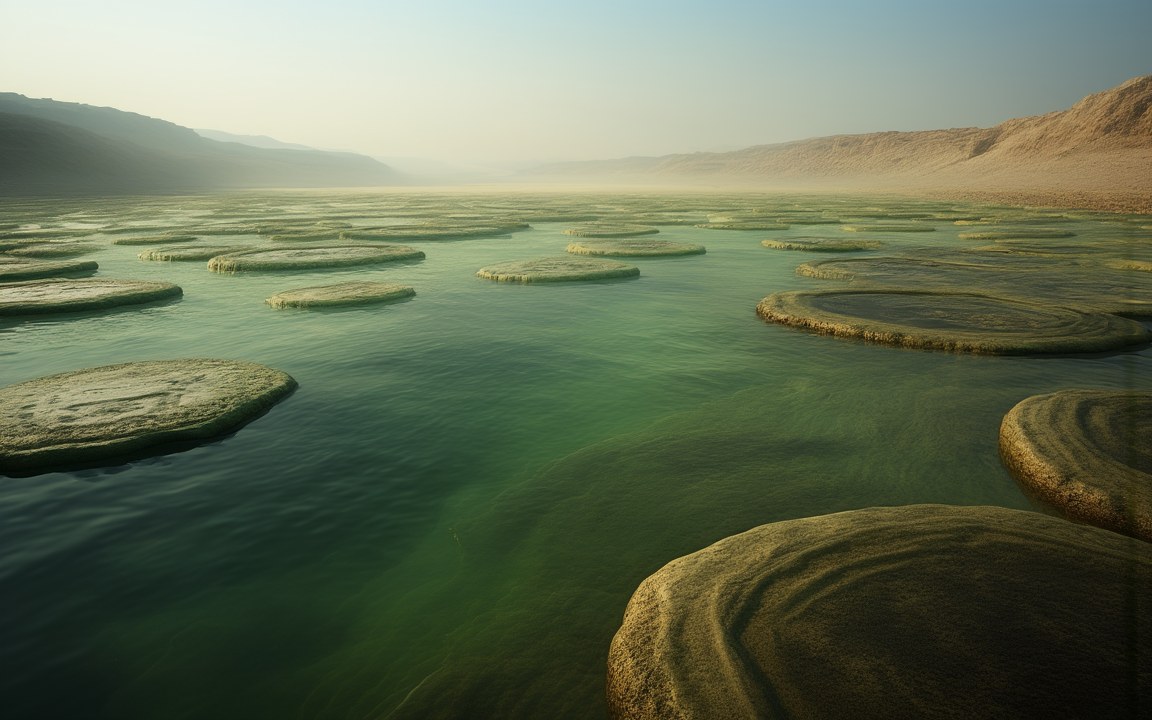
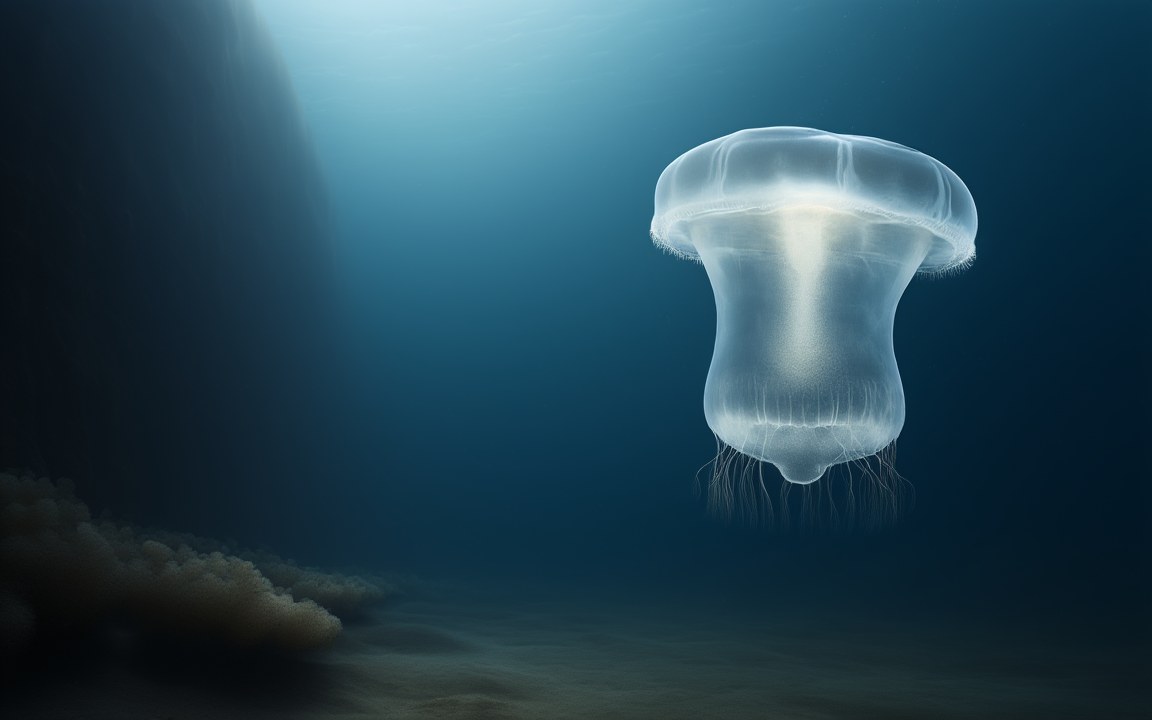
About the pictures. Painted as four sea floors: a meadow of feather-shaped fronds rising from disc-shaped holdfasts in dark, deep water; a flat, ribbed Dickinsonia seen from above; Kimberella as a smooth dome with a frilled edge; and a shallow, sunlit floor covered by a lumpy microbial mat with ring-marked discs and a single frond. The fronds, holdfasts, frill and mat follow outlines and textures preserved in sandstone and volcanic ash. The fossils are impressions, so every colour is imagined, as is the light in the deep-water scene: the oldest fronds lived below the reach of sunlight.

The Ediacaran biota are the earliest known complex, many-celled organisms: soft-bodied living things that lay on or stood up from the sea floor between about 575 and 538.8 million years ago, at the very end of the Precambrian. Some were feathery fronds up to 1.85 m long, some flat, ribbed ovals more than a metre long, others worms the size of a grain of rice. Named after the Ediacara Hills in South Australia, they are now known from at least 52 rock formations worldwide. They show what large life looked like before the animals of the Cambrian took over, and most of them are still hard to place on the tree of life.

Mistaken for jellyfish

The first finds were not recognised for what they were. In 1868 Murray found small discs in Newfoundland, later named Aspidella and taken for jellyfish. In 1933 Gürich collected similar fossils in Namibia but assigned them to the Cambrian, and in 1946 Sprigg noticed what he took for fossil jellyfish in the Ediacara Hills. When a 15-year-old schoolgirl, Negus, spotted a fern-like fossil in Charnwood Forest in England, her teacher dismissed the idea of Precambrian fossils. A year later, in 1957, Mason and his friends found it while rock climbing, and it was named Charnia. In 1959 Glaessner linked the English finds with the earlier ones.

The jellyfish idea has not survived: not one is now confidently recognised as a jellyfish. Many of the discs are holdfasts, sand-filled bulbs that anchored the stems of upright fronds.

Deep fronds and shallow mats

The fossils fall into three groups of different ages. The Avalon assemblage, about 575 to 565 million years old, is defined by Mistaken Point in Newfoundland, a UNESCO World Heritage Site since 2016. Its fronds lived in water too deep for sunlight to support photosynthesis, which is one reason Charnia is not thought to be a plant or alga. Fine volcanic ash buried them and kept details that coarser sand would have lost.

The White Sea assemblage, about 560 to 550 million years old, takes its name from Russia’s White Sea coast. The Nama assemblage, about 550 to 542 million years old, is best represented in Namibia, where many of its fossils lie in sand bars formed at the mouths of deltas. Almost everywhere the sea floor was covered by microbial mats, which left a wrinkled “elephant skin” texture in the rock. At Nilpena in South Australia, a single bed has yielded more than 400 fossils of 16 genera. Storms and underwater flows buried these communities in sand, sometimes forming mineral “death masks” over the bodies.

The oldest large fossils appear after the Gaskiers glaciation, which lasted about 250 000 years around 580 million years ago. Unlike the Snowball Earth glaciations before it, it is thought not to have covered the globe.

Animal or something else

How most Ediacaran organisms fed is unclear. The most widely accepted idea is that the quilted forms absorbed nutrients directly from seawater. Charnia grew as a frond 1 to 66 cm long, built from repeated branching units, and its relative Trepassia reached 1.85 m. From 1966 it was read as a sea pen, but that idea has since been discredited.

Dickinsonia was round to oval, ribbed on either side of a central groove, from a few millimetres to about 1.4 m long but at most a few millimetres thick. It moved over the sea floor and fed on microbial mats through its underside, leaving chains of feeding marks. In 2018 cholesterol, made only by animals, was reported from Russian specimens, although not everyone accepts this as proof.

Others look more like animals. Kimberella, up to 15 cm long, had a stiff but unmineralised shell, a muscular foot and a frilled fringe, and scratch marks around it resemble the feeding traces of molluscs. Ikaria, 2 to 7 mm long, had a body with a distinct front and back end, and its size matches small burrows found in the same rocks. Quaestio, described in 2024, is the earliest known animal with a left-right asymmetry.

Gone by the Cambrian

The Ediacaran communities vanish at the base of the Cambrian, 538.8 million years ago, and Cambrian animals almost completely replaced them. In the youngest, Nama assemblage, extinctions outpaced new arrivals throughout. Changing environments, new predators, competition and gaps in preservation have all been proposed as causes.
Where it sits in deep time

Ediacaran biota: About 575 to 538.8 million years ago, in the Ediacaran.

Ediacaran biota

Earth forms, 4.57 billion years agoToday

Each step to the right is ten times closer to today, so the last few million years get as much room as the first billion.

If Earth's history were one day

Squeeze all of Earth's history, about 4.6 billion years, into 24 hours, starting at midnight. Ediacaran biota runs from 20:58:43 to 21:10:07, ending 2 h 49 min before midnight.

On this clock one second is about 52 862 years. All of written history fits into the last tenth of a second.

How big

The largest known specimens of three Ediacaran organisms, next to a person.

Lengths of the largest specimens; all three are also known from specimens only millimetres or centimetres long. Dickinsonia was at most a few millimetres thick.

Reconstructions

Feather-shaped fronds standing up from round discs anchored in the mud of a dim, blue-green deep sea floor, an impression of a meadow of Ediacaran fronds about 565 million years ago. AI-generated painting.
Seen from above, a flat, oval, finely ribbed shape with a groove down its middle lying on a wrinkled sea floor in rippling light, an impression of Dickinsonia about 555 million years ago. AI-generated painting.
A soft, smooth, oval dome with a frilled edge resting on a sandy sea floor in green, rippling light, an impression of Kimberella about 555 million years ago. AI-generated painting.
A shallow sea floor covered by a lumpy olive-brown microbial mat, scattered with flat, round discs marked with rings and a single feather-like frond, under shafts of sunlight, an impression of Ediacaran life about 555 million years ago. AI-generated painting.

Questions people ask

What was the Ediacaran biota?

The earliest known complex, many-celled organisms: soft-bodied fronds, discs, ribbed ovals and small worm-like creatures that lived on the sea floor from about 575 million years ago until the start of the Cambrian, 538.8 million years ago.

Were the Ediacaran organisms animals?

Some were. Kimberella is generally accepted as a bilaterian, Ikaria had a body with a front and a back end, and cholesterol found in Dickinsonia points to an animal. Many others, such as the fronds, are of uncertain relationship, and most are not directly related to living animals.

What did Dickinsonia look like?

A flat, round to oval body with ribs running out on each side of a central groove. It ranged from a few millimetres to about 1.4 m long, yet was at most a few millimetres thick, and it seems to have had no mouth or gut. It moved over the sea floor and fed on microbial mats through its underside.

Were Ediacaran fossils jellyfish?

They were first described as jellyfish, but not one is now confidently recognised as a jellyfish. Many of the round discs are holdfasts that anchored the stems of upright fronds.

Why did the Ediacaran biota disappear?

Its communities vanish at the end of the Ediacaran, 538.8 million years ago, and Cambrian animals replaced them. Proposed causes include changing environments, the arrival of predators, competition from other life, and the possibility that later rocks simply failed to preserve them.

Where can you see Ediacaran fossils?

Mistaken Point in Newfoundland, a UNESCO World Heritage Site since 2016, the Ediacara Hills and Nilpena in South Australia, the White Sea coast of Russia, Namibia and Charnwood Forest in England.

Sources

  1. Wikipedia: Ediacaran biota
  2. Wikipedia: Dickinsonia
  3. Wikipedia: Charnia
  4. Wikipedia: Kimberella
  5. Wikipedia: Trepassia
  6. Wikipedia: Aspidella
  7. Wikipedia: Gaskiers glaciation
  8. Wikipedia: Mistaken Point Ecological Reserve
  9. Wikipedia: Quaestio (genus)
  10. Evans et al. (2020), Discovery of the oldest bilaterian from the Ediacaran of South Australia, PNAS 117, 7845
  11. Phys.org (2020), Ancestor of all animals identified in Australian fossils (Evans et al., PNAS)