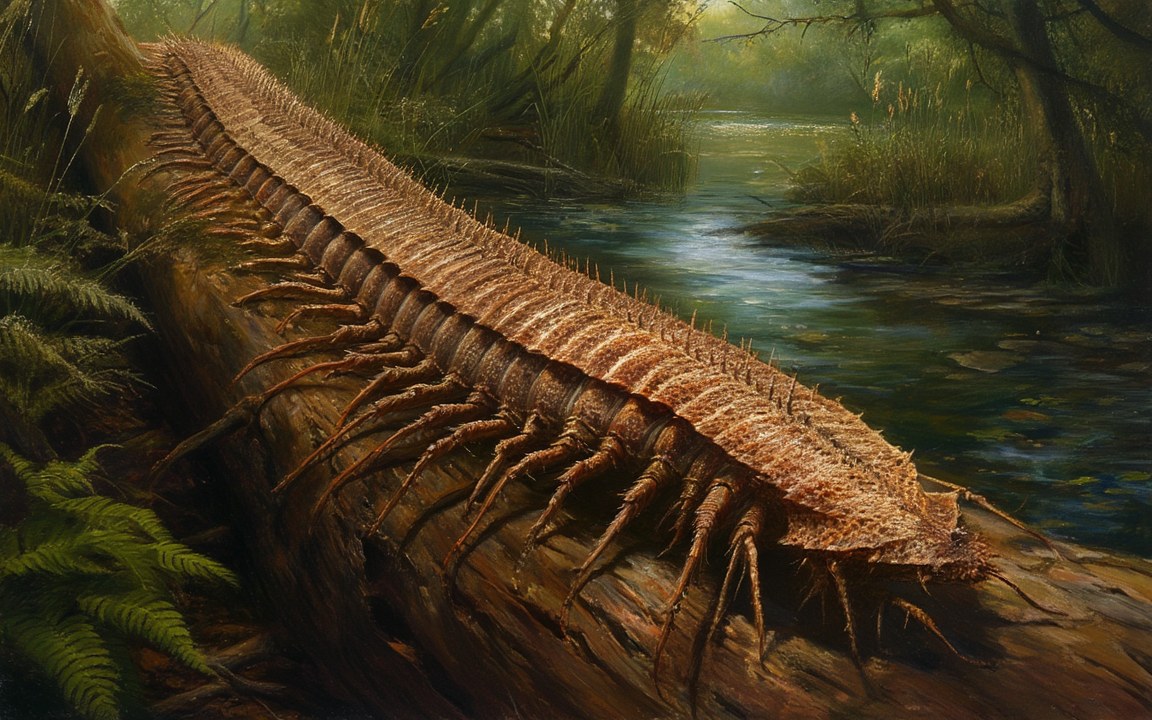
A giant, flat, many-legged arthropod with broad, spiny-edged armour plates crawling along a fallen tree trunk beside a forest stream, ferns in the foreground, an impression of Arthropleura in a Carboniferous woodland.

Lost GiantsCarboniferous

Arthropleura

The largest arthropod ever to walk on land, a millipede relative longer than a person

About 344 to 292 million years ago Reconstruction, not a photograph
Lived about 344 to 292 million years ago the Carboniferous and early Permian [1]
Length up to about 2.6 m for the largest individuals [7]
Width up to 55 cm [1]
Weight about 50 kg for the largest known [2]
Record largest known land arthropod [1]
Body 28 to 32 segments in adults, with two pairs of legs on each [1]
Diet probably decaying plant matter inferred from its anatomy; no direct evidence of its diet is known [5]
Fossils Europe and North America all close to the equator of the time [1]
Relatives millipedes probably an early offshoot of their line [5]

About the pictures. One painting shows the animal on a fallen trunk beside a stream; the other shows only a trackway of two rows of small footprints, like those it left on both submerged and exposed ground. The long, low body of many plates with spines follows its fossils, most of which are shed skins, but the painting does not reproduce the real count of 28 to 32 segments with two pairs of legs on each. The head is inferred from much smaller animals and is uncertain. The colour, trees and other plants are imagined and do not record any fossil site, and grasses like those on the bank had not yet evolved.

Arthropleura was a millipede relative longer than a person. The largest individuals grew to about 2.6 m long and 55 cm wide, making it the largest arthropod, the group that includes insects, spiders and crabs, ever known to have lived on land. It crawled across the equatorial lowlands of Europe and North America for about 50 million years, from the Carboniferous into the early Permian.

The largest arthropod on land

Most large Arthropleura fossils are not bodies but shed skins, left behind as the animal moulted and grew. In January 2018 a section of one of these shed skins, about 326 million years old, was found at Howick Bay in Northumberland, England. A 2021 study of this specimen estimated that the whole animal was between 1.9 and 2.63 m long and weighed about 50 kg. Fossil trackways at Joggins in Nova Scotia are up to 50 cm wide.

Its body was made of 28 to 32 segments in adults, each covered by an armoured plate in three lobes, typically studded with bumps or spines, and each carrying two pairs of legs. Not every Arthropleura was a giant: tracks at Montceau-les-Mines in France suggest that the kind living there reached only about 40 cm, though larger animals cannot be ruled out.

A head at last

For more than 150 years no complete head was known, because the large fossils do not preserve one. In 2024 a team scanned the fossils of two young animals, about 2.3 and 4 cm long, from Montceau-les-Mines, using micro-CT and a synchrotron. The heads had antennae, stalked compound eyes, internal jaws and two pairs of further mouthparts.

The result was a surprise: a head with features like a centipede’s on a body like a millipede’s, but with none of the venom claws that centipedes use to kill. The team’s main analysis placed Arthropleura as an early offshoot of the line leading to millipedes, although adding a fragmentary older relative pushed it further down the myriapod family tree. They concluded that it was most likely a detritivore, though no direct evidence of its diet has been found.

A 2025 study described heads on two further specimens from northern France, from animals of at most about 50 cm, so the heads of the largest animals are still inferred from smaller ones.

Not a swamp monster

Arthropleura has often been drawn crawling through the dense coal swamps of the Carboniferous. The 2021 study argued that it preferred more open, sparsely wooded ground near water, such as coasts and floodplains. Its trackways cross both ground that was underwater and ground that was dry, so it may sometimes have waded. A 2025 study found pores on some of its plates that could have been openings for breathing tubes, which would confirm it as a land animal.

Why so big?

Giant Carboniferous animals are often explained by the high oxygen levels of the time. Arthropleura does not fit that story: it was already large before oxygen rose, and its largest known fossil comes from a time when the air held about 23 per cent oxygen, only slightly more than today. Plenty of food and little competition may matter more.

It disappeared in the early Permian, about 292 million years ago. The 2021 study suggested that the drying out of the equatorial regions and competition from four-limbed animals finished it off, though the cause is still uncertain.

Where it sits in deep time

Arthropleura: About 344 to 292 million years ago, in the Carboniferous.

Arthropleura

Earth forms, 4.57 billion years agoToday

Each step to the right is ten times closer to today, so the last few million years get as much room as the first billion.

If Earth's history were one day

Squeeze all of Earth's history, about 4.6 billion years, into 24 hours, starting at midnight. Arthropleura runs from 22:11:33 to 22:27:56, ending 1 h 32 min before midnight.

On this clock one second is about 52 862 years. All of written history fits into the last tenth of a second.

How big

The largest known Arthropleura next to a person.

The length of the largest specimen is estimated at 1.9 to 2.63 m from a partial fossil.

Reconstructions

A giant, flat, many-legged arthropod with broad, spiny-edged armour plates crawling along a fallen tree trunk beside a forest stream, ferns in the foreground, an impression of Arthropleura in a Carboniferous woodland. AI-generated painting.
Rippled sand on a river bar beside shining water, crossed by a long, curving trail of many small footprints in two rows, an impression of a trackway left by Arthropleura about 320 million years ago. AI-generated painting.

Questions people ask

How big was Arthropleura?

The largest known individual was about 1.9 to 2.63 m long, 55 cm wide and about 50 kg. It is the largest arthropod known to have lived on land. Some kinds of Arthropleura may have been much smaller.

Was Arthropleura a millipede or a centipede?

A relative of millipedes. A 2024 study of its head found that it had a head rather like a centipede's on a body like a millipede's, and its main analysis placed it as an early offshoot of the millipede line. It had no venom claws.

Why could Arthropleura grow so big?

Not because of high oxygen, as was long assumed. It was already a giant before oxygen levels rose in the Carboniferous, and the largest known fossil comes from a time with about 23 per cent oxygen in the air, only a little more than today.

What did Arthropleura eat?

Most likely dead and decaying plant matter on the ground, according to the 2024 study of its head and mouthparts, although no direct evidence of its diet has been found. Earlier suggestions included seeds and nuts, or even small animals.

Why did Arthropleura go extinct?

It disappeared in the early Permian, about 292 million years ago. The likely causes are the drying out of the equatorial lowlands it lived in and competition from four-limbed animals, but the question is not settled.

Sources

  1. Wikipedia: Arthropleura
  2. University of Cambridge (2021), Millipedes 'as big as cars' once roamed England (Davies et al., Journal of the Geological Society 179)
  3. ESRF (2024), Scientists unveil the head of a prehistoric giant arthropod (Lhéritier et al., Science Advances 10)
  4. Lhéritier, Vallois & Durand (2025), Re-assessment of Arthropleura from the Moscovian of Northern France, Open Palaeontology 2, 1-15
  5. Lhéritier et al. (2024), Head anatomy and phylogenomics show the Carboniferous giant Arthropleura belonged to a millipede-centipede group, Science Advances 10, eadp6362
  6. Davies et al. (2021), The largest arthropod in Earth history, Journal of the Geological Society 179, jgs2021-115
  7. Natural History Museum (2024), Largest ever millipede's head revealed by 300-million-year-old fossils