For about forty million years, some of the most fearsome predators in South America were birds. Terror birds, the family Phorusrhacidae, were mostly flightless. They ran on long legs and killed with huge hooked beaks shaped like the blade of an axe. Most were no taller than a person’s waist, but a few grew to giant size, and one of them had the biggest skull of any bird ever found.
A beak like an axe
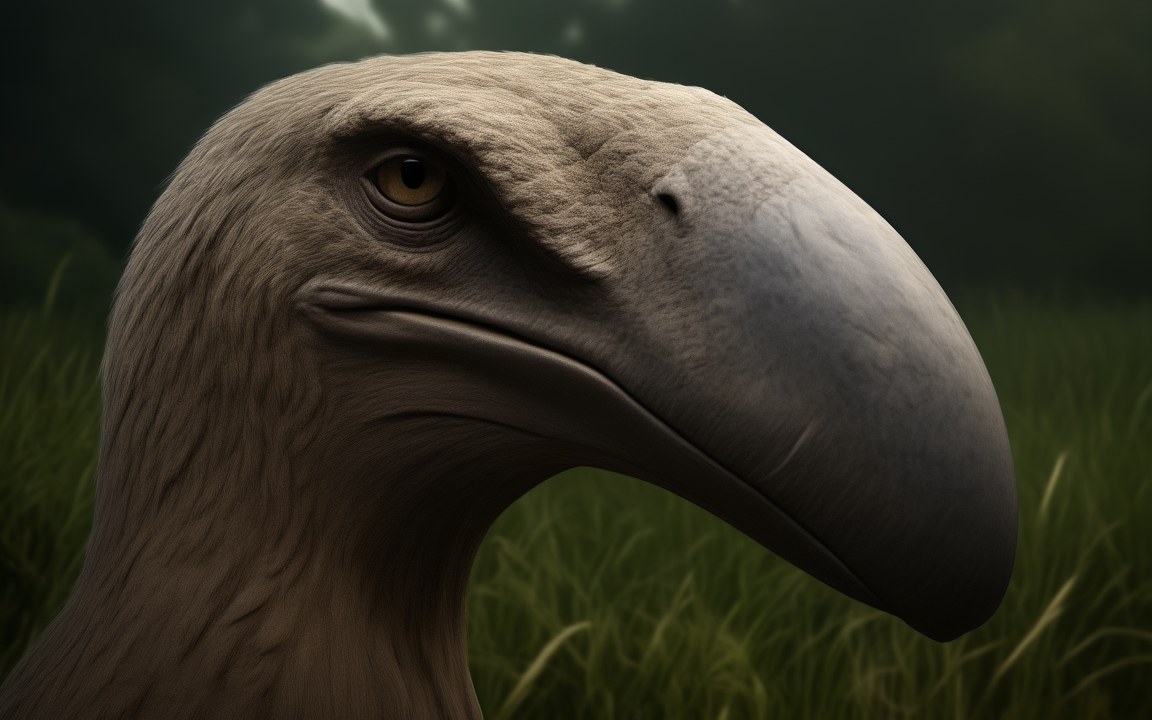
Terror bird skulls were tall and narrow, with the bones of the beak fused tightly together and a sharply hooked tip. Studies of the skull suggest it was poor at shaking prey from side to side but strong at striking downwards, again and again. Small animals were probably swallowed whole, larger ones killed with repeated blows.
The rest of the body was built for the chase: a flexible neck for striking, tiny arms with no working fingers, and long, slender legs with four toes. The second toe carried a large curved claw. Fossil footprints found in Argentina and described in 2023 show that a medium-sized terror bird of about 8 million years ago held this toe raised off the ground as it walked.
The giants
Kelenken, which lived in Patagonia about 15 million years ago, is known from a skull 716 mm long, found by a high-school student around 2004. The bird it belonged to probably stood about 3 m tall. In 2024 researchers described a leg bone from the Tatacoa Desert in Colombia, about 12 million years old, from a terror bird estimated at about 2.5 m and 156 kg. It is the most northerly record from South America, its describers suggest it may be the largest terror bird known, and the bone bears bite marks that a 2025 study attributed to a caiman.
One terror bird reached North America. Titanis walleri lived in Florida and Texas between about 5 and 1.8 million years ago, after its ancestors crossed from South America. A study published in 2024 found that gigantism evolved only once in the family, in a single branch, and that the different kinds rarely overlapped in size, as if they divided the food between them.
Why they disappeared
The giants were gone by about 1.8 million years ago. For a long time the favourite explanation was competition from mammal predators that crossed into South America over the new land bridge from the north, but the timing does not fit well and the idea is now largely discounted. A 2025 study of their bones points to environmental conditions instead. Humans played no part in the end of the giants, which disappeared more than a million and a half years before people reached the Americas.
Small terror birds lasted much longer. In 2026 researchers described Eschatornis, a terror bird of 6 kg or less whose leg bone, from the Toca dos Ossos cave in Bahia, was radiocarbon dated to about 25 500 years ago. That puts the last of the terror birds in the last Ice Age.
Mistaken for a mammal
The first terror bird to be named, Phorusrhacos, was described in 1887 by the Argentine palaeontologist Ameghino, who at first thought its jaw came from a toothless mammal. It took four more years for another researcher to recognise it as a bird. Their closest living relatives are the seriemas, long-legged birds about 80 cm tall that still stalk the grasslands of South America.