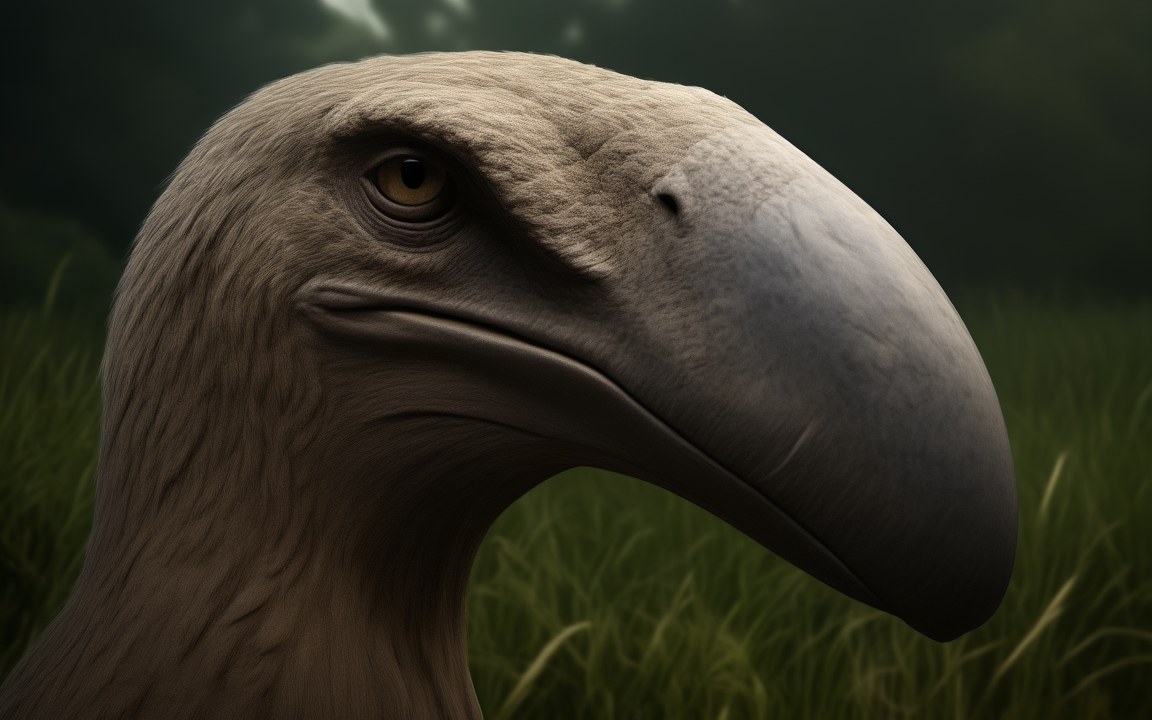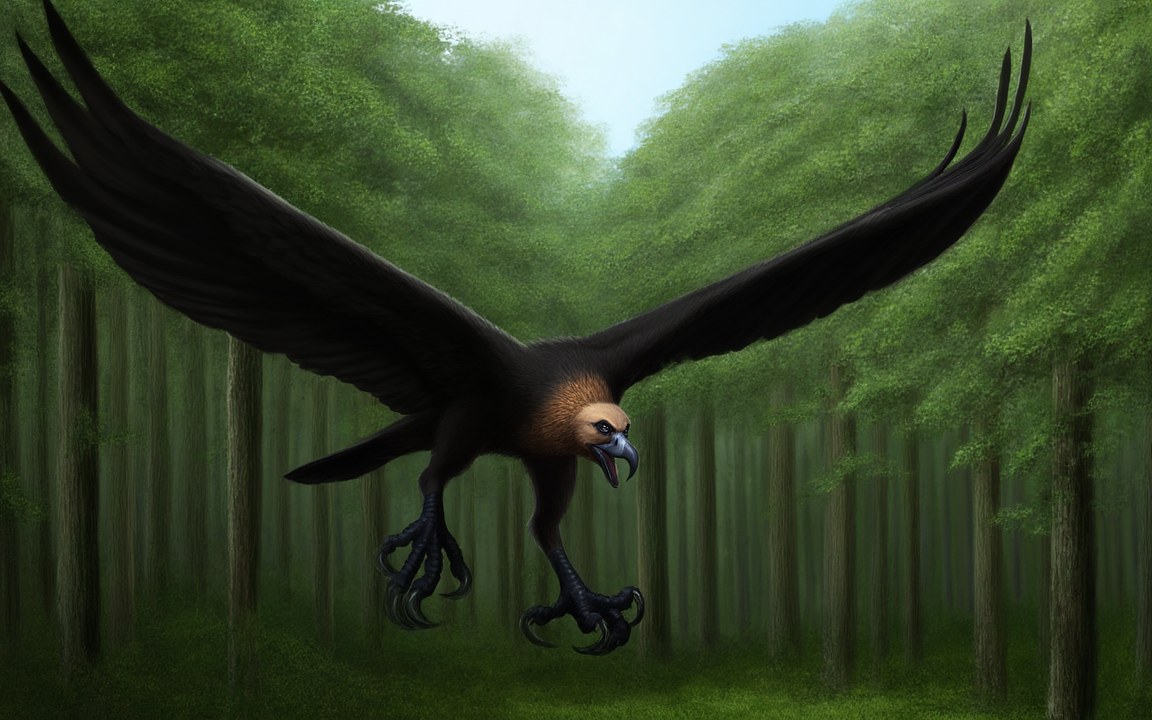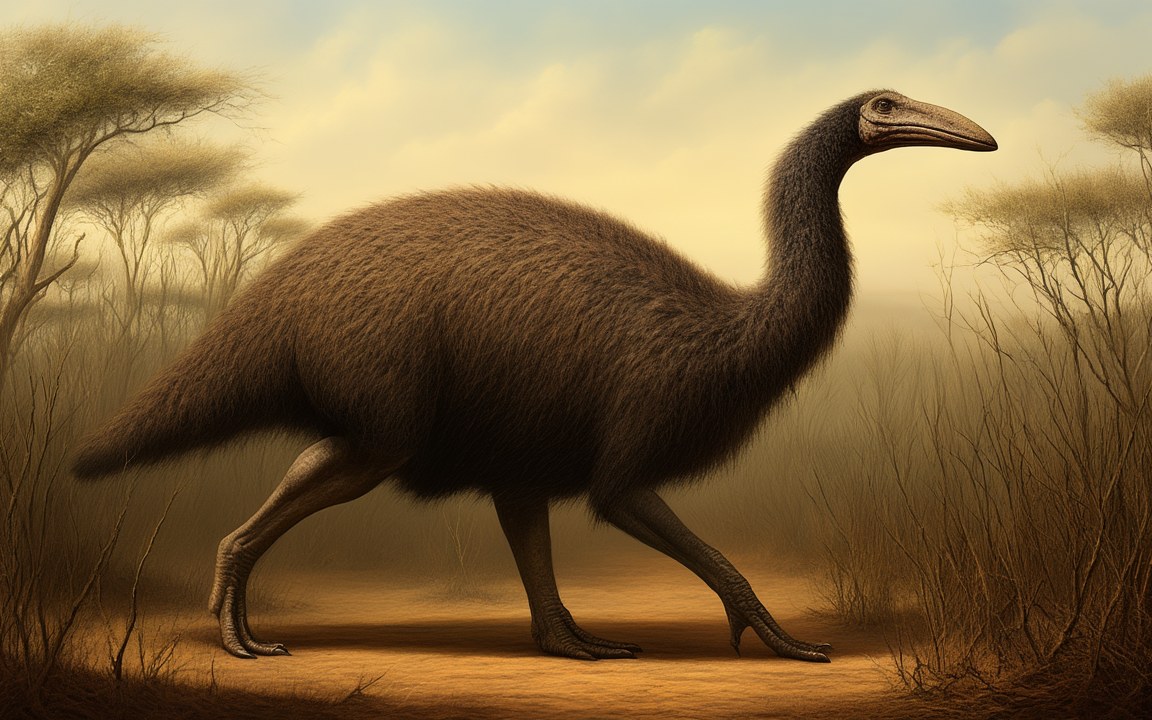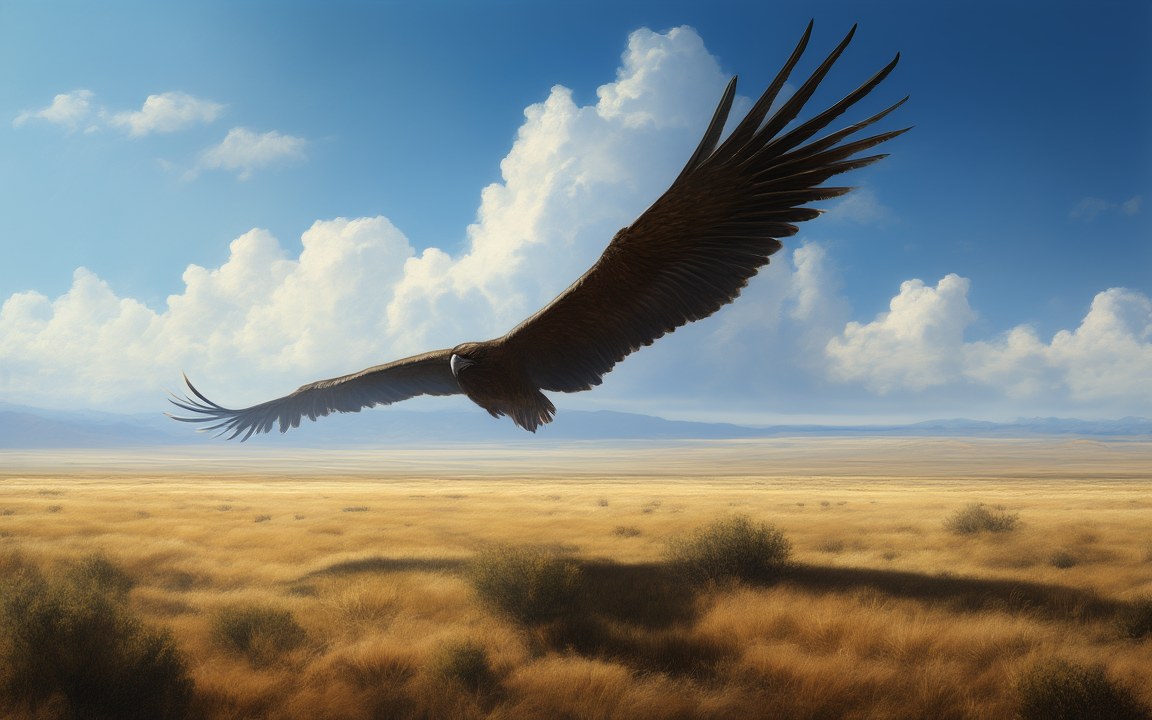
Argentavis magnificens was a giant bird of Argentina that lived about 9 to 6 million years ago, late in the Miocene. At about 70 kg it is the heaviest flying bird known, around six times the average weight of an Andean condor. Its wing bones still carry the marks where contour feathers attached, so there is little doubt that it flew, and it undid an older idea that condors, swans and bustards mark the size limit for flying birds. It belonged to the teratorns, an extinct family related to the New World vultures and condors.
A wingspan that keeps shrinking
No feathers survive and the wing bones are incomplete, so the span has to be estimated, and the figure has fallen over time. Campbell and Tonni first suggested 6.5 to 7.5 m in 1980, scaling from the smaller teratorn Teratornis merriami. Scaling from the California condor in 1983, they arrived at 5.7 to 6.4 m in most estimates, with one reaching 8.3 m, which Gayford and colleagues treated as an outlier in 2024.
In 2010 Mayr and Rubilar-Rogers put the wing skeleton at about 1.83 m, against 2.1 m for the bony-toothed bird Pelagornis chilensis, whose span they estimated at 5.2 to 6.1 m, and concluded that Argentavis probably had the smaller span unless its main flight feathers were much longer. Ksepka’s estimates in 2014 were 5.09 to 5.57 m by one method and 5.70 to 6.07 m by another. A span of about 5 to 6 m is now the usual figure: far wider than the 3.3 m of the largest Andean condors, but short of the 6.06 to 7.38 m that Ksepka gave for the much lighter Pelagornis sandersi.
Soaring because it had to
The fullest flight study is a 2007 computer model by Chatterjee, Templin and Campbell, which assumed a span of about 7 m, a wing area of about 8.11 m² and a mass of 70 kg, and its numbers depend on those assumptions. Level flapping flight would have needed at least 600 W, about 3.5 times the 170 W its muscles could supply. So it lived by gliding, at about 67 km/h and an angle close to 3 degrees, climbing in thermals over the plains and on wind pushed up the slopes of the Andes. Thermals big enough to use near the ground are about 100 m across. A 2022 modelling study by Goto and colleagues also concluded that it was a thermal soarer.
Take-off was the hard part. A running take-off from level ground was out of reach, but a short run down a 10-degree slope into a light headwind, or a launch from a perch, should have been enough.
Scavenger, thief or hunter
Teratorns have long beaks and wide gapes, more like eagles than vultures, and in theory Argentavis could swallow an animal the size of a hare whole. That has made them look like active predators to some authors. Their feet were no help in that: blunt, moderately curved claws could not hold prey the way a hawk’s talons do. A large claw bone once credited to Argentavis itself was reassigned to a terror bird in 2012.
In a study published in 2025, Torres Etchegorry and Degrange used CT scans of the type skull to reconstruct the brain. Its shape is condor-like and its smell centres are about the size of an Andean condor’s, but ridges linked to vision look more like those of hawks and falcons. They concluded that it was a scavenger, perhaps one that stole kills, finding food more by sight than by smell. Small terror birds may have been among the animals it robbed, and large ones were probably its main threat. The largest in its time, Devincenzia, weighed up to 350 kg.
A slow life, from a few broken bones
The evidence is thin. The type specimen, named in 1980, is a badly fractured partial skeleton found about 15 km south of Hidalgo station in La Pampa Province. A coracoid and a tibiotarsus from about 1 200 km to the north-west, in rocks dated to 6.02 and 6.68 million years, are the only other bones still assigned to it. From these and from living birds, Palmqvist and Vizcaíno calculated in 2003 what life a bird this large could lead: one or two eggs of about 1 kg every two years, young independent after some 16 months, adulthood at about twelve years, and a territory of more than 500 km². These are estimates from scaling, not observations.