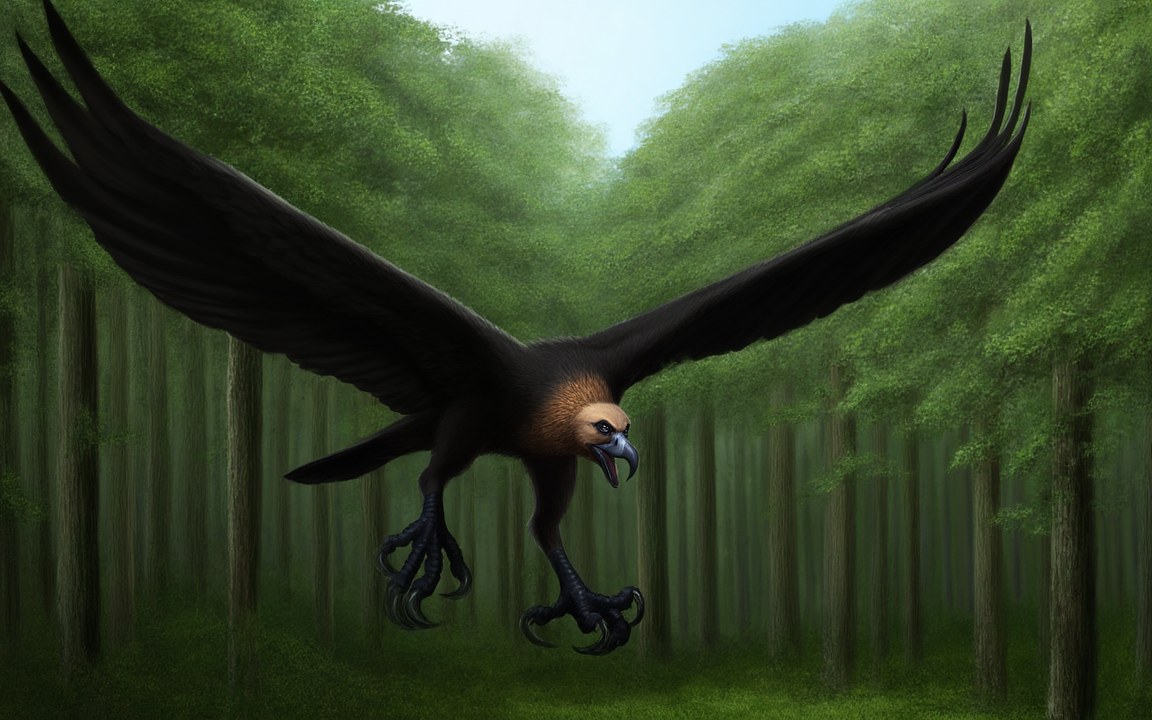
A huge blackish eagle with a tawny head swooping low between the tall trunks of a green forest, wings spread wide and its big black talons stretched forward, an impression of the extinct Haast's eagle of New Zealand.

Lost GiantsPleistocene

Haast's eagle

The largest eagle that ever lived, a hunter of giant moa in New Zealand's South Island

Gone about 600 years ago Reconstruction, not a photograph
Wingspan about 2.6 m possibly up to 3 m [3]
Weight females 10 to 18 kg males 9 to 12 kg; estimates vary by study [1]
Length up to 1.4 m in females, which were larger than males [2]
Talons up to 75 mm one estimate gives the hind claw up to 11 cm; Te Papa compares its claws to a tiger's [2]
Home South Island of New Zealand fossils at more than 50 sites, none on the North Island [3]
Prey moa up to about 15 times the eagle's own weight [1]
Extinct about 1400s soon after the moa it hunted [2]
Described 1871, by Haast from bones found by Fuller on the Glenmark Estate [1]
Closest living relative the little eagle of Australia and the booted eagle [1]

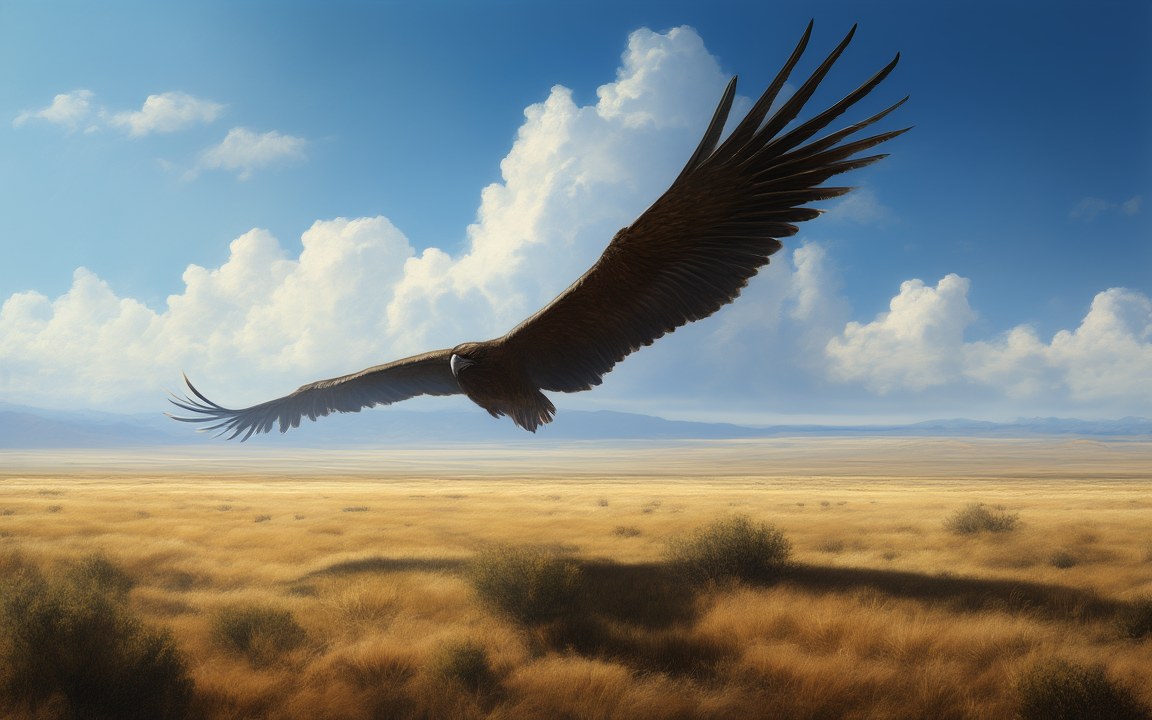
About the pictures. Three paintings show the eagle swooping through forest, perched on a mossy branch and gliding over dry shrubland. The heavy build, huge feet and long talons come from its bones. The dark body and paler head and neck follow Māori rock drawings thought to show it and a 2021 study that found its skull built like a condor's, which may mean a bare or thinly feathered head; these paintings give it short feathers instead. Its real plumage is not known. The paintings differ from one another in the colours of the body, eyes, beak and feet because all of these are guesses, and the forest and shrubland are imagined.

Haast’s eagle was the largest eagle that has ever lived. It hunted in the forests and shrublands of New Zealand’s South Island, and its prey was the moa, a flightless bird that could weigh many times as much as the eagle itself. It died out around 600 years ago, not long after people first arrived on the islands. Nobody drew it on paper while it lived, but Māori rock drawings are thought to show it, and stories may remember it.

Built to kill a moa

Females were the larger sex, weighing around 10 to 18 kg depending on whose estimate you follow, with wings spanning about 2.6 m and perhaps as much as 3 m. For a bird that heavy the wings were short and broad, an adaptation for flying fast between trees rather than soaring over open land. Its feet were enormous. The museum Te Papa compares its claws to a tiger’s, and the talons reached about 7.5 cm, with one estimate of up to 11 cm for the hind claw.

A study published in 2021 scanned its skull, beak and talons and compared them with living birds of prey. The beak and talons were eagle-like: it probably seized the moa with its talons and delivered the killing blow with its beak. But the skull was built more like that of an Andean condor, which feeds by pushing its head deep into a carcass. The researchers concluded that Haast’s eagle killed like an eagle and then ate like a condor, starting with the soft organs.

A bald head?

That condor-like feeding suggests a head that was bare or only thinly feathered, as it is in vultures. Māori rock art seems to agree. A drawing at Craigmore Station in South Canterbury, thought to show the eagle, has a black body with the head and neck left uncoloured, and Māori cave art near Timaru, in the same region, is also described as showing a pale head. Accounts written down in the late 1800s describe black feathers tinged with yellow or green and a bunch of red feathers on the head, but those come from oral tradition, not from any specimen. Its true colours are not known.

From small to giant

Ancient DNA has shown that its closest living relatives are not the big wedge-tailed eagles of Australia but two much smaller species, the little eagle and the booted eagle. A study in 2019 put the split from the little eagle at about 2.2 million years ago. In the time since, the ancestor that reached New Zealand grew into a giant.

The end of the eagle

Polynesian settlers reached New Zealand in the second half of the 13th century. Within about two hundred years they had hunted all the moa to extinction, and the eagle, which depended on them, disappeared too. Burning of the dry forest and shrubland may have hastened its end. Most fossils come from the drier east of the South Island, from more than 50 sites, and none has ever been found on the North Island.

Māori tradition remembers a giant bird, the pouākai, that could kill a person. Haast’s eagle is commonly taken to be that bird, but this cannot be proved, and some have doubted it because the eagle is not known from the North Island.

The eagle may yet get a new common name. In 2025 the biologist Holdaway, who coined the name “Haast’s eagle” in the early 1990s, proposed calling it “Fuller’s eagle” after the man who actually found the first bones, in a former marsh on the Glenmark Estate.
Where it sits in deep time

Haast's eagle: Gone about 600 years ago, in the Pleistocene.

Haast's eagle

Earth forms, 4.57 billion years agoToday

Each step to the right is ten times closer to today, so the last few million years get as much room as the first billion.

If Earth's history were one day

Squeeze all of Earth's history, about 4.6 billion years, into 24 hours, starting at midnight. Haast's eagle runs from 23:59:25.9 to 23:59:59.99, ending 0.01 seconds before midnight.

On this clock one second is about 52 862 years. All of written history fits into the last tenth of a second.

How big

Wingspan of Haast's eagle next to the height of a person.

Its wings were short for a bird of its weight, which helped it fly between trees.

Reconstructions

A huge blackish eagle with a tawny head swooping low between the tall trunks of a green forest, wings spread wide and its big black talons stretched forward, an impression of the extinct Haast's eagle of New Zealand. AI-generated painting.
A huge, dark eagle with a paler brown head and a heavy grey hooked beak perched on a mossy branch among ferns in a dim green forest, its big talons gripping the bark, an impression of Haast's eagle in a New Zealand forest. AI-generated painting.
A huge blackish eagle with a brown head and a heavy hooked beak gliding low over golden grassland and green shrubs, its broad wings spread wide with long, separated tip feathers and its big black talons hanging below, an impression of the extinct Haast's eagle of New Zealand. AI-generated painting.

Questions people ask

How big was Haast's eagle?

Females, the larger sex, weighed about 10 to 18 kg depending on the estimate, with a wingspan of about 2.6 m and possibly up to 3 m. That makes it the largest eagle known.

What did Haast's eagle eat?

Mainly moa, flightless birds that weighed up to about 15 times as much as the eagle. It may also have taken large geese, rails and ducks.

Did Haast's eagle attack humans?

Māori tradition tells of a giant bird, the pouākai, that killed people. Whether that bird was Haast's eagle is not certain, but New Zealand Birds Online says the eagle was large enough to attack children.

Why did Haast's eagle go extinct?

After Polynesian settlers reached New Zealand in the 13th century, the moa were hunted to extinction within about two centuries. Without them the eagle lost its prey, and burning of the dry forests and shrubland it lived in may have added to its decline.

What is its closest living relative?

Ancient DNA shows it was most closely related to the little eagle of Australia, a far smaller bird, and to the booted eagle.

Sources

  1. Wikipedia: Haast's eagle
  2. Szabo (2013), Haast's eagle, New Zealand Birds Online
  3. Te Papa: Haast's eagle
  4. Natural History Museum (2021), The world's largest eagle hunted unlike any other bird of prey
  5. Canterbury Museum (2021), Bald Haast's eagle feasted on moa guts
  6. van Heteren et al. (2021), New Zealand's extinct giant raptor killed like an eagle, ate like a condor, Proceedings of the Royal Society B 288, 20211913
  7. Holdaway (2021), Two new radiocarbon ages for Haast's eagle, Notornis 68, 278–282
  8. Bunce et al. (2005), Ancient DNA provides new insights into the evolutionary history of New Zealand's extinct giant eagle, PLOS Biology 3, e9
  9. Knapp et al. (2019), Mitogenomic evidence of close relationships between New Zealand's extinct giant raptors and small-sized Australian sister-taxa, Molecular Phylogenetics and Evolution 134, 122-128
  10. Holdaway (2025), The genus name for the extinct New Zealand Eagle and a suggested replacement for an inappropriate vernacular name, Bulletin of the British Ornithologists' Club 145, 406-410