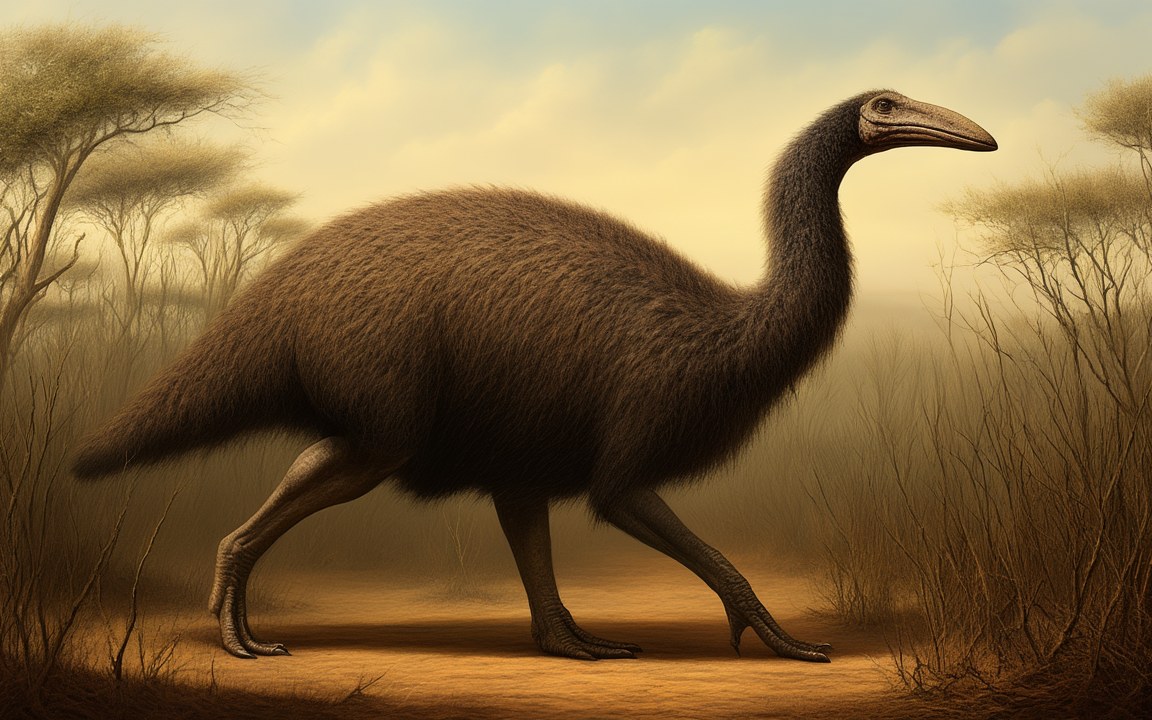
A huge, shaggy, dark brown flightless bird with thick legs, a long neck and a heavy bill walking through dry, thorny bush, an impression of Aepyornis, the giant elephant bird of Madagascar.

Lost GiantsPleistocene

Elephant bird

Flightless giants of Madagascar, relatives of the kiwi, with eggs that could weigh about 10 kg

From about 1.4 million years ago, when the Aepyornis lines split, to about 1 000 years ago Reconstruction, not a photograph
Lived until about AD 800 to 1050 by molecular clock the living lines of Aepyornis split about 1.4 million years ago, and Aepyornis split from Mullerornis about 30 million years ago; one dated bone is about 10 700 years old [1]
Height about 3 m the largest, standing upright [1]
Weight, from bones 536 to 732 kg for 'Vorombe' mean 642.9 kg; A. maximus mean 409.5 kg; one incomplete femur gives 860 kg [4]
Weight, from eggshell about 1 000 kg give or take 413 kg, for the bird that laid the thickest eggs [5]
Eggs 26 to 40 cm long, 5.6 to 13 litres the largest known for any amniote [1]
Egg weight about 10.5 kg shell 3.32 mm thick; Mullerornis eggs about 0.86 kg [5]
Species three or four four in three genera (Hansford and Turvey); Grealy and colleagues find no genetic support for Vorombe [5]
Closest living relatives kiwis the lines split about 54 million years ago, by molecular clock [1]
Diet plants mostly browsers; A. hildebrandti of the central highlands ate up to about 48 per cent grass [8]
Range Madagascar only from the far north to the far south; two whole eggs found in Western Australia are thought to have drifted there [1]

About the pictures. The walking bird in dry bush follows skeletons for its long neck, small head and heavy legs. Its bill curves down near the tip, where skulls show a straight, thick cone, and one foot has a spur, which the fossils do not show. The close view of a foot has three broad, blunt-nailed toes, following fossil toe bones. The single egg in a sand scrape takes its size and shape from the many known eggs. Feather colour and texture, the skin, the colour of the egg, the scrape, the plants and the light are all imagined.

Elephant birds were flightless giants found only on Madagascar, and they died out about a thousand years ago. The largest stood about 3 m tall with the head raised, and their eggs are the largest known from any bird, reptile or mammal. Their closest living relatives are the kiwis of New Zealand. The name refers only to size.

Who holds the record

Calling an elephant bird the largest bird ever rests on weights that differ by more than three times. From the girth of the thigh bone, Hansford and Turvey in 2018 calculated a mean of 409.5 kg for Aepyornis maximus and 642.9 kg for an even bigger form, with one incomplete femur reaching 860 kg, the largest known bird individual, they say. On comparable data the Australian thunderbird Dromornis averaged 583.6 kg for males. From eggshell, Grealy and colleagues estimated about 1 000 kg for the layer of the thickest eggs, with a margin of more than 400 kg. Hume and Walters gave A. maximus about 275 kg.

Hansford and Turvey warn that all these numbers lie outside the range of the living birds used to build the equation. Dromornis stirtoni remains a contender, and “possibly the largest” is as far as the evidence goes.

Aepyornis, and the short life of Vorombe

Geoffroy Saint-Hilaire described Aepyornis maximus in 1851 from bones and eggs, and 15 species had been named by 1934. Hansford and Turvey measured collections worldwide and cut the list to four species in three genera: Mullerornis modestus, Aepyornis hildebrandti, Aepyornis maximus and, for the largest bones, the new genus Vorombe, Malagasy for “big bird”, with the species name titan from Andrews in 1894.

DNA soon challenged that. Grealy and colleagues gathered more than 960 eggshell fragments from 291 localities and recovered 17 near-complete mitochondrial genomes. They found no genetic sign of a separate genus: one bone identified as probable Vorombe and one as probable A. maximus were identical at the gene compared. They suggest the two are one species with much larger females, as in kiwis, where females can reach 120 to 180 per cent the size of males. That would make the record-holder a female A. maximus. Sexing the bones with nuclear DNA is still needed to confirm it, though some authors already treat Vorombe as a synonym.

The same study argued that Mullerornis needs a family of its own and found a separate Aepyornis lineage in the far north, at about 230 kg.

Eggs that crossed an ocean

The eggs were 26 to 40 cm long and held 5.6 to 13 litres, about 160 times the volume of a hen’s egg. The thickest shells average 3.32 mm, and Grealy estimates such eggs weighed about 10.5 kg. Two whole eggs of A. maximus have turned up in dunes in Western Australia, thought to have floated there from Madagascar. In 1658 Flacourt, a French governor, wrote of an ostrich-like bird, the vouron patra, that laid eggs like an ostrich.

Such giant size may be recent: Grealy and colleagues estimate that the common ancestor of Aepyornis, about 1.4 million years ago, weighed about half as much as A. maximus.

A giant that may not have seen much

Aepyornis had a long neck, small head, straight conical bill, vestigial wings and very stout legs, with no sign of a fourth toe or spur. Torres and Clarke reconstructed their brains in 2018 and found very small optic lobes, almost absent in the larger species, like those of kiwis. That points to a nocturnal bird, perhaps blind. Large olfactory bulbs in A. maximus suggest a forest life guided by smell. Isotopes show mostly browsers, except A. hildebrandti of the central highlands, which ate up to about 48 per cent grass.

Cut marks and a sudden end

In 2018 Hansford and colleagues reported chop and cut marks on bones from Christmas River dated to 10 721 to 10 511 years ago, which would put people on Madagascar more than 6 000 years earlier than other evidence. The claim is controversial: the oldest securely dated evidence of people is from the middle of the first millennium AD.

Either way, people and elephant birds overlapped for centuries at least. A 2021 study with 30 new dates found that elephant birds and hippos persisted across much of Madagascar until about 1 200 to 900 years ago, then collapsed suddenly. The collapse matches the conversion of forest to grassland around 1 100 to 1 000 years ago, probably linked to a shift to farming and herding. Direct evidence of hunting is limited.
Where it sits in deep time

Elephant bird: From about 1.4 million years ago, when the Aepyornis lines split, to about 1 000 years ago, in the Pleistocene.

Elephant bird

Earth forms, 4.57 billion years agoToday

Each step to the right is ten times closer to today, so the last few million years get as much room as the first billion.

If Earth's history were one day

Squeeze all of Earth's history, about 4.6 billion years, into 24 hours, starting at midnight. Elephant bird runs from 23:59:33.5 to 23:59:59.98, ending 0.02 seconds before midnight.

On this clock one second is about 52 862 years. All of written history fits into the last tenth of a second.

How tall

Height of the largest elephant birds, standing upright with the head raised, next to a person.

Reconstructions

A huge, shaggy, dark brown flightless bird with thick legs, a long neck and a heavy bill walking through dry, thorny bush, an impression of Aepyornis, the giant elephant bird of Madagascar. AI-generated painting.
Close-up of a huge, scaly bird's foot with three thick toes ending in broad, blunt nails, standing on red sand among dry leaves, an impression of the foot of Aepyornis, the elephant bird of Madagascar. AI-generated painting.
A single huge, pale egg lying in a shallow scrape in red sand among low, thorny shrubs in evening light, an impression of an egg of Aepyornis, the elephant bird of Madagascar, many times larger than a hen's egg. AI-generated painting.

Questions people ask

Was the elephant bird the largest bird ever?

Possibly. Hansford and Turvey (2018) gave the largest form a mean of 642.9 kg and one femur 860 kg, above their comparable figure for the Australian thunderbird Dromornis. Grealy and colleagues (2023) reached about 1 000 kg from eggshell, with wide uncertainty. All such figures lie beyond the range of living birds.

What is the difference between Aepyornis and Vorombe?

Aepyornis is the genus named in 1851. Vorombe was created in 2018 for the largest bones. A 2023 eggshell DNA study found no genetic support for it and suggested that 'Vorombe titan' may simply be large females of Aepyornis maximus, which still needs testing.

How big was an elephant bird egg?

Between 26 and 40 cm long and 19 and 25 cm wide, holding 5.6 to 13 litres, about 160 times the volume of a hen's egg. The heaviest are estimated at about 10.5 kg. They are the largest eggs known for any amniote.

Is the elephant bird related to the kiwi?

Yes. Ancient DNA shows the kiwis of New Zealand are its closest living relatives, even though the lines split about 54 million years ago and a kiwi is the size of a chicken.

When and why did elephant birds go extinct?

Around AD 800 to 1050, together with Madagascar's hippos. A 2021 study found that they collapsed suddenly as forests were converted to grassland, probably as people shifted to farming and herding. Direct evidence of hunting is limited.
Was the elephant bird the roc of legend?

The idea that Marco Polo's roc was based on elephant birds was popular in the late 19th century, but it is disputed. Elephant birds could not fly, and the name refers only to their size.

Sources

  1. Wikipedia: Elephant bird
  2. Wikipedia: Aepyornis
  3. Wikipedia: Dromornis
  4. Hansford & Turvey (2018), Unexpected diversity within the extinct elephant birds (Aves: Aepyornithidae) and a new identity for the world's largest bird, Royal Society Open Science 5, 181295
  5. Grealy et al. (2023), Molecular exploration of fossil eggshell uncovers hidden lineage of giant extinct bird, Nature Communications 14, 914
  6. Hansford et al. (2018), Early Holocene human presence in Madagascar evidenced by exploitation of avian megafauna, Science Advances 4, eaat6925
  7. Hansford et al. (2021), Simultaneous extinction of Madagascar's megaherbivores correlates with late Holocene human-caused landscape transformation, Quaternary Science Reviews 263, 106996
  8. Hansford & Turvey (2022), Dietary isotopes of Madagascar's extinct megafauna reveal Holocene browsing and grazing guilds, Biology Letters 18, 20220094
  9. University of Texas at Austin (2018), Biggest bird may have been blind (on Torres & Clarke, Proceedings of the Royal Society B)