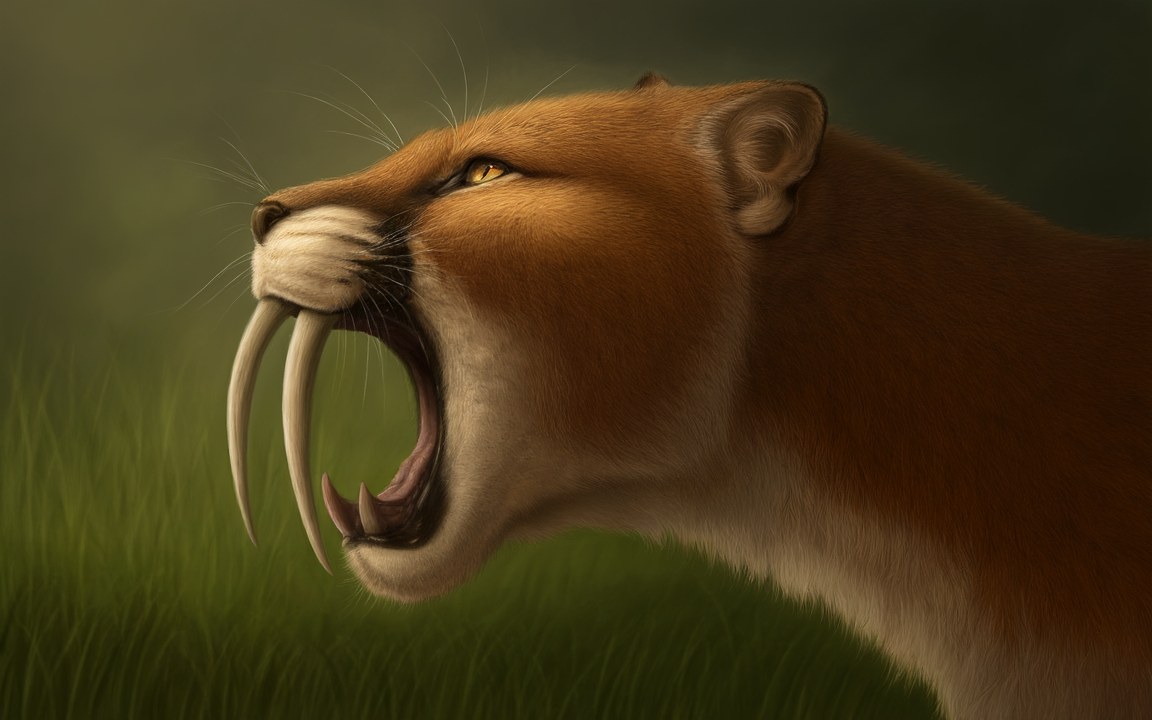
Lived about 2.5 million to 10 000 years ago the latest record is about 8 200 years old [1] Species three S. gracilis, S. fatalis and S. populator [1] Weight, S. fatalis 160 to 280 kg about lion-sized but more robust [2] Weight, S. populator 220 to 360 kg very large individuals probably over 400 kg [2] Sabres up to about 28 cm flattened, finely serrated, visible with the mouth closed [1] Gape possibly over 110° a lion's is about 65°; a 2020 study gives about 82° to 89° for two species [1] La Brea Tar Pits more than 2 000 individuals of S. fatalis, in Los Angeles [3] Named 1842, by Lund from fossils found in Brazil [1] Relatives not tigers its line split from living cats about 20 million years ago [1] About the pictures. Two paintings built on skeletons: a close-up with the jaws at full gape, and a cat walking straight towards the viewer through tall grass, carrying the heavy build the bones show, with its short tail out of sight. The long, flattened upper canines show even with the mouth closed, as a 2022 study concluded they did. No skin or hair of Smilodon is known, so the plain tawny coat with its pale throat is a guess; it may just as well have been spotted.
Smilodon is the cat most people mean when they say “sabre-toothed tiger”, although it was not a tiger at all. It belonged to an extinct branch of the cat family whose ancestors split from those of today’s cats about 20 million years ago. Its upper canines grew up to about 28 cm long, so long that they showed below the lip even when its mouth was shut, and its jaw may have opened more than 110 degrees. It hunted across the Americas for more than two million years and died out at the end of the last Ice Age.
Three kinds of sabre-tooth
There were three species. The earliest, Smilodon gracilis, lived from about 2.5 million to 500 000 years ago and was about the size of a jaguar. Smilodon fatalis, the best-known, lived mainly in North America and was about as large as a lion but more robust, at 160 to 280 kg. The biggest was Smilodon populator of eastern South America, which stood about 1.2 m at the shoulder and weighed 220 to 360 kg, with some individuals probably over 400 kg. All three had short tails and enormously strong forelimbs.
How the sabres worked
A lion opens its jaws to about 65 degrees. Smilodon may have managed more than 110, though a 2020 study gives about 82 to 89 for two of the species; either way it was enough to clear the long canines and drive them into prey. The teeth were flattened from side to side and finely serrated, more like blades than spikes. It probably held its prey down with those powerful forelimbs and killed with a stabbing, slicing bite of the canines. A 2025 study of sabre-toothed predators found that extreme sabres like these pierced flesh with very little force but broke more easily, which fits the older view that the cat had to restrain its victim before biting.
Growing such teeth took time. Young Smilodon kept their milk canines beside the growing sabres for up to 30 months, and a 2024 study found that the baby tooth braced the new one against bending. An adult with fully grown sabres was at least three years old.
Lessons from the tar pits
More than 2 000 Smilodon fatalis have been dug out of the La Brea Tar Pits in Los Angeles, making it the second most common large animal found there. Several of the skeletons have healed injuries, which some researchers take as a sign that injured cats were helped by others in a group, though that reading is disputed. A 2023 study found joint defects in 6 per cent of 834 thigh bones and suggested inbreeding as the species neared extinction, while noting that other causes are possible.
Chemical traces in the bones show what they ate. At La Brea one study found mostly bison and camels, another found more forest prey such as tapir and deer. In the Pampas of South America, Smilodon populator hunted ground sloths, horses and Macrauchenia.
The end
Smilodon disappeared between about 13 000 and 9 000 years ago, along with most of the large animals it fed on; the latest known record is about 8 200 years old. At La Brea, a study published in 2023 used 172 new radiocarbon dates to show that it and six other large species were gone by about 12 900 years ago. The main driver there was a series of large fires in a warming and drying landscape, possibly set off by people as their impact grew.
Where it sits in deep time
Smilodon: About 2.5 million to 10 000 years ago, in the Pleistocene.
Smilodon
1 billion100 million10 million1 million100 00010 0001 000
Earth forms, 4.57 billion years agoToday
Each step to the right is ten times closer to today, so the last few million years get as much room as the first billion.
If Earth's history were one day
Squeeze all of Earth's history, about 4.6 billion years, into 24 hours, starting at midnight. Smilodon runs from 23:59:12.7 to 23:59:59.81, ending 0.19 seconds before midnight.
On this clock one second is about 52 862 years. All of written history fits into the last tenth of a second.
The last minute, enlarged
23:59:00midnight How big
Shoulder height of the two largest Smilodon species next to a person.
- Smilodon populator 1.2 m
- Smilodon fatalis 1 m
- Person, for scale 1.7 m
Questions people ask
How big was Smilodon?
Smilodon fatalis of North America stood about 1 m at the shoulder and weighed 160 to 280 kg, about the size of a lion but more heavily built. Smilodon populator of South America stood about 1.2 m and weighed 220 to 360 kg, with some individuals probably over 400 kg.
How long were Smilodon's teeth?
The upper canines reached about 28 cm in Smilodon populator. They were flattened from side to side, finely serrated, and long enough to show even when the mouth was closed.
Is Smilodon a sabre-toothed tiger?
It is a cat, but not a tiger. It belonged to an extinct branch of the cat family, the machairodonts, which split from the ancestors of living cats about 20 million years ago.
Why did Smilodon go extinct?
It disappeared between about 13 000 and 9 000 years ago, together with most of the large animals it hunted. At the La Brea Tar Pits it vanished by about 12 900 years ago, and a 2023 study linked that to large fires in a warming, drying landscape, possibly started by people.
What colour was Smilodon?
Nobody knows. No skin or hair has been found, and both plain and spotted coats are possible.
Sources
- Wikipedia: Smilodon
- Christiansen & Harris (2005), Body size of Smilodon (Mammalia: Felidae), Journal of Morphology 266, 369–384
- Natural History Museum of Los Angeles County (2021), Tar Pits fossil count
- O'Keefe et al. (2023), Pre–Younger Dryas megafaunal extirpation at Rancho La Brea linked to fire-driven state shift, Science 381
- Schmökel, Farrell & Balisi (2023), Subchondral defects resembling osteochondrosis dissecans in joint surfaces of the extinct saber-toothed cat Smilodon fatalis and dire wolf Aenocyon dirus, PLOS ONE 18, e0287656
- UC Berkeley (2024), The double-fanged adolescence of saber-toothed cats (Tseng, The Anatomical Record)
- Monash Lens (2025), Why sabre-toothed predators evolved their deadly teeth (Pollock et al., Current Biology)