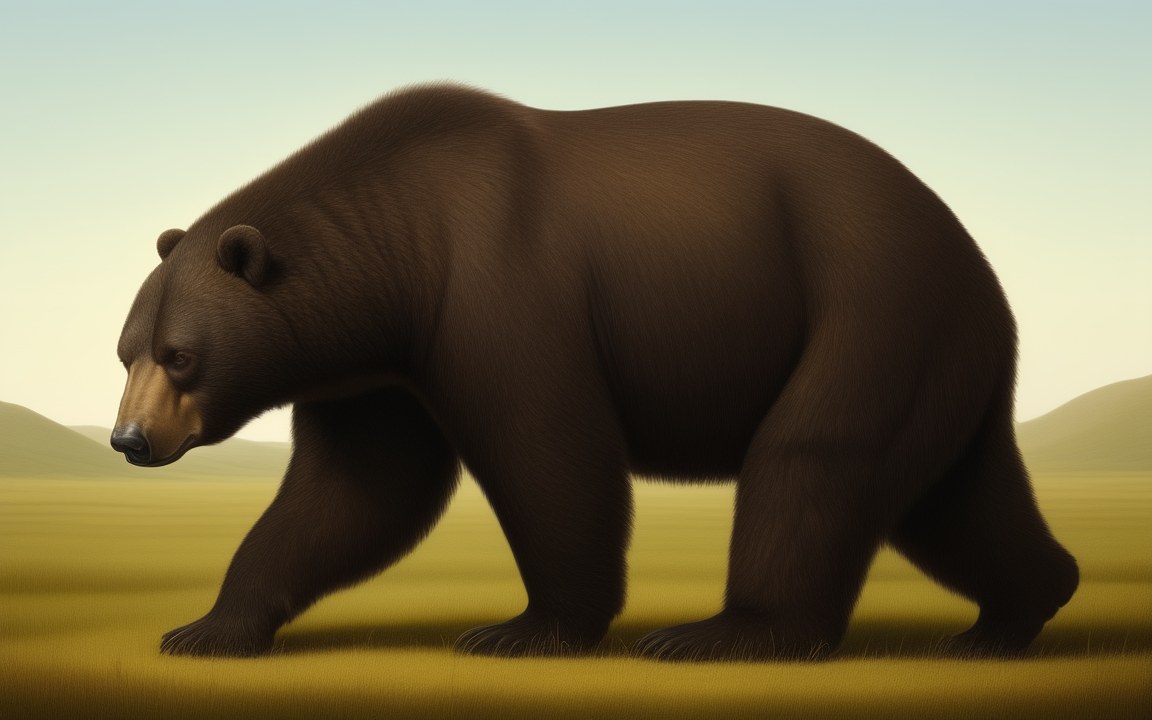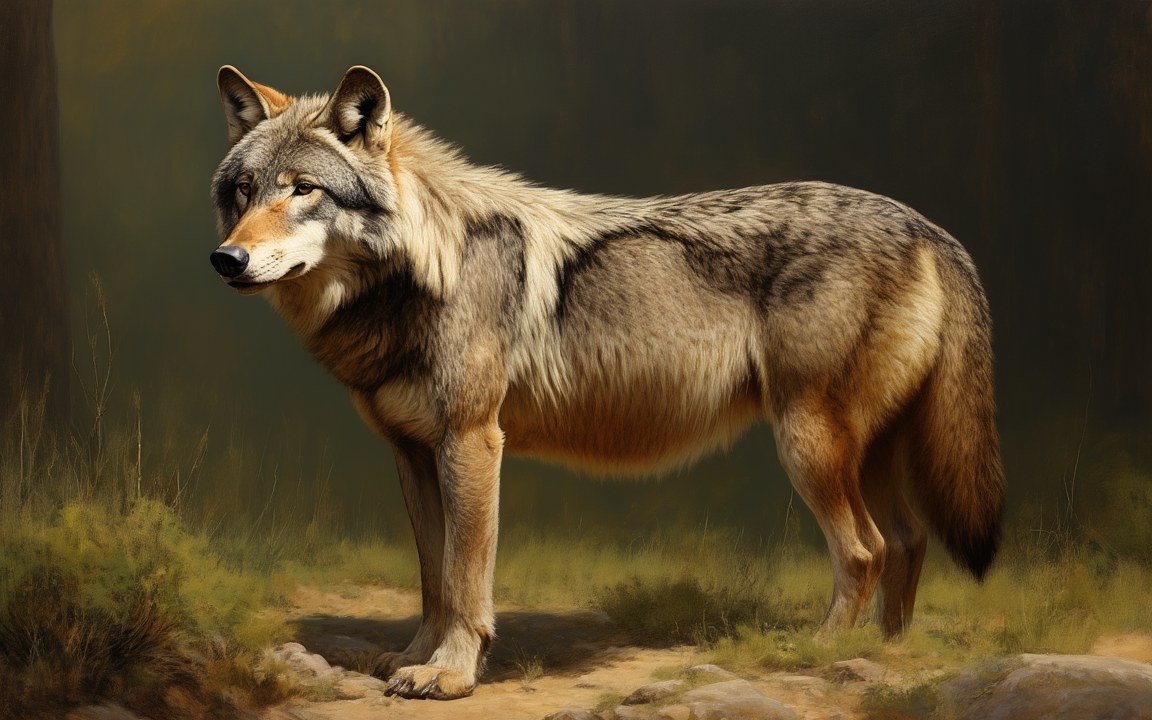
A large, heavily built grey-brown wolf standing calmly in profile at the edge of a shadowy woodland, its mouth closed and its ears pricked, an impression of a dire wolf.

Lost GiantsPleistocene

Dire wolf

The real Ice Age hunter behind the legend, and not quite a wolf at all

About 125 000 to 10 000 years ago Reconstruction, not a photograph
Lived about 125 000 to 10 000 years ago possible older fossils about 250 000 years old [1]
Weight about 60 to 68 kg on average probably never more than about 110 kg [1]
Skull 31 cm long or more with larger, more shearing teeth than a grey wolf [1]
Bite 163 newtons per kg of body against 136 for a grey wolf [1]
Range North and South America south to Bolivia and Chile [1]
Most fossils California, Florida and the Ozarks north as far as Medicine Hat, Alberta [4]
La Brea Tar Pits more than 4 000 individuals the most common large animal found there [11]
Named 1858, by Leidy from a jaw found on the Ohio River in 1854 [1]
Lineage split about 5.7 million years ago from the line leading to grey wolves and coyotes, by a 2021 study; a 2026 study led by Colossal says about 4.5 million [2]
Extinct about 10 000 years ago going by its youngest dated remains [1]

About the pictures. Four scenes painted from skeletons: a lone animal at the edge of a wood, a pack of six crossing open grassland, one beside a black asphalt seep of the kind that trapped so many at La Brea, and a close portrait of the head. The bones give a build close to a large grey wolf's; the heavier skull and bigger teeth barely show, so these animals look much like ordinary wolves. No hair or skin of a dire wolf is known, so the grey-brown coat is a guess, as are the plants and the light. The white coats of the gene-edited wolves announced in 2025 were engineered. The company behind them reports genes for a light coat in dire wolf DNA, which these paintings do not follow.

The dire wolf was real. Long before it became famous from fantasy novels and television, it hunted across the Americas, from Alberta in Canada to Bolivia and Chile, and it died out about 10 000 years ago. Its bones turn up in great numbers: more than 4 000 dire wolves have been pulled from the La Brea Tar Pits in Los Angeles alone. In 2025 it was in the news again, when a company announced it had brought the species back. It had not.

Not quite a wolf

For more than a century the dire wolf was thought to be a close cousin of the grey wolf, a bigger, heavier version of the same animal. Ancient DNA changed that. A 2021 study found that its lineage had split from the one leading to grey wolves and coyotes about 5.7 million years ago, and it saw no sign of interbreeding with either, even after they reached North America. The researchers revived an old genus name for it, Aenocyon, meaning “terrible dog”. On this reading its wolf-like shape is convergent evolution: two separate lines arriving at the same design for the same job.

A later genome study with much better coverage, led by scientists at the company Colossal Biosciences and published in 2026, argued instead for a mixed ancestry: about 60 per cent from the side of the family that includes wolves and coyotes and about 40 per cent from the line of South American canids, with a split about 4.5 million years ago. Its figures differ between versions of the paper, and most of its authors work for the company or its partners.

A heavyweight hunter

A dire wolf had a body shaped much like a large northern grey wolf, but a broader, heavier skull that could reach 31 cm or more, bigger teeth with more shearing power, and a stronger bite for its size. Average weights were about 60 to 68 kg, and the bones suggest none weighed more than about 110 kg. It was not much longer than a big modern wolf, but it was more heavily built.

Its fossils are concentrated in California, Florida and the Ozarks, and it was rare north of about 42 degrees latitude. Its prey is thought to have included horses, bison, camels, ground sloths and peccaries, and at La Brea chemical traces in its bones point mainly to young bison and camels. Like grey wolves, it probably hunted in packs. A 2025 study of finds from Iowa used protein fingerprints to confirm their identity and compared their chemistry with Smilodon from the same region: the two big predators seem not to have competed closely for the same prey there.

Gone with the big game

Dire wolves vanished at the end of the last Ice Age, along with most of the large animals they hunted. At La Brea, a 2023 study dated their disappearance, and that of six other large species, to about 12 900 years ago, after large fires in a warming and drying landscape. Elsewhere they lasted a little longer. Climate change, the loss of big prey and competition, perhaps with grey wolves and human hunters, are all thought to have played a part.

The 2025 “dire wolves”

In April 2025 Colossal Biosciences announced three pups, Romulus, Remus and Khaleesi, which it called dire wolves. They were grey wolves with 20 edits in 14 genes, chosen after studying ancient dire wolf DNA from a 13 000-year-old tooth and a 72 000-year-old ear bone. No ancient DNA was put into them. One of the edits gave them white fur. The company says dire wolves carried genes for a light coat, a claim that no surviving hair can test.

Independent scientists were blunt. The IUCN’s specialist group on wild dogs concluded that the pups are neither dire wolves nor valid stand-ins for them, and that the project does nothing for conservation. A month later Colossal’s own chief scientist described them as grey wolves with 20 edits and called “dire wolf” a colloquial name. The real dire wolf remains extinct, known only from its bones.
Where it sits in deep time

Dire wolf: About 125 000 to 10 000 years ago, in the Pleistocene.

Dire wolf

Earth forms, 4.57 billion years agoToday

Each step to the right is ten times closer to today, so the last few million years get as much room as the first billion.

If Earth's history were one day

Squeeze all of Earth's history, about 4.6 billion years, into 24 hours, starting at midnight. Dire wolf runs from 23:59:57.6 to 23:59:59.81, ending 0.19 seconds before midnight.

On this clock one second is about 52 862 years. All of written history fits into the last tenth of a second.

Reconstructions

A large, heavily built grey-brown wolf standing calmly in profile at the edge of a shadowy woodland, its mouth closed and its ears pricked, an impression of a dire wolf. AI-generated painting.
A pack of six large grey-brown wolves trotting in a line across a golden grassy plain at sunset, a herd of bison far away on the horizon, an impression of Ice Age dire wolves. AI-generated painting.
A large grey-brown wolf standing in profile at the edge of a black, glistening pool with leaves floating on it, misty conifers and green grass behind, an impression of a dire wolf at an asphalt seep in Ice Age Los Angeles. AI-generated painting.
Close-up of the head of a grey-brown wolf in profile, with amber eyes, upright ears and a closed mouth, against blurred golden grassland, an impression of a dire wolf. AI-generated painting.

Questions people ask

How big was a dire wolf?

On average about 60 to 68 kg, with a body shaped much like a large northern grey wolf but a bigger, heavier skull and a stronger bite. The bones suggest no dire wolf weighed more than about 110 kg.

Were dire wolves real?

Yes. They lived across the Americas until about 10 000 years ago, and more than 4 000 of them have been dug out of the La Brea Tar Pits in Los Angeles alone.

Did Colossal bring back the dire wolf?

No. In 2025 the company Colossal Biosciences announced three pups that were grey wolves with 20 edits in 14 genes, and no ancient DNA was inserted. The IUCN's specialist group on wild dogs concluded that they are neither dire wolves nor valid stand-ins, and Colossal's own chief scientist later described them as grey wolves with 20 edits.

Is the dire wolf related to the grey wolf?

Less closely than its looks suggest, though how closely is argued. A 2021 study of ancient DNA found that the dire wolf's lineage split from the one leading to grey wolves and coyotes about 5.7 million years ago, with no sign of interbreeding, and put its resemblance to wolves down to convergent evolution. A 2026 study led by Colossal Biosciences argues for a mixed ancestry and a split about 4.5 million years ago.

Why did dire wolves go extinct?

They disappeared by about 10 000 years ago, as most of the large animals they hunted vanished at the end of the Ice Age. Climate change and competition, possibly with grey wolves and human hunters, may have played a part.

Sources

  1. Wikipedia: Dire wolf
  2. Scientific American (2021), Dire wolves were not really wolves, new genetic clues reveal (Perri et al., Nature 591)
  3. Natural History Museum of Los Angeles County, The dire wolf: an Ice Age Angeleno
  4. Hill et al. (2025), An update on Aenocyon dirus in the interior of North America, PeerJ 13, e19219
  5. O'Keefe et al. (2023), Pre–Younger Dryas megafaunal extirpation at Rancho La Brea linked to fire-driven state shift, Science 381
  6. Colossal Biosciences (2025), Colossal Biosciences brings back the dire wolf: inside the de-extinction of Romulus, Remus, and Khaleesi (company page)
  7. Science News (2025), The story of dire wolves goes beyond de-extinction
  8. Gedman et al. (2025), On the ancestry and evolution of the extinct dire wolf, bioRxiv preprint
  9. Gedman et al. (2026), On the ancestry and evolution of the extinct dire wolf, Cell Genomics 6, 101306
  10. Zimmer (2025), Scientists revive the dire wolf, or something close, The New York Times
  11. Natural History Museum of Los Angeles County (2021), Tar Pits fossil count