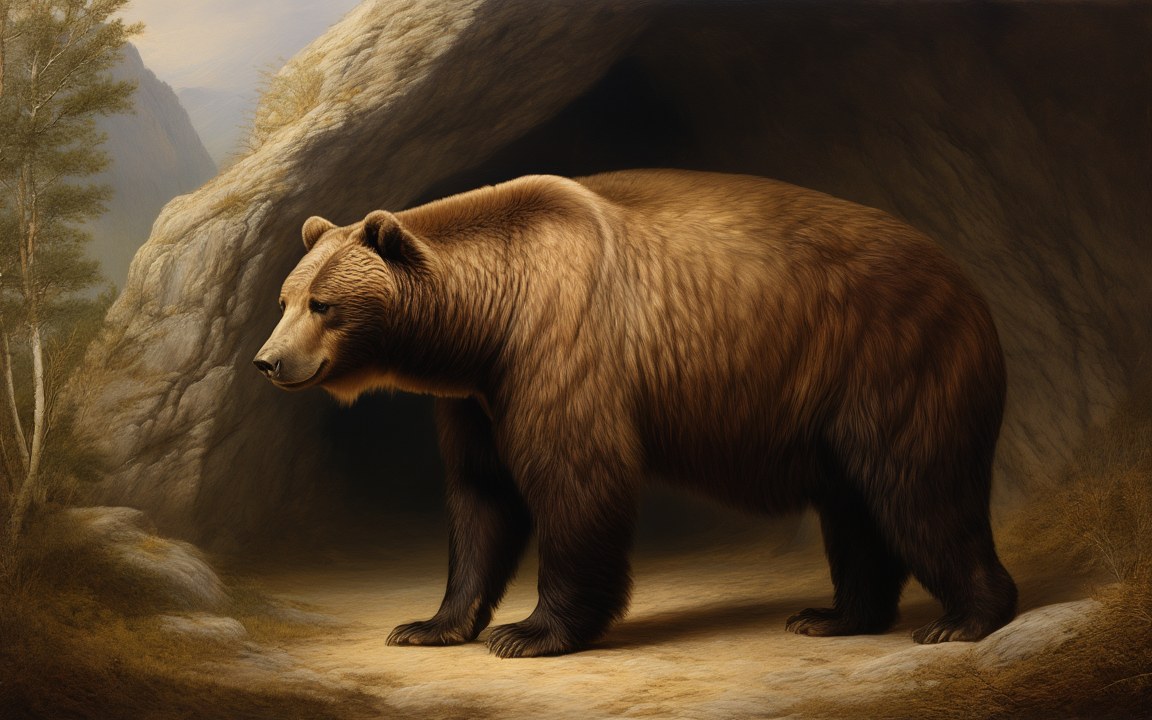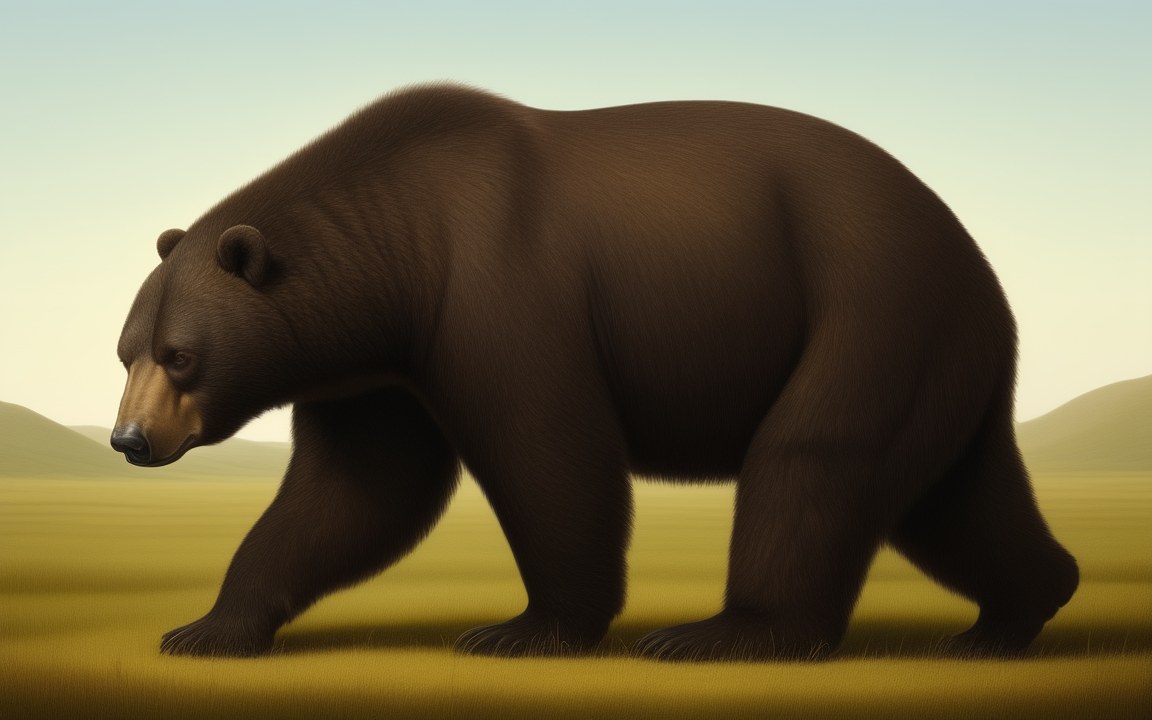
Some individuals of the giant short-faced bear, Arctodus simus, may have been the largest land-dwelling members of the order Carnivora that ever lived in North America. The biggest males stood 1.67 m at the shoulder, tall enough to look a person in the eye, and the species ranged from Alaska and the Yukon to Mexico until about 12 800 years ago. For decades it was drawn as a long-legged, running super-predator. Research since 2010 has taken most of that image apart, including the short face in its name.
How big, and why the numbers disagree
On its hind legs it stood about 2.4 to 3.4 m, with an arm reach of up to 4.3 m. Weight is harder to pin down. A 1999 limb-bone study by Christiansen gave a mean of about 770 kg for large males. In 2010 Figueirido and colleagues estimated six specimens: three at 740 to 957 kg and three under 500 kg, the lightest at 317 kg. A 2006 study capped the species at about 555 kg from the largest known skull, while others have speculated about males of 1 000 to 1 200 kg. A species average of about 625 kg is often quoted.
Much of the spread has a simple cause: males could be twice the size of females. In 1967 Kurtén proposed that large and small bears were two subspecies, but a 2025 DNA study led by Salis, with 31 mitochondrial genomes, found no support for that. All seven large specimens it could sex were male, and all four small ones female.
It was still not the largest bear ever. Soibelzon and Schubert gave that title in 2011 to a South American relative, Arctotherium angustidens, from an old, injured male in Buenos Aires Province, likely 1 588 to 1 749 kg.
A face and legs that mislead
The 2010 study’s title ends “the ‘short-faced’ long-legged and predaceous bear that never was”. The face only looks short: the snout is deep and the nasal bones are short, so the face is deeper, not shorter, than in most living bears. The leggy look, the authors argued, comes largely from a short back and torso, since all bears are long-limbed under their fur and bulk. Others measure proportionally longer limb bones, though still stouter than a big cat’s.
Kurtén pictured a “running bear” that chased down horses and saiga. Its mass, stiff spine and flat-footed gait would have handicapped any such chase. Matheus proposed instead that the long limbs served efficient travel over great distances. Fossil trackways near Lakeview, Oregon, show long claws and front paws slightly larger than the hind, and one print from White Sands, New Mexico, measures 15 cm long and 19 cm wide.
What it really ate
Earlier ideas cast it as a hunter of big game, or as a specialised scavenger that drove other predators from their kills. Its teeth fit neither well. The carnassials are built for crushing and grinding, not shearing, and specimens from La Brea lack the wear of bone-crackers. Fossil dung from South Dakota and the Yukon contains juniper seeds.
It did eat meat, as nitrogen isotopes show, and large males may have eaten more of it. Figueirido’s team summed the animal up as “a colossal omnivore whose diet probably included varying amounts of meat”. Its closest living relative, the spectacled bear, is itself mostly vegetarian.
Gone from the north first
In Alaska and the Yukon, every dated fossil falls between about 50 000 and 23 000 years ago, which is why its disappearance from Beringia is usually put at about 23 000 years ago. Salis and colleagues, citing older work, give about 20 000 years. Either way, it never came back, and it apparently never reached Asia.
South of the ice it lasted thousands of years longer. The most reliable last date, about 12 800 years, comes from Huntington Dam in Utah. A vertebra from Bonner Springs in Kansas gives the same age, though another laboratory dated it younger, and a date of about 12 700 years from Friesenhahn Cave in Texas rests on degraded collagen.
The cause is unsettled. Proposals include the loss of large herbivores, poorer plant food as the climate shifted, competition with brown bears and people, and low genetic diversity. People certainly met the bear: trackways appear to cross at White Sands, and at Lubbock Lake in Texas, Clovis people butchered one about 13 000 years ago. There is no clear sign, though, that they drove it to extinction.