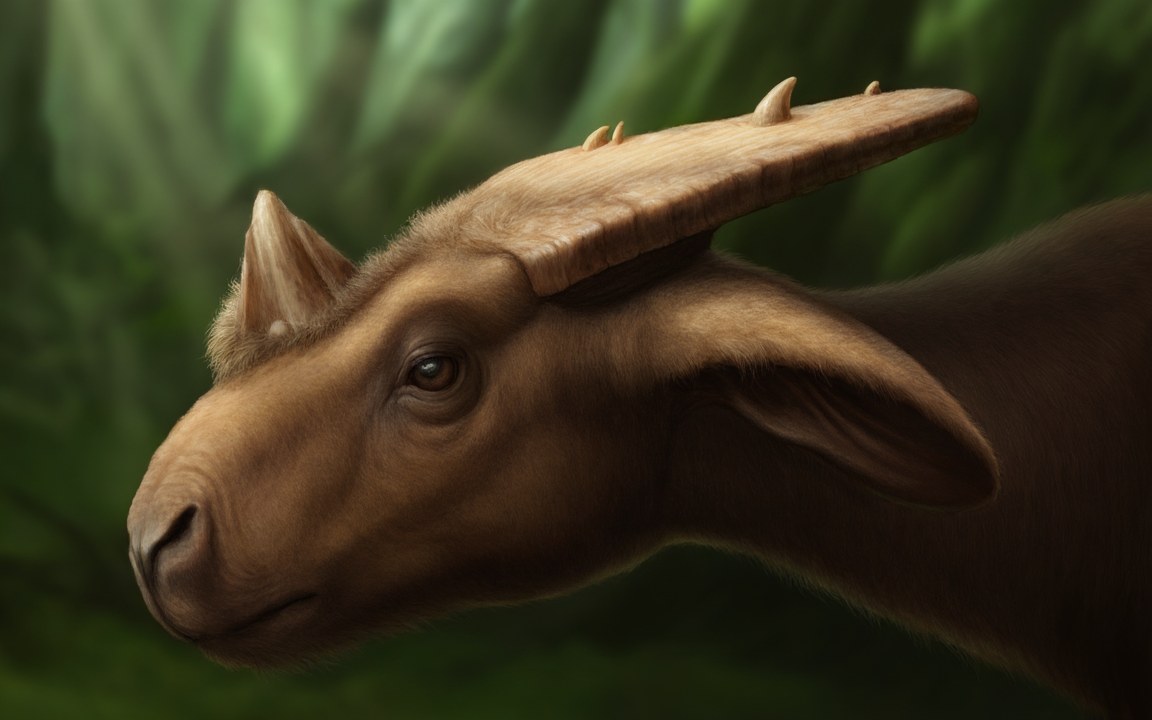
Sivatherium was a giraffid, a relative of the giraffe and okapi, that resembled a far larger and heavier okapi. It lived from about 7 million to about 1 million years ago in Africa and Asia, with a relatively short neck, short, thick lower legs and two pairs of ossicones on a huge, flat-faced skull. A 2016 study suggested it may have been the largest ruminant mammal that has ever existed. Early humans were cutting up its carcasses at Olduvai Gorge about 1.3 million years ago.
Weighing an animal without a ribcage
Falconer and Cautley named Sivatherium in 1836, from fossils found in the Himalayan foothills that are now in the Natural History Museum in London. The collection has no ribcage or pelvis and lacks most of the backbone behind the neck, so the animal’s weight has always been an estimate. Earlier calculations from individual bones ran from 1 230 to 3 720 kg, a threefold difference, while an older figure repeated online, 400 to 500 kg, sits far below all of them.
In 2016 Basu, Falkingham and Hutchinson turned 26 of the London bones, from at least three animals, into three-dimensional models and built a digital skeleton, modelling the missing torso from a giraffe. A hull fitted closely around that skeleton gave 1 246 kg, with a range of 857 to 1 812 kg. Other methods in the same paper gave 1 101 kg, 1 966 kg from the chest and 3 053 kg from the thickness of the upper arm bone, which shows how much the answer depends on the method.
The authors are clear about the limit: it did not weigh as much as an adult African or even Asian elephant, and an African elephant can pass 6 500 kg. Their total leaves out the large ossicones of the males, and they say it probably sits at the lower end of the range for the species. A report on the study gives about 1.8 m at the shoulder for the model, although the paper itself gives no height, and older accounts give 2.2 m at the shoulder and 3 m overall.
Ossicones, not antlers
The structures on its head are often called horns or antlers, but they were ossicones: bone with a permanent covering of skin and fur, the same kind of structure a giraffe has. Sivatherium carried two pairs. A wide, flattened pair at the back of the head reached about 70 cm, and a smaller pair sat above the eyes. Basu and colleagues describe the large appendages as exclusive to males.
Lifting such a skull took very powerful shoulders to support the neck muscles. That heavy, robust build led early scholars astray: Sivatherium was at first taken for a link between ruminants and the “pachyderms”, an abandoned grouping of elephants, rhinoceroses, hippopotamuses and tapirs.
A wide range and a flexible diet
Fossils have turned up in India and Pakistan, across Africa from Morocco, Tunisia and Chad to Malawi and South Africa, and as far apart as Spain and Kazakhstan. The diet seems to have been flexible. The teeth of S. hendeyi, from the Early Pliocene of South Africa, are low-crowned but higher than a giraffe’s, and it is best classed as a mixed feeder. In Morocco, a 2023 study of tooth wear and isotopes found that S. maurusium fed mainly on C3 vegetation, plants that do best with moderate light and warmth and plenty of water. New giraffid fossils from Pakistan have been read as a sign of mixed woodland in the Miocene Siwaliks.
Bones of S. hendeyi from Langebaanweg in South Africa show repeated interruptions in growth, which Jannello and Chinsamy link to stress from droughts, fires or floods.
Cut marks at Olduvai
At Olduvai Gorge in Tanzania, Sivatherium remains about 1.3 to 1.35 million years old carry cut marks and lie with stone tools. Domínguez-Rodrigo and colleagues cite the thorough exploitation of a complete carcass at the site of BK and of another at TK. The butchers were probably Homo erectus. The marks show that people cut the animals up, but they do not by themselves show how the animals died.
Claims of a much later meeting have not held up. Figurines from Sumer and rock paintings in the Sahara and central India have been suggested as images of Sivatherium, but it died out long before modern humans, and the images probably show other animals. It disappeared around 1 million years ago, in the late Early Pleistocene. The fossil record shows when, but not why.