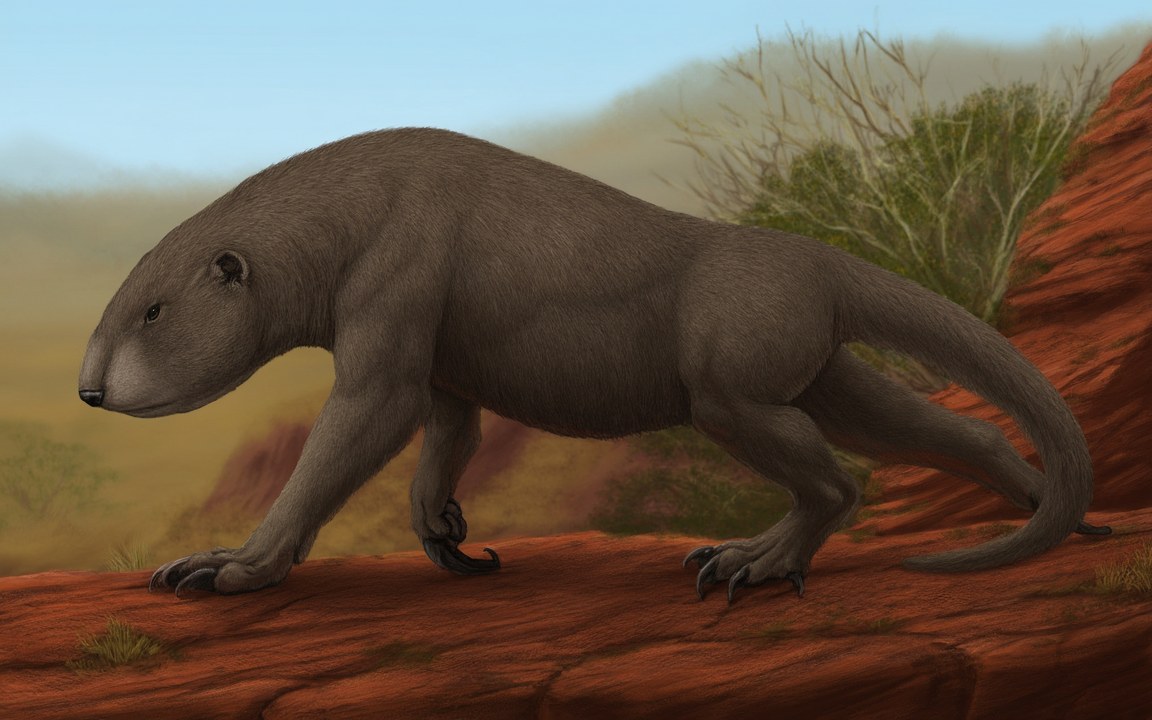
A stocky, muscular grey-brown predator with a short, blunt face, large curved claws and a long, thick tail walking along a red rock ledge in dry scrub, an impression of Thylacoleo, the marsupial predator of Ice Age Australia.

Lost GiantsPleistocene

Thylacoleo

A predator descended from plant-eaters, with blade-like cheek teeth, a hooked thumb claw and a long tail to brace on

About 2 million to 40 000 years ago Reconstruction, not a photograph
Lived until about 40 000 years ago a top predator for nearly 2 million years; last known records 35 000 to 45 000 years old [10]
Length about 1.5 m, head to tail 75 cm at the shoulder [2]
Weight about 101 to 130 kg on average the largest 128 to 164 kg; the Australian Museum gives 90 to 160 kg [1]
Bite about 1 692 N at the front teeth modelled for a 109 kg animal; a 295 kg lion scored 1 768 N in the same study [4]
Cheek teeth long shearing third premolars relatively larger than in any other mammalian carnivore [4]
Thumb claw hooked, on a semi-opposable thumb no more than 28 mm long, by the estimate of Wroe and Sansalone [5]
Tail almost half the length of the backbone 49 per cent in the most complete skeleton; probably used as a brace [6]
Closest living relatives koalas and wombats a 2025 collagen study favours the koala [12]
Range all Australian states and the Northern Territory western and Tasmanian animals were smaller than eastern ones [2]
Named 1859, by Owen from a skull found at Lake Colongulac, Victoria; the name means 'pouch lion' [1]

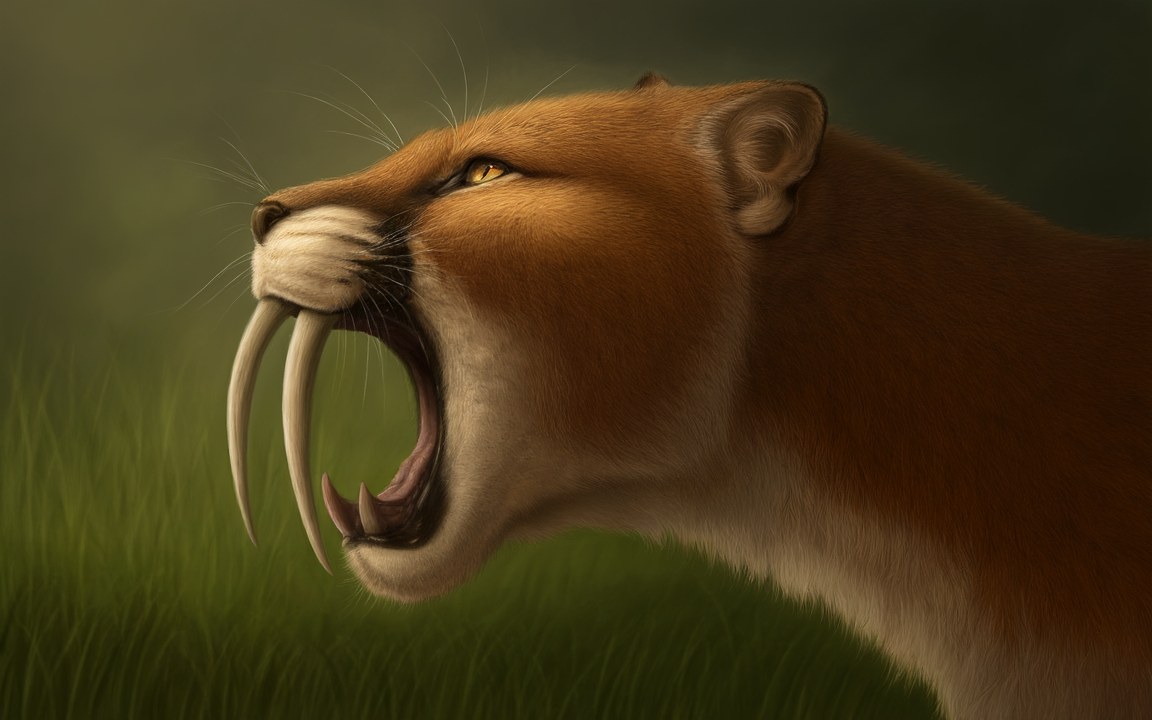
About the pictures. The stocky build, strong forelimbs and long, thick tail follow skeletons from Naracoorte and the Nullarbor, which gave the first complete tail. The four paintings show it on a rock ledge, asleep on a branch, the head in close-up, and a dark outline at dusk. Sleeping in a tree is imagined: it could climb, but no one has proposed it as a habitual tree dweller. Fossils show one large hooked claw, on the thumb, with small claws on the other fingers, where the ledge and branch scenes give long claws to every toe. The real tail was thicker than the one in the dusk outline, and its upright ears are a guess. Mouths are closed, so the teeth do not show. Coat colour and faces are guesses.

Thylacoleo carnifex, the marsupial lion, was the largest meat-eating mammal known from Australia, approaching the weight of a lioness. It was no lion. Its ancestors ate plants, its closest living relatives are koalas and wombats, and it had almost no canine teeth. It lived across the whole continent, was a top predator for nearly 2 million years, and disappeared about 40 000 years ago.

A carnivore from a family of leaf-eaters

Owen named it in 1859 from a damaged skull and called it among the most destructive of predators. Few agreed. Its skull and teeth were laid out like those of koalas and wombats, so Flower took it for a plant-eater, and it was later credited with diets of crocodile eggs, carrion, cycad nuts and native cucumbers. Broom answered that an animal with no grinding teeth could not have lived on plants. Skeletons found since 1966 have settled it as a specialist meat-eater. Its family tree is still moving: a 2025 collagen study placed it closer to the koala than to anything else sampled, a result its authors call a novel hypothesis.

Blades instead of fangs

The true canines were stubby. In their place the first incisors grew large, the lower pair lying almost horizontal, and the third premolars became long shearing blades, relatively larger than the cheek teeth of any other mammalian carnivore. In a 2005 model by Wroe and colleagues, a 109 kg Thylacoleo bit with about 1 692 N at the front of the jaw, close to the 1 768 N of a 295 kg lion. For its size that was the highest of any large predator studied. A 2018 university summary is lower, at about 80 per cent of a large lion, and all these figures are calculated from skulls, not measured.

How it used the teeth is disputed. The Australian Museum describes stabbing incisors. Janis argued that the upper incisors wore blunt and met tip to tip, so they could grip skin but not pierce it. The blades may have opened wounds, or the jaws may have delivered a crushing or suffocating throat bite.

The thumb

Each hand had a semi-opposable thumb bearing a hooked claw in a sheath, on an arm whose elbow combined weight-bearing with wide rotation of the forearm, a mix not seen in living placental carnivores. The Australian Museum suggests the claw may have disembowelled prey. Wroe and Sansalone are sceptical: they put it at no more than 28 mm, too short to kill large animals, and say it looks big mainly because the other finger claws were small. Janis still judged Thylacoleo able to bring down prey larger than itself, hunting alone. A Diprotodon forearm bone from near Glen Innes, New South Wales, has blade-like tooth marks, which could mean predation or scavenging.

Claw marks in the dark

Tight Entrance Cave in south-western Australia shows how it moved. It used the cave off and on between about 140 000 and 51 000 years ago, and thousands of claw marks cover steep rock faces up to 3.3 m high. Most seem to come from young animals, and Arman and Prideaux concluded in 2016 that marsupial lions climbed well and raised their young in caves. A near-complete skeleton from Moree, New South Wales, fits: an adult female found with a pouch baby and an older juvenile. Of more than 10 000 bones in the cave, few if any carry its tooth marks.

In 2018 Wells and Camens described the first complete tail, almost half the length of the backbone, and a rigid lower back. They compared the build to a Tasmanian devil’s and pictured a stealth hunter and scavenger that braced on its tail to free its forelimbs. No one has proposed it as a habitual tree dweller.

A forest hunter in a drying land

Among its youngest reliably dated fossils are bones from South Walker Creek in Queensland, 40 100 ± 1 700 years old, from the same deposit as the last megalania and Diprotodon. Tooth chemistry offers the most specific account of its end. A study led by DeSantis, presented at a conference in 2018, found from 35 samples from eastern Australia that it hunted mainly in forests rather than open country, which suits an ambush predator. Australia began drying about 350 000 years ago, and on this reading the hunter lost its cover as forests thinned, outlasting the arrival of people but not the climate. Others read the habitat differently: Nullarbor finds suggest open, arid country, and the role of people remains debated. Whether people painted it is contested too. Akerman and Willing reported a striped animal in Kimberley rock art as Thylacoleo in 2009, while Welch and Lewis conclude such figures are probably thylacines.
Where it sits in deep time

Thylacoleo: About 2 million to 40 000 years ago, in the Pleistocene.

Thylacoleo

Earth forms, 4.57 billion years agoToday

Each step to the right is ten times closer to today, so the last few million years get as much room as the first billion.

If Earth's history were one day

Squeeze all of Earth's history, about 4.6 billion years, into 24 hours, starting at midnight. Thylacoleo runs from 23:59:22.2 to 23:59:59.24, ending 0.76 seconds before midnight.

On this clock one second is about 52 862 years. All of written history fits into the last tenth of a second.

How big

Head-to-tail length and shoulder height of Thylacoleo carnifex next to a person.

Reconstructions

A stocky, muscular grey-brown predator with a short, blunt face, large curved claws and a long, thick tail walking along a red rock ledge in dry scrub, an impression of Thylacoleo, the marsupial predator of Ice Age Australia. AI-generated painting.
A heavily built grey-brown predator with huge curved claws and a thick tail lying asleep along a thick branch in a green forest, an impression of Thylacoleo, the marsupial predator of Ice Age Australia, resting in a tree. AI-generated painting.
Close-up of a broad, wedge-shaped grey-brown head with a dark nose, a small eye and small rounded ears against dry scrub, an impression of the head of Thylacoleo, the marsupial predator of Ice Age Australia. AI-generated painting.
The dark outline of a stocky predator with a long tail walking past a wall of rounded boulders under a purple evening sky, an impression of Thylacoleo at dusk in Ice Age Australia. AI-generated painting.

Questions people ask

How big was the marsupial lion?

About 1.5 m long from head to tail and 75 cm at the shoulder, according to the Australian Museum. It averaged about 101 to 130 kg, close to the weight of a lioness, and the largest animals may have reached about 160 kg.

Was the marsupial lion related to lions?

No. It was a marsupial whose closest living relatives are koalas and wombats, and its ancestors ate plants. The name Thylacoleo means 'pouch lion' and refers only to its superficial likeness and its role as a large predator.

Did the marsupial lion have the strongest bite of any mammal?

For its body size it had the highest bite force of any large predator in a 2005 study by Wroe and colleagues. In absolute terms a big lion still bit harder: the model gave 1 692 N for a 109 kg Thylacoleo and 1 768 N for a 295 kg lion.

Could Thylacoleo climb trees?

Very probably. Thousands of claw marks on steep rock in Tight Entrance Cave show that it climbed well, and its skeleton suits climbing. No one has proposed that it lived in trees as a habit, however, and the 'drop bear' of Australian tall tales has no link to it.

What did the marsupial lion eat?

Meat. It had no grinding teeth for plants, and few if any of more than 10 000 bones in one of its caves carry its tooth marks, which suggests it ate flesh and left bone. Likely prey includes large kangaroos and possibly Diprotodon, and it probably scavenged as well.

Why did the marsupial lion go extinct?

It died out about 40 000 years ago, but the cause is debated. A study led by DeSantis, presented at a conference in 2018, concluded that it hunted mainly in forests and declined as Australia dried. The role of people, who arrived about 50 000 to 60 000 years ago, is unresolved.

Sources

  1. Wikipedia: Thylacoleo
  2. Australian Museum: Thylacoleo carnifex
  3. Australian Museum: Diprotodon optatum (tooth marks on the Glen Innes bone)
  4. Wroe, McHenry & Thomason (2005), Bite club: comparative bite force in big biting mammals and the prediction of predatory behaviour in fossil taxa, Proceedings of the Royal Society B 272, 619–625
  5. Janis (2024), Who was the real sabertooth predator: Thylacosmilus or Thylacoleo?, The Anatomical Record 308, 2896–2912
  6. Wells & Camens (2018), New skeletal material sheds light on the palaeobiology of the Pleistocene marsupial carnivore, Thylacoleo carnifex, PLoS ONE 13, e0208020
  7. Flinders University (2018), Marsupial lion 'similar to Tassie devil'
  8. Arman & Prideaux (2016), Behaviour of the Pleistocene marsupial lion deduced from claw marks in a southwestern Australian cave, Scientific Reports 6, 21372
  9. Black (2016), Giant flesh-eating koala of legend was real, National Geographic
  10. UNSW Sydney (2018), Climate change the likely killer of Australian marsupial lion (on the study led by DeSantis)
  11. Dvorsky (2018), New clues may explain why this fearsome marsupial lion disappeared from Australia, Gizmodo
  12. Buckley et al. (2025), Collagen fingerprinting and sequence analysis provides a molecular phylogeny of extinct Australian megafauna, Proceedings of the Royal Society B 292, 20250856
  13. Hocknull et al. (2020), Extinction of eastern Sahul megafauna coincides with sustained environmental deterioration, Nature Communications 11, 2250
  14. Akerman (2009), Interaction between humans and megafauna depicted in Australian rock art?, Antiquity project gallery
  15. Lewis (2016), Comment on Welch's 'Thy Thylacoleo is a thylacine', Australian Archaeology