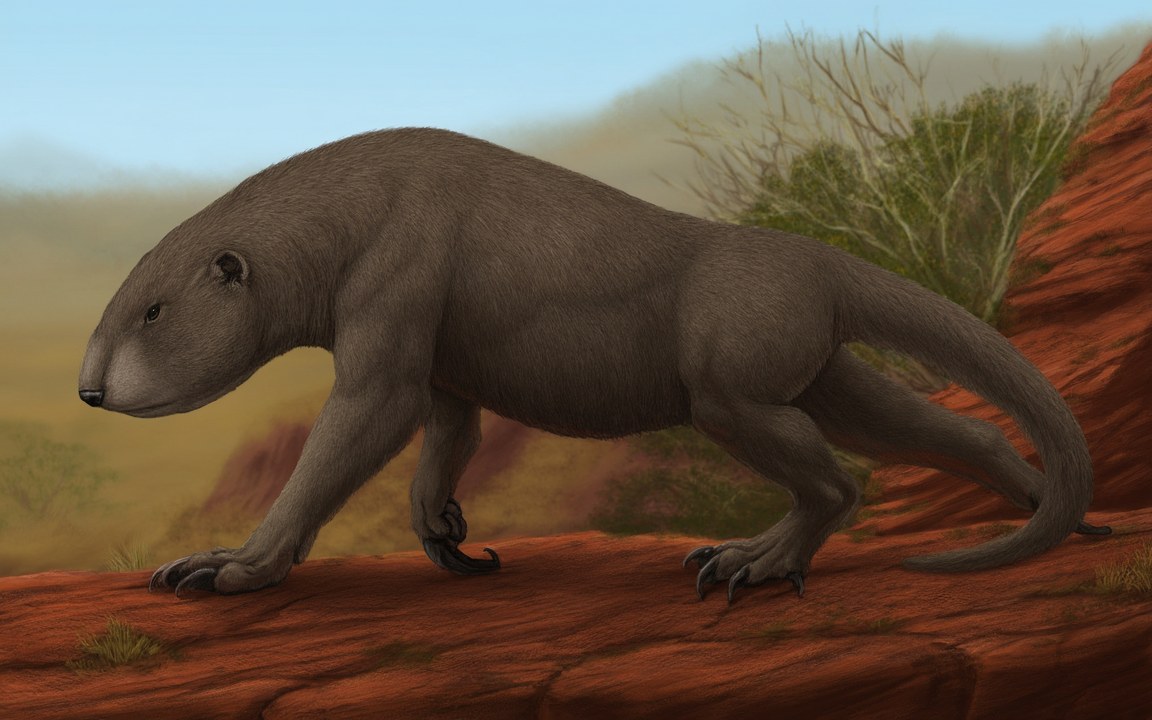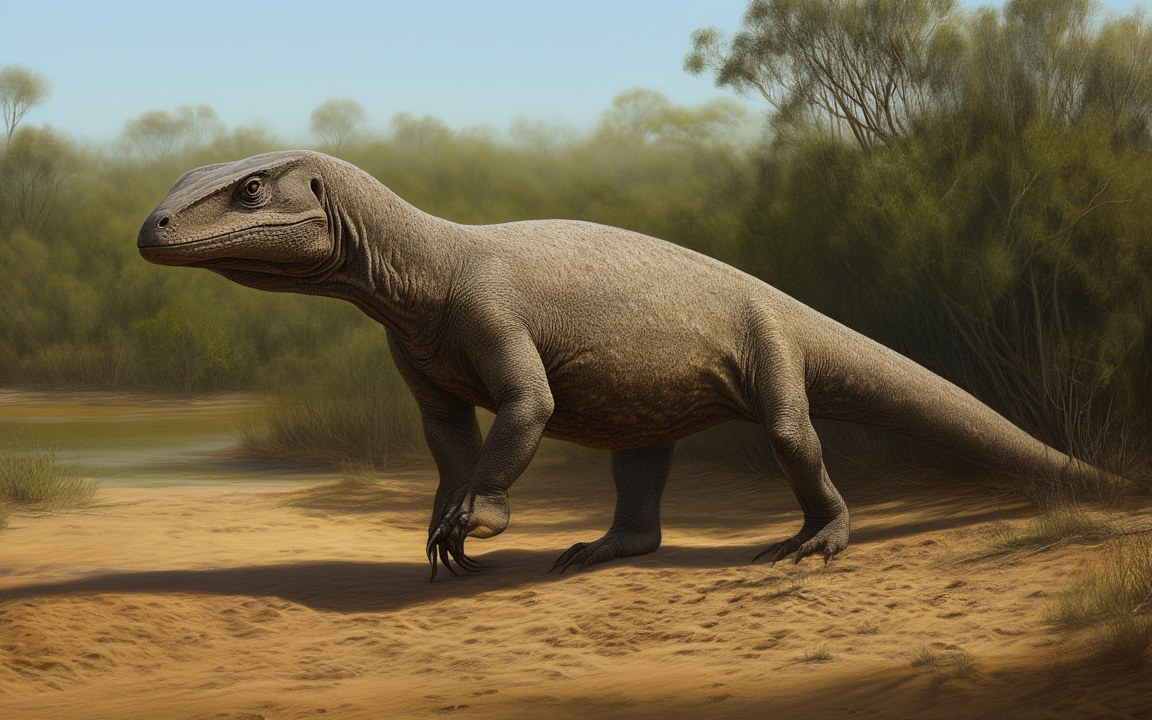
Megalania was a giant monitor lizard from eastern Australia, the largest land lizard known, which lived from about 1.5 million years ago until at least about 40 000 years ago. Scientists now call it Varanus priscus, because its bones belong in the same genus as living monitors, and “megalania” survives as a common name. No complete skeleton or intact skull has been found, so almost every popular figure for it, length above all, needs care.
A length that keeps changing
Owen named it in 1859 from three vertebrae and worked out a length of 20 feet, about 6 m, from snout to tail. Later estimates for the largest animals reached 7 m and 600 to 620 kg, and museum skeletons looked like Komodo dragons pumped up to almost 6 m. In 2002 Wroe pushed back. He argued that most size figures for fossil reptiles are maximums, which mislead for animals that keep growing, and proposed an average of 3.45 m and 97 to 158 kg, with a maximum of 4.5 m and 331 kg.
Molnar went the other way in a 2004 book. Scaling from vertebrae, he gave mature animals 7 to 7.9 m depending on the tail, and the largest known vertebra implied a body of 3.8 m without the tail and up to 1 940 kg. In 2009 Wroe joined Fry and others in a calculation that simply scaled up a Komodo dragon. It gave at least 575 kg and more than 5.5 m, and they warned that figures of 7 m and 2 000 kg rest on extrapolation well beyond any living lizard.
The most cautious numbers leave the tail out, since total length depends on what is assumed about it. In 2012 Conrad and colleagues compared a 53 mm vertebra with living monitors and estimated a body of about 2.1 m without the tail. The largest wild monitors can reach 151 to 225 per cent of their species’ average, so exceptional megalania might have passed 3 m. The Australian Museum settles on 3.5 to 5 m overall.
Two giant lizards in one country
Megalania shared Australia with the Komodo dragon. Hocknull and colleagues showed in 2009 that Pliocene giant monitor fossils from Australia, more than 3.8 million years old, belong to that species, which seems to have begun there and spread west. At South Walker Creek in Queensland, megalania lies alongside a second, Komodo-sized monitor. A braincase study by Head makes the Komodo dragon its closest relative, with the lace monitor its nearest Australian kin. The Australian Museum favours the perentie.
Teeth, and possibly venom
Its teeth were sharp, recurved and serrated. Small bones called osteoderms sat in the skin of the snout and neck, and the skull carried a low crest, on the snout according to the Australian Museum and between the eyes according to other accounts. Fry and colleagues found that the Komodo dragon’s light skull bites weakly but resists pulling, and that venom stops blood clotting in the deep wounds it makes. Because megalania’s teeth and jaws are similar, they argued it killed the same way and called it the largest venomous animal that ever lived. That is an inference from relatives, not something the fossils show.
It lived in open forests, woodlands and perhaps grasslands. Its diet is mostly inferred, from fossils found with kangaroos and other large animals. It was rare at every site, and Wroe’s 2002 review calls the old picture of reptiles ruling Australia’s predators a myth. One estimate of its top speed is 9.4 to 10.8 km/h, and Dick and Clemente concluded in 2016 that it probably could not outrun early humans. Large monitors carry their weight with stronger muscles, not a more upright stance.
The last records
For years the end date was about 50 000 years, from a 1 cm osteoderm found in Capricorn Caves near Rockhampton and reported by Price in 2015. The team could not say whether it came from megalania or a Komodo dragon. The firmer record came in 2020, when Hocknull and colleagues reported a megalania tooth and vertebra from South Walker Creek, whose youngest deposit is 40 100 ± 1 700 years old. They rated the cave date less reliable, at 30 000 to under 50 000 years. People were on the continent by then, but the team found no evidence of them near the site at that time and tied the local losses to sustained environmental change: drier conditions, shifting vegetation and fire. The Komodo dragon, alone among the giants, survived on Indonesian islands.