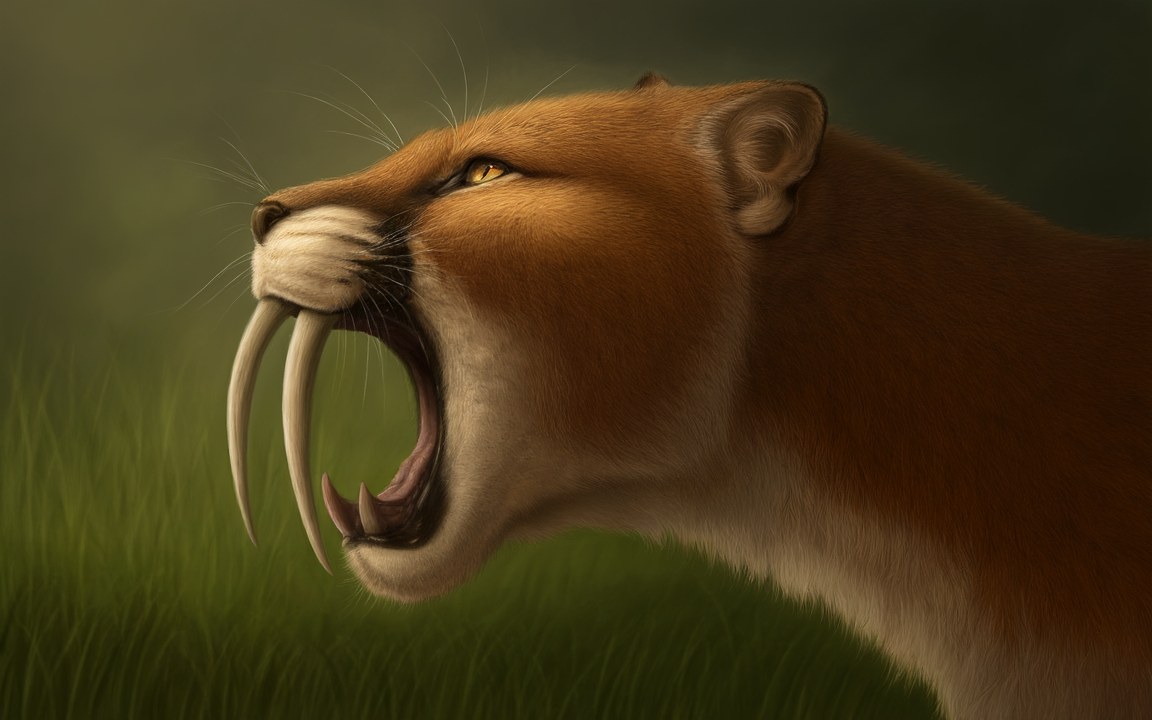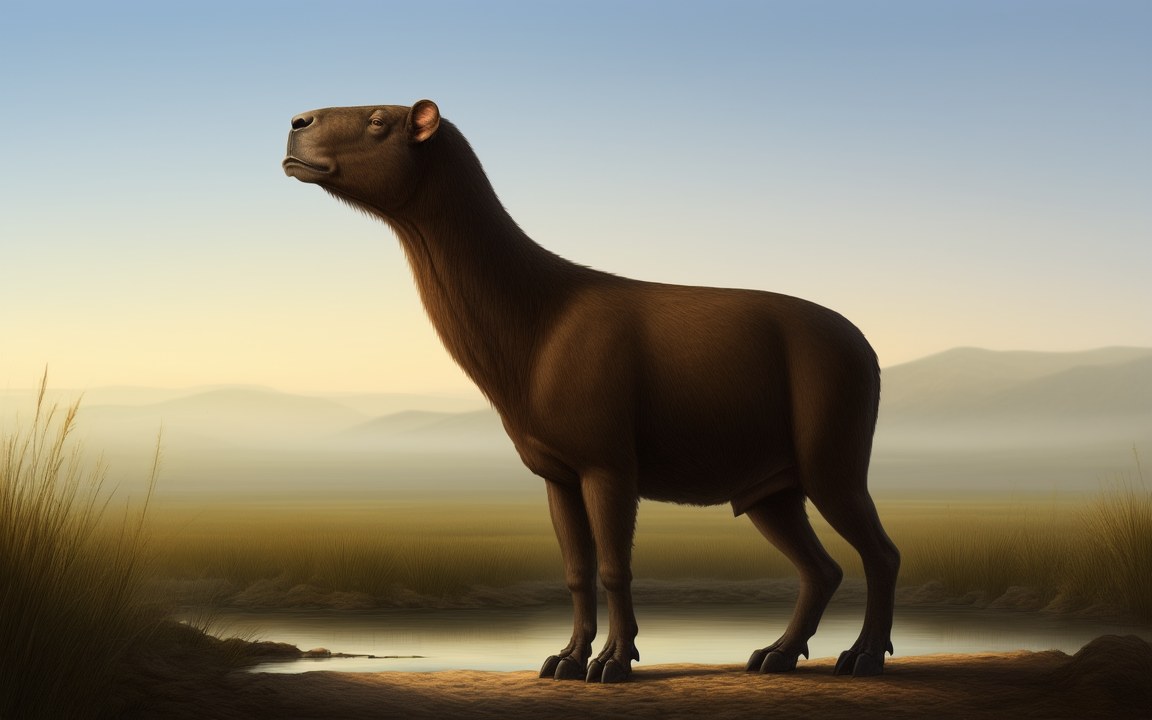
A long-legged brown hoofed animal with a long, upright neck and a small head standing beside a shallow river in early morning mist, an impression of Macrauchenia on the Pampas of Ice Age South America.

Lost GiantsPleistocene

Macrauchenia

A long-necked, three-toed South American mammal whose nostrils opened on top of its skull

About 400 000 to 12 000 years ago Reconstruction, not a photograph
Lived about 400 000 to 12 000 years ago older late Pliocene fossils have been attributed to the genus, but other authors doubt them [1]
Weight about 730 to 1 100 kg a median of 734 kg in a 2026 study, 1 100 kg in a 2005 study; about 1 tonne is the figure usually quoted [7]
Hind limb about 125 cm thigh bone 59 cm, shin 42 cm, upper foot 24 cm, in one skeleton [8]
Neck long, often held upright almost horizontal at speed, from modelling of its joints [9]
Feet three toes on each foot fossil footprints suggest it walked up on its toes [1]
Teeth 44, in an unbroken row low-crowned, with no gaps [1]
Diet both woody plants and grass from tartar on one animal's teeth and tooth wear on another's [1]
Range southern South America from southern Peru to southernmost Patagonia [1]
Found January 1834, by Darwin at Port St Julian, Patagonia; named by Owen in 1838 [2]
Closest living relatives horses, rhinos and tapirs from ancient proteins and DNA; the split was about 66 million years ago [6]

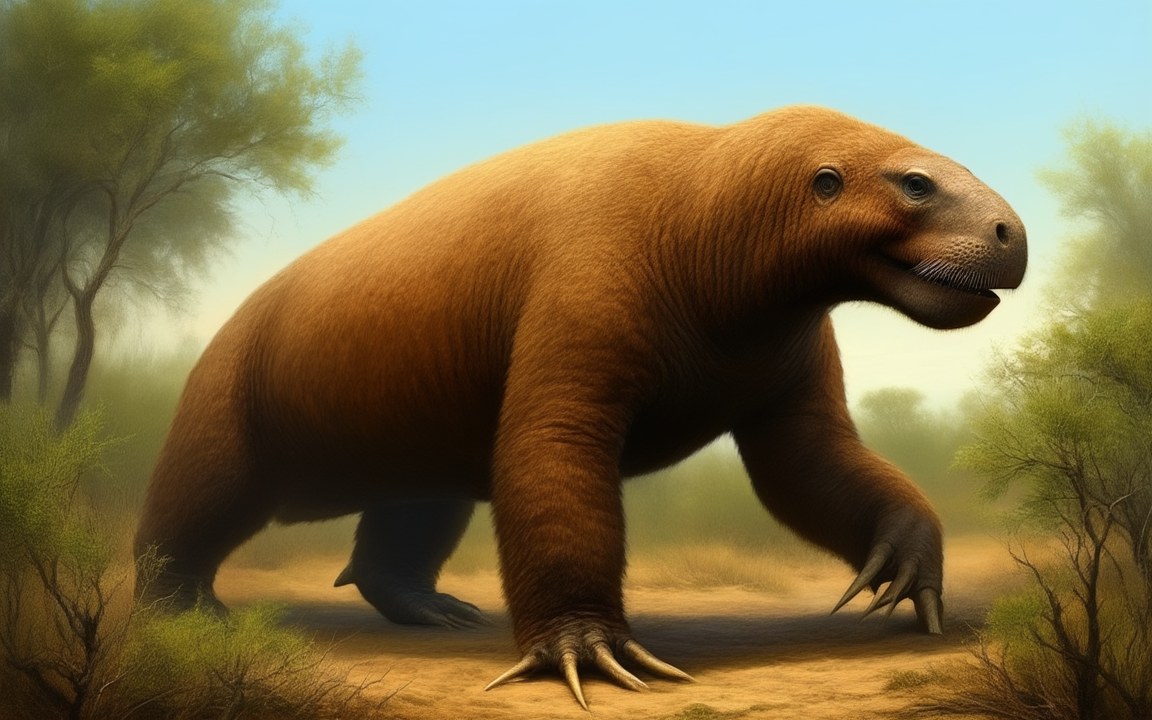
About the pictures. All three paintings start from skeletons: a camel-like body, a long neck and long legs. The upright neck at the river follows a 2023 study of its neck joints, and the lowered neck at the lake follows its known flexibility. The nose is the great unknown: the skull shows only a nasal opening high between the eyes, so the short, fleshy nose and lip in the close view are one possibility among several, and no trunk is shown. The animal at the lake has the face of a horse, with no fleshy nose. In b and d each foot shows two large hooves, where the real animal had three toes. Hair, colour, ears and tail are imagined.

Macrauchenia was a large, long-necked hoofed mammal of South America, shaped something like a camel but related to neither camels nor llamas. It lived across the south of the continent from about 400 000 to about 12 000 years ago, and it was one of the last litopterns, an order with no living members. Darwin dug up the first bones, and its true place among mammals was settled only in the last decade or so, with the help of ancient proteins and DNA.

A Mastodon that was not

Darwin found the first bones in January 1834 at Port St Julian in southern Patagonia, while the Beagle was surveying the coast. Writing to Henslow that March, he called them “some large animal, I fancy a Mastodon”. Back in England, Owen saw in the leg bones and vertebrae a giant resembling a llama or camel, and in 1838 named it Macrauchenia patachonica, roughly “long llama”.

One old error lasted far longer. In 2023 Püschel and Martinelli described the real atlas, the first neck vertebra, for the first time. The bone published under that label 159 years earlier by Burmeister probably came from a bovid, and later researchers had simply not gone back to it, although most mounted skeletons carry a correct atlas taken from a more complete specimen found by Roth around 1904.

The nose question

The strangest thing about the skull is where the nose opens: on top, between the eye sockets, with a sunken area behind it covered in pits and ridges for nasal muscles. This was long taken as a sign of a trunk like a tapir’s, and a 1913 restoration by Horsfall went further and gave it one like an elephant’s. That is now seen as out of date. Recent authors doubt even the tapir-like trunk. They suggest a grasping lip like a moose’s, a nose like a saiga antelope’s for filtering dust in its dry, open habitat, or something that did both. The skull shows that muscles worked a fleshy nose, but not what shape it took.

Cousins of horses, by a long road

A firm answer on its relationships came in 2015, when Welker and colleagues read collagen proteins from Macrauchenia and Toxodon, another South American hoofed mammal. The two formed one group, whose closest living relatives are horses, tapirs and rhinoceroses. In 2017 Westbury and colleagues recovered mitochondrial DNA from a foot bone found in Baño Nuevo-1 Cave in Chile. It supported the link and put the split at about 66 million years ago, with an uncertainty of 56.64 to 77.83 million.

A tonne, more or less, built to swerve

Weight estimates differ with the method. Fariña and colleagues used 1 100 kg in 2005, Blanco and colleagues gave about 1 tonne in 2021, and in 2026 Lobo, Gelfo and de Azevedo ran 162 estimates from ten specimens and reached a median of 734 kg. They also found that the family grew steadily heavier over 30 million years, from an ancestor of about 43 kg.

Footprints suggest it walked up on its toes, and its build was that of a fast runner. Fariña’s team noticed that its thigh bone was much stronger from side to side than from front to back, a pattern seen in living animals that escape by dodging, and proposed that it survived attacks by Smilodon by swerving. Isotope studies suggest Smilodon populator ate it regularly. Modelling of the neck joints in 2023 found that an upright neck fitted best when standing or feeding, and an almost horizontal one at speed. At least three individuals preserved together at Kamac Mayu in Chile hint that it lived in herds.

Few traces of the hunters

Macrauchenia disappeared about 12 000 years ago, some time after people reached South America, which they had done at least 14 500 years ago. Direct evidence of contact is thin. A lower jaw collected in the Pampas in the 19th century, now in Paris, may carry butchery marks. At Arroyo Seco 2 its bones lie among human artefacts but show no cut marks, and at Paso Otero 5 they were burned beside Fishtail spear points, probably as fuel. Hunting and climate change remain the two main explanations for its end.
Where it sits in deep time

Macrauchenia: About 400 000 to 12 000 years ago, in the Pleistocene.

Macrauchenia

Earth forms, 4.57 billion years agoToday

Each step to the right is ten times closer to today, so the last few million years get as much room as the first billion.

If Earth's history were one day

Squeeze all of Earth's history, about 4.6 billion years, into 24 hours, starting at midnight. Macrauchenia runs from 23:59:52.4 to 23:59:59.77, ending 0.23 seconds before midnight.

On this clock one second is about 52 862 years. All of written history fits into the last tenth of a second.

Reconstructions

A long-legged brown hoofed animal with a long, upright neck and a small head standing beside a shallow river in early morning mist, an impression of Macrauchenia on the Pampas of Ice Age South America. AI-generated painting.
Close-up of a small brown head on a long neck, with a dark eye and a soft, fleshy nose, against blurred green leaves and dry grass, an impression of the head of Macrauchenia. AI-generated painting.
A long-legged brown hoofed animal grazing with its long neck lowered beside a shallow lake at dusk, an impression of Macrauchenia on the Pampas of Ice Age South America. AI-generated painting.

Questions people ask

Did Macrauchenia have a trunk?

Probably not a long one. Its nasal opening sits high on the skull between the eyes, with pits and ridges behind it for nasal muscles. That was long read as a sign of a tapir-like trunk, but recent authors favour a moose-like grasping lip, a saiga-like nose for filtering dust, or a mixture of the two. The nose itself has not survived, so the question stays open.

What kind of animal was Macrauchenia?

A litoptern, a member of an extinct order of South American hoofed mammals. Ancient proteins and DNA show that litopterns were close relatives of the order that includes horses, rhinoceroses and tapirs.

How big was Macrauchenia?

Estimates of its weight run from about 730 kg to about 1 100 kg, and about 1 tonne is the figure usually quoted. Studies of its size report mass and limb bones rather than overall length. The hind limb of one skeleton measures about 125 cm without the toes.

Did Darwin discover Macrauchenia?

Yes. He collected the first bones at Port St Julian in Patagonia in January 1834, during the voyage of the Beagle, and guessed they came from a Mastodon. Owen recognised them as something new and named Macrauchenia patachonica in 1838.

Was Macrauchenia related to camels?

No. It shares the shape of a camel or llama, and its name means roughly long llama, but its relatives are the litopterns, and through them horses, rhinoceroses and tapirs.

When did Macrauchenia go extinct?

Around 12 000 years ago, at the end of the Pleistocene, along with most large mammals of the Americas and after people had reached South America. Hunting and climate change are the leading explanations, and direct evidence of people butchering it is limited.

Sources

  1. Wikipedia: Macrauchenia
  2. iDigBio: Natural History Museum specimen PV M 43402 v, Macrauchenia patachonica, collected by Darwin, January 1834
  3. Darwin Correspondence Project, Letter 238: Darwin to Henslow, March 1834
  4. Püschel & Martinelli (2023), More than 100 years of a mistake: on the anatomy of the atlas of the enigmatic Macrauchenia patachonica, Swiss Journal of Palaeontology 142, 16
  5. Welker et al. (2015), Ancient proteins resolve the evolutionary history of Darwin's South American ungulates, Nature 522, 81–84
  6. Westbury et al. (2017), A mitogenomic timetree for Darwin's enigmatic South American mammal Macrauchenia patachonica, Nature Communications 8, 15951
  7. Lobo, Gelfo & de Azevedo (2026), Increasing until extinction: understanding Macraucheniidae body-mass evolutionary history, Paleobiology 52, 363–372
  8. Fariña, Blanco & Christiansen (2005), Swerving as the escape strategy of Macrauchenia patachonica Owen, Ameghiniana 42, 751–760
  9. Blanco, Yorio & Montenegro (2023), Reconstruction of the cervical skeleton posture of the recently-extinct litoptern mammal Macrauchenia patachonica, Palaeovertebrata 46, e1
  10. Blanco et al. (2021), Macrauchenia patachonica Owen, 1838: limb bones morphology, locomotory biomechanics, and paleobiological inferences, Geobios 68, 61–70
  11. Toledo (2023), Anthropic modifications on megafauna bones in the paleontological collections of the Museum national d'Histoire naturelle de Paris, L'Anthropologie 127, 103134