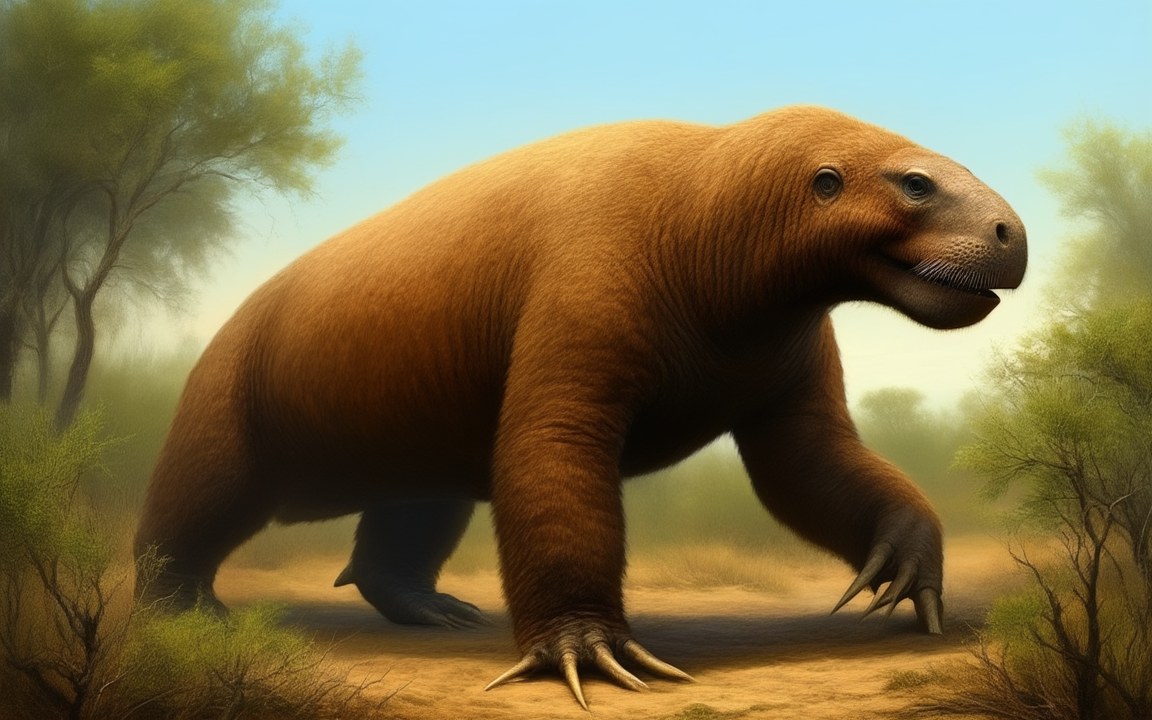
A massive, barrel-shaped brown marsupial with short, thick legs, a big belly and a broad head walking across dry golden grassland, an impression of Diprotodon, the largest marsupial that ever lived, in Ice Age Australia.

Lost GiantsPleistocene

Diprotodon

The largest marsupial known, a plant-eater often compared to a rhinoceros, that walked on its wrists and heels across Ice Age Australia

About 1.77 million to 40 000 years ago Reconstruction, not a photograph
Lived about 1.77 million to 40 000 years ago the oldest finds date to between 1.77 million and 780 000 years ago; most specimens are younger than 110 000 years [1]
Shoulder height 1.6 to 1.8 m the Australian Museum gives 1.7 m [1]
Length 2.75 to over 4 m mounted skeletons reach 3.4 m; restoring the discs of the spine may add 20 per cent [1]
Weight about 2 800 kg 2 272 to 3 417 kg from limb bones, mean 2 786 kg [3]
Upper incisor 280 mm long in an old male ever-growing, with about 215 mm of it inside the jaw [1]
Diet plants, a mixed feeder saltbush in one skeleton's belly; perhaps 100 to 150 kg of plants a day [2]
Walking speed about 5.5 to 6.3 km/h estimated from two fossil trackways [1]
Range most of mainland Australia not known from New Guinea, south-western Western Australia, the Northern Territory or Tasmania, though it reached King Island [2]
Closest living relatives wombats and koalas it had its own extinct family, the Diprotodontidae [1]
Named 1838, by Owen the first Australian fossil mammal to be named; first bones found in 1830 [1]

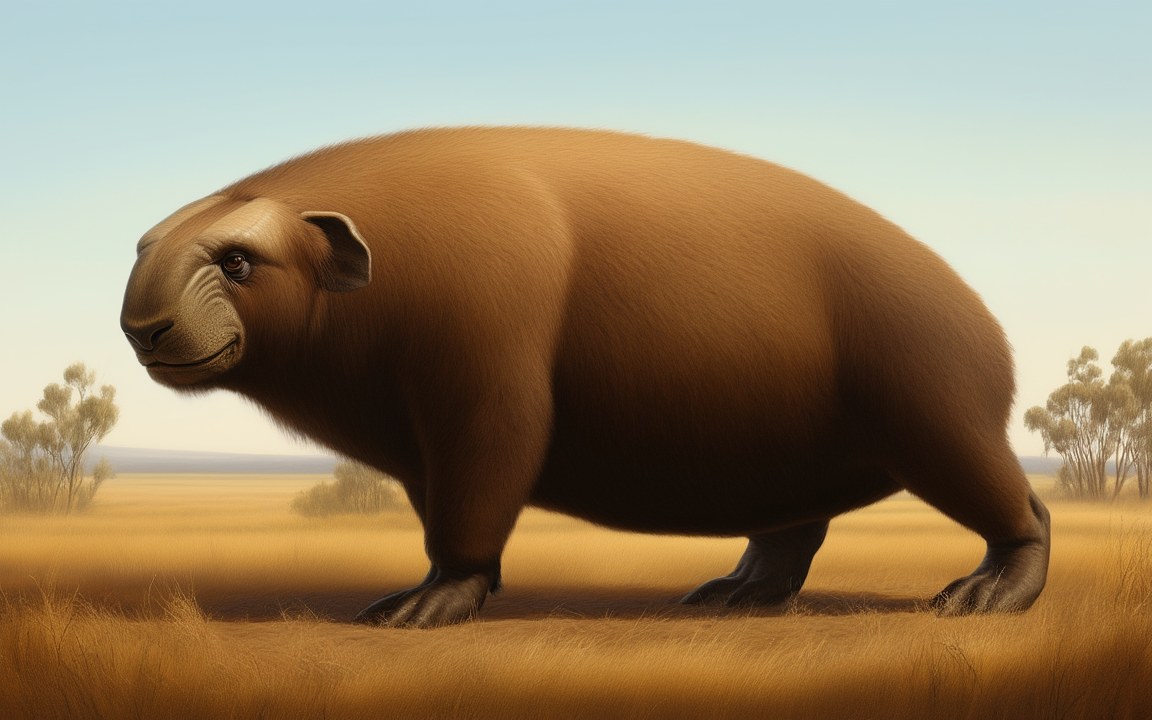
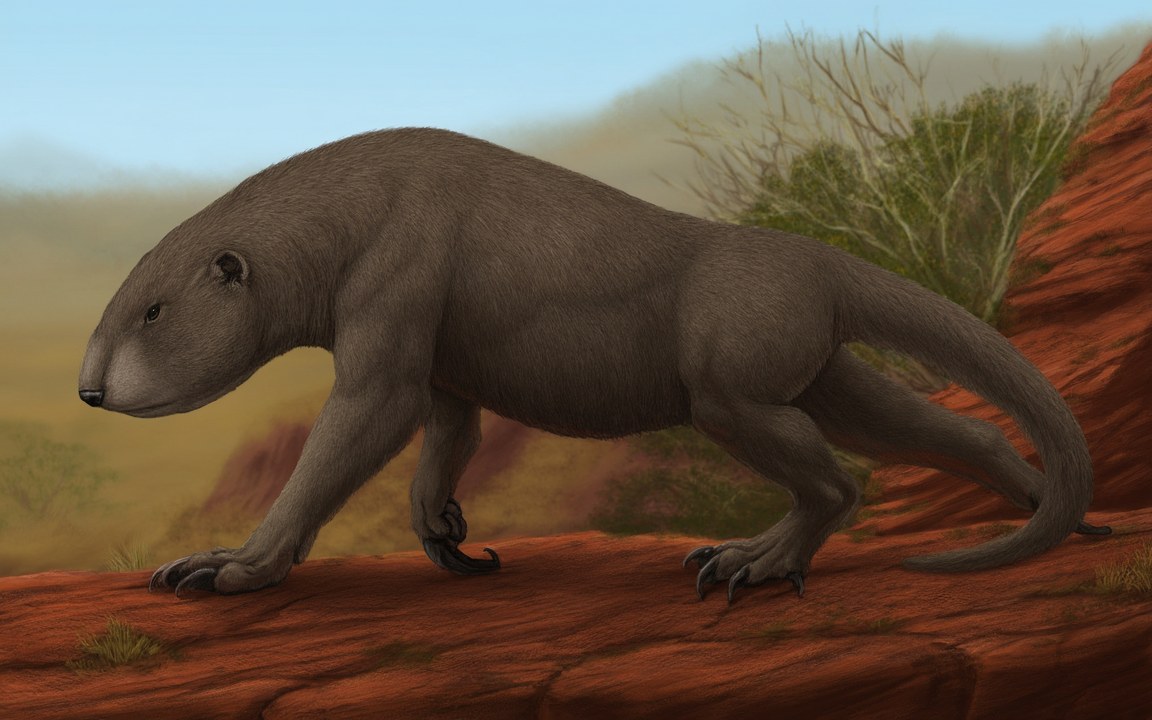
About the pictures. Two paintings show the whole animal, on dry grassland and at a waterhole under gum trees; a third shows the head, and a fourth only rounded prints along a lake shore, after the toeless trackways from Lake Callabonna and Victoria. The heavy, big-bellied body follows skeletons. The real skull was long and narrow, closer to the head study than to the short, round faces of the two full-body paintings, and the real animal stood taller on pillar-like legs, with weak toes that probably did not touch the ground. Hair impressions are recorded, but coat colour and length, the ears, the fleshy nose and the plants are imagined.

Diprotodon optatum was the largest marsupial known to have lived, a plant-eater often compared to a rhinoceros, whose closest living relatives are wombats and koalas. It ranged over most of mainland Australia and disappeared about 40 000 years ago, after people had reached the continent. Its oldest fossils may reach 1.77 million years, though most are younger than 110 000. It was also the first Australian fossil mammal to be named, by Owen in 1838, from bones dug out of Wellington Caves in New South Wales.

One tonne or nearly three

Its weight depends heavily on method. In 1991 Murray used skull and tooth measurements and got about 1 150 kg, a figure he did not consider precise. Wroe and colleagues instead measured the girth of 17 thigh and upper arm bones against 18 marsupials and 32 placental mammals. Their 2004 answer was 2 272 to 3 417 kg, mean 2 786 kg, which most sources now repeat, though they warned that projecting so far beyond living marsupials is problematic.

Length is unsettled too. Mounted skeletons measure 2.75 to 3.4 m from head to tail, but with the discs of the spine restored the animal may have been 20 per cent longer, over 4 m. Adults fall into two clear size groups, once named as separate species. Price reviewed them in 2008, kept one species and read the larger form as probably male.

Walking on its wrists

The feet were small for the body and turned inwards, the hind toes at about 130 degrees from the ankle. A 2023 study of a smaller Pliocene relative, Ambulator, explains the odd arrangement. In these animals a wrist bone worked as a second heel, weight passed through the wrist and ankle, and the weak digits probably never touched the ground. That fits the fossil trackways, which show no finger or toe marks.

Two trackways are known. At Lake Callabonna in South Australia one animal left strides of about 1 500 mm, an estimated 6.3 km/h. On the Victorian Volcanic Plain the stride was 1 310 mm, the speed about 5.5 km/h and the stance more sprawled, perhaps a female carrying a large joey in her pouch.

A lakebed full of skeletons

Lake Callabonna also holds the largest known fossil assemblage. Hurst dug there in 1893 and reported up to 360 individuals, trapped in the mud as the lakebed dried. Some researchers read such clusters as herds, often mostly female. The Australian Museum thinks large herds unlikely, because marsupials are not known to form them, and takes these for smaller family groups drawn to a shrinking waterhole.

The bones also record last meals. One Callabonna skeleton had saltbush in its abdomen, and the gut contents of another, about 53 000 years old, held young leaves, stalks and twigs.

A 200 km round trip, from one tooth

The first incisors grew throughout life, so a single tooth keeps a record of where its owner fed. In 2017 Price and colleagues measured strontium along an upper incisor from the Darling Downs in Queensland, from an animal that lived around 300 000 years ago. The values cycled over nearly three years, as if it made a round trip of up to about 200 km each year. No living marsupial migrates this way. In 2023 Koutamanis and colleagues found that teeth from Wellington Caves and Bingara in New South Wales matched bedrock within 10 to 25 km, with no sign of long journeys. The results come from different regions, so both could be right, but neither settles it for the species.

Twenty-five thousand years ago, or forty

The Australian Museum still says Diprotodon died out about 25 000 years ago. Recent dating does not support a date that young. In 2001 Roberts and colleagues dated 28 fossil sites and placed the last megafauna between about 50 000 and 41 000 years ago, and a 2021 study rejected later survival at Cloggs Cave in south-eastern Australia. The youngest reliable fossils, from South Walker Creek in Queensland, are 40 100 ± 1 700 years old.

Direct evidence of contact with people is almost nil. No butchered megafauna bones are known. A rib from Tambar Springs has a small square hole, tentatively identified as spear damage. An incisor from Spring Creek with 28 fine marks was long cited as human work, until a 2020 reanalysis by Langley attributed them to a tiger quoll. Drought, hunting and burning of the landscape have all been proposed, and the cause remains open.
Where it sits in deep time

Diprotodon: About 1.77 million to 40 000 years ago, in the Pleistocene.

Diprotodon

Earth forms, 4.57 billion years agoToday

Each step to the right is ten times closer to today, so the last few million years get as much room as the first billion.

If Earth's history were one day

Squeeze all of Earth's history, about 4.6 billion years, into 24 hours, starting at midnight. Diprotodon runs from 23:59:26.5 to 23:59:59.24, ending 0.76 seconds before midnight.

On this clock one second is about 52 862 years. All of written history fits into the last tenth of a second.

How big

Head-to-tail length and shoulder height of Diprotodon next to a person.

Australian Museum figures. Other estimates run from 1.6 to 1.8 m at the shoulder and from 2.75 m to over 4 m long.

Reconstructions

A massive, barrel-shaped brown marsupial with short, thick legs, a big belly and a broad head walking across dry golden grassland, an impression of Diprotodon, the largest marsupial that ever lived, in Ice Age Australia. AI-generated painting.
A massive, barrel-shaped brown marsupial with a broad, wrinkled nose and short, thick legs standing in a shallow waterhole under tall gum trees at dusk, an impression of Diprotodon in Ice Age Australia. AI-generated painting.
Close-up of a long, broad brown head with a soft, fleshy nose, a dark eye and a small rounded ear against blurred golden grass, an impression of the head of Diprotodon. AI-generated painting.
A trail of large, rounded footprints pressed into soft grey mud along the edge of a calm lake at sunset, dry golden grass beyond, an impression of footprints left by Diprotodon in Ice Age Australia. AI-generated painting.

Questions people ask

How big was Diprotodon?

It stood about 1.6 to 1.8 m at the shoulder and was roughly 3 to 4 m long. Its weight is usually given as about 2 800 kg, from limb-bone measurements by Wroe and colleagues, with a range of 2 272 to 3 417 kg. An older estimate based on the skull and teeth gave about 1 150 kg.

What is the largest marsupial that ever lived?

Diprotodon optatum is the largest known. The largest marsupial alive today, the red kangaroo, weighs at most about 85 kg.

Was Diprotodon a giant wombat?

Not exactly. Wombats and koalas are its closest living relatives, but it belonged to its own extinct family, the Diprotodontidae. Its skull was long and narrow, and its pillar-like legs gave it a more upright stance than a wombat's.

Did Diprotodon migrate?

Possibly. Strontium in one incisor from the Darling Downs suggests seasonal round trips of up to about 200 km (Price and colleagues, 2017). Teeth from New South Wales point instead to small home ranges (Koutamanis and colleagues, 2023). Neither study settles it for the species.

When did Diprotodon go extinct, and why?

The youngest reliably dated fossils are 40 100 ± 1 700 years old, from South Walker Creek in Queensland, although the Australian Museum gives about 25 000 years ago. Drought, hunting and burning of the landscape by people have all been proposed, and the cause is still debated.

Did people hunt Diprotodon?

There is almost no direct evidence. No butchered megafauna bones are known, and one rib from Tambar Springs has a small square hole only tentatively identified as spear damage. People and Diprotodon did share the continent for thousands of years.

Sources

  1. Wikipedia: Diprotodon
  2. Australian Museum: Diprotodon optatum
  3. Wroe et al. (2004), The size of the largest marsupial and why it matters, Proceedings of the Royal Society B 271 (Suppl. 3), S34–S36
  4. van Zoelen et al. (2023), Description of the Pliocene marsupial Ambulator keanei gen. nov. from inland Australia and its locomotory adaptations, Royal Society Open Science 10, 230211
  5. ScienceAlert (2023), The strange walk of this extinct marsupial giant was perfect for roaming (the authors' summary, from The Conversation)
  6. Price et al. (2017), Seasonal migration of marsupial megafauna in Pleistocene Sahul (Australia–New Guinea), Proceedings of the Royal Society B 284, 20170785
  7. University of Queensland (2017), Giant Australian marsupials were no other
  8. Koutamanis et al. (2023), Reconstructing Pleistocene Australian herbivore megafauna diet using calcium and strontium isotopes, Royal Society Open Science 10, 230991
  9. Hocknull et al. (2020), Extinction of eastern Sahul megafauna coincides with sustained environmental deterioration, Nature Communications 11, 2250
  10. David et al. (2021), Late survival of megafauna refuted for Cloggs Cave, SE Australia, Quaternary Science Reviews 253, 106781