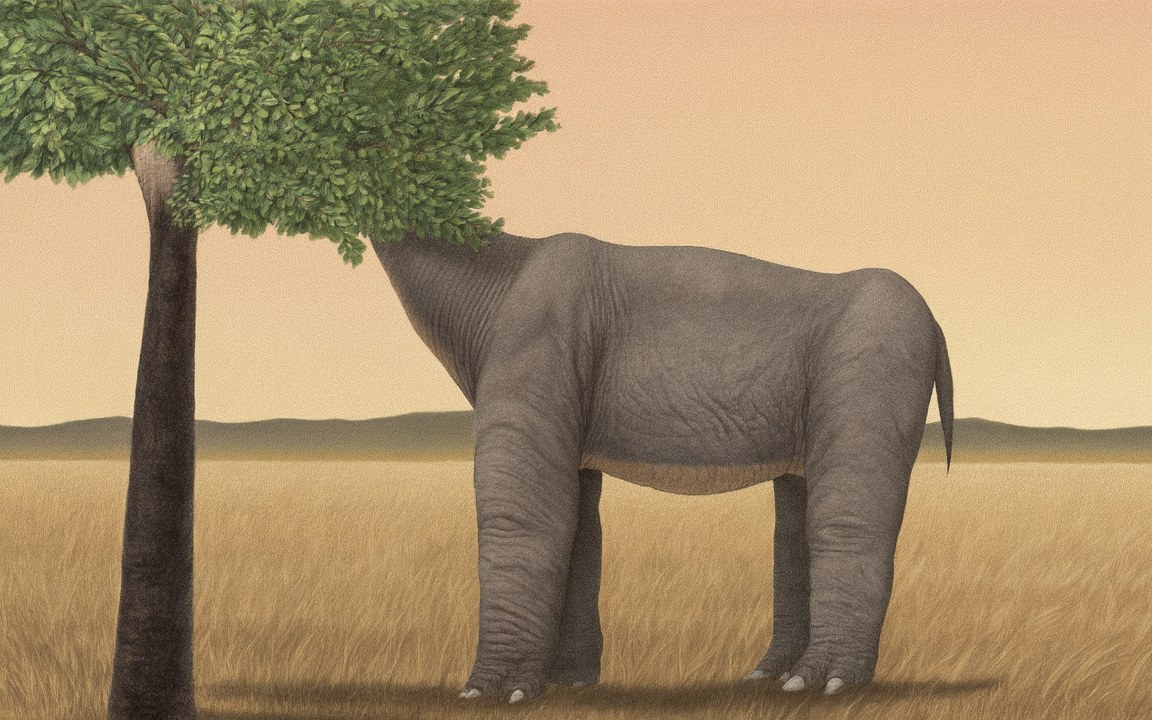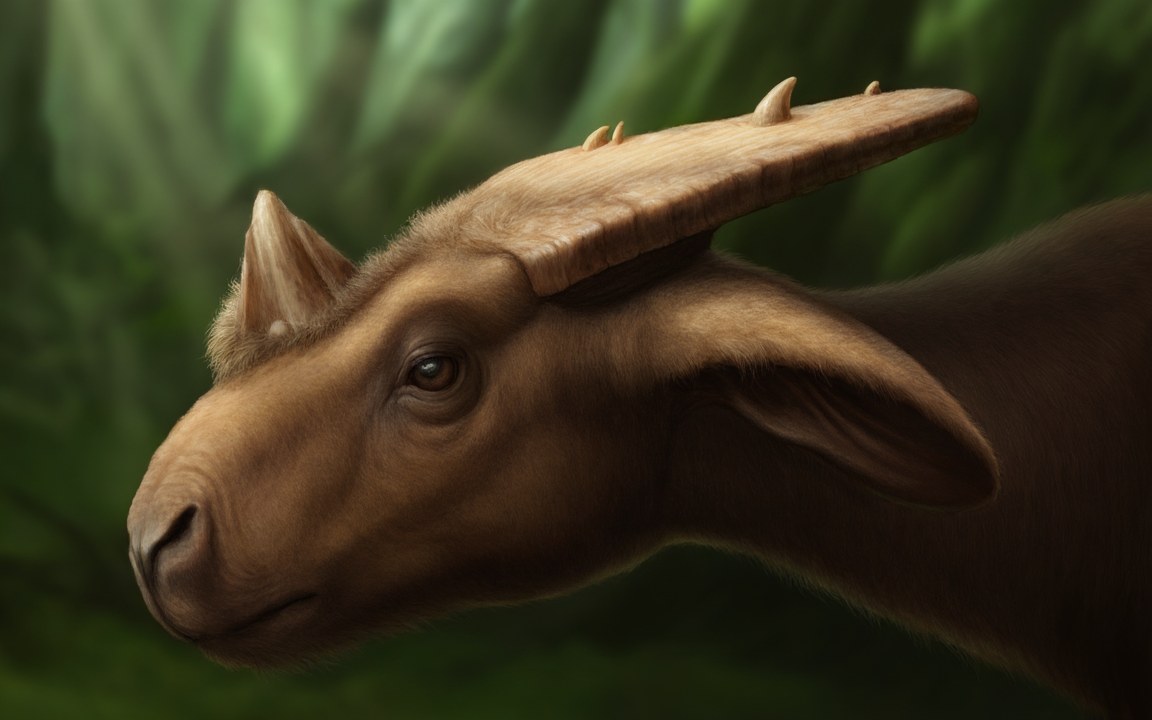
A wide, slow river winding through open woodland of flat-topped acacias, with grassy banks and morning mist rising from the water, an impression of the riverside woodland of East Africa where Deinotherium lived about 2 million years ago.

Lost GiantsNeogene

Deinotherium

A distant relative of elephants, up to 4 m at the shoulder, with tusks that curved down and back from its chin

About 13 to 1 million years ago Reconstruction, not a photograph
Lived about 13 to 1 million years ago in Europe until about 6 to 5 million years ago, in Africa the longest [1]
Shoulder height about 3.6 to 4 m a partial skeleton from Crete may have reached 4.1 m [2]
Weight about 9 to 12 tonnes the largest about twice as heavy as an African bush elephant [2]
Tusks two, in the lower jaw only curving down and back, up to 1.4 m long [1]
Skull up to 120 to 130 cm long short, low and flat on top [1]
Diet leaves of broad-leaved plants from wear on the teeth [1]
Range Europe, southern Asia and Africa perhaps as far north as southern Finland [1]
Named 1829, by Kaup from a broken lower jaw found near Eppelsheim, Germany [1]
Split from the elephants' line more than 44 million years ago [1]
Top speed about 17 to 18 km/h a 2025 estimate for a 10.5-tonne animal, which its authors call less reliable for this genus [4]

About the pictures. This painting shows the kind of East African country where the last Deinotherium lived: a river winding through open woodland, with no animal in view. The trees and the light are imagined. The animal itself is described from its skulls, jaws and skeletons in the text below.

Deinotherium was a giant relative of elephants with a feature no living animal shares: its only tusks grew from the lower jaw and curved down and back under its chin. It lived from about 13 million to about 1 million years ago across Europe, southern Asia and Africa, and the largest individuals stood about 4 m at the shoulder, well above an average African elephant bull. Its name means “terrible beast”. Its family split from the line that leads to modern elephants more than 44 million years ago, so it was a distant cousin of them, not an ancestor.

Four metres at the shoulder

The most detailed size estimates come from a 2016 study by Larramendi, who rebuilt skeletons as volumetric models. Several fairly complete skeletons of Deinotherium proavum from eastern Europe all come out at about 3.65 m at the shoulder and 10.5 tonnes. Fully grown Deinotherium giganteum could reach about 4 m and 12 tonnes, roughly twice the weight of an African bush elephant, whose bulls average about 3.2 m. The African species, Deinotherium bozasi, stood over 3.6 m and weighed about 9 tonnes.

It was not simply a scaled-up elephant. Its legs were longer and slimmer in proportion, its neck a little longer, and its skull short, low and flat on top, without the high dome of an elephant’s head. Its ancestor Prodeinotherium was much smaller: about 2 m at the shoulder in one summary, and about 2.5 to 2.8 m in Larramendi’s models of two European skeletons. A 2025 study led by Ruiz estimated that a 10.5-tonne Deinotherium could reach about 17 to 18 km/h, while warning that the method is less reliable for animals so distantly related to living elephants.

What the downturned tusks were for

The front of the lower jaw was long and bent sharply downwards, and the two tusks emerged about halfway round that curve. In some animals they carried on curving backwards into an almost semicircular hook; in others they pointed nearly straight down. They could reach 1.4 m. There were no tusks in the upper jaw at all.

The tusks were probably used in feeding rather than for digging. Markov and colleagues proposed that the animal pulled obstructing branches aside with them while its trunk moved leaves to its mouth. Wear on the cheek teeth of Deinotherium giganteum shows it browsed on the leaves of broad-leaved plants, and a 2023 study by Saarinen and Lister found that deinotheres kept the same simple, low-crowned browsing teeth throughout their history. They preferred open woodland.

The trunk is less certain. A large nasal opening shows there was one, but Markov and colleagues argued that it was short and muscular, unlike an elephant’s. Larramendi agreed that the neck and jaw point towards a shorter trunk, but argued that legs this long still called for one that could reach the ground to feed and drink, and judged a trunk of medium length the most plausible.

A jaw, a hoax and an aquatic giant

Kaup named Deinotherium in 1829 from a broken lower jaw found in sands near Eppelsheim in south-west Germany. He first reconstructed the tusks pointing upwards and corrected this several years later. Cuvier had already described its teeth in 1822 as belonging to “giant tapirs”, and in the 1830s Straus-Dürckheim and Buckland suggested it lived in water, Buckland picturing it clinging to riverbanks with its tusks. Older still, giant bones said to have been found near Montrigaud in France in 1613 and shown as the remains of a king called Theutobochus were recognised centuries later as Deinotherium.

The last of the deinotheres

Deinotheres spread from Africa into Eurasia over a land bridge that formed about 18 to 19 million years ago. Fossils of Deinotherium in India span about 13.5 to 8 million years ago, and in Europe it appeared about 13 to 11 million years ago and lasted until the end of the Miocene, about 6 to 5 million years ago. A fragment of upper arm bone from southern Finland may show that it ranged that far north, although the identification is provisional.

Africa was its last refuge. Deinotherium bozasi lived in East Africa, at sites such as Olduvai, Omo and Koobi Fora, into the Early Pleistocene. Saarinen and Lister date the extinction of the deinotheres to about 1.5 million years ago; other summaries give about 1 million. Its disappearance was part of a wider decline of large browsing animals as grasslands spread across Africa.
Where it sits in deep time

Deinotherium: About 13 to 1 million years ago, in the Neogene.

Deinotherium

Earth forms, 4.57 billion years agoToday

Each step to the right is ten times closer to today, so the last few million years get as much room as the first billion.

If Earth's history were one day

Squeeze all of Earth's history, about 4.6 billion years, into 24 hours, starting at midnight. Deinotherium runs from 23:55:54 to 23:59:41.1, ending 18.9 seconds before midnight.

On this clock one second is about 52 862 years. All of written history fits into the last tenth of a second.

How big

Shoulder height of a large Deinotherium giganteum next to an average African bush elephant bull and a person.

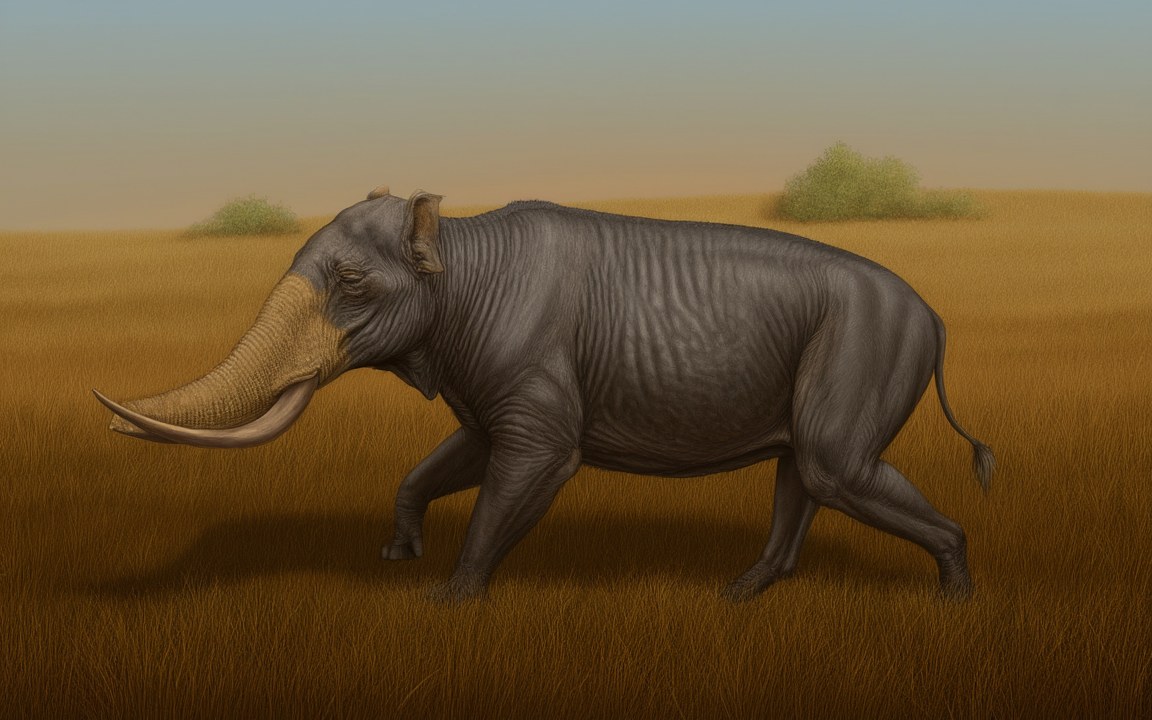
Reconstructions

A wide, slow river winding through open woodland of flat-topped acacias, with grassy banks and morning mist rising from the water, an impression of the riverside woodland of East Africa where Deinotherium lived about 2 million years ago. AI-generated painting.

Questions people ask

How big was Deinotherium?

Large adults stood about 3.6 to 4 m at the shoulder and weighed about 9 to 12 tonnes, according to volumetric reconstructions published by Larramendi in 2016. That is taller than an African bush elephant bull, which averages about 3.2 m, and at the top of that range roughly twice as heavy.

Why did Deinotherium have tusks pointing down?

Its two tusks grew from the front of the lower jaw, which itself bent sharply downwards, and they curved down and back under the chin. Wear on them suggests they were used in feeding, perhaps to pull branches aside, and not for digging. It had no tusks in the upper jaw.

Is Deinotherium an elephant?

No. It belonged to the order Proboscidea, like elephants, but its family split from the line leading to modern elephants more than 44 million years ago. It was a distant cousin, not an ancestor.

When did Deinotherium go extinct?

In Europe at the end of the Miocene, about 6 to 5 million years ago. In Africa it survived into the Early Pleistocene: a 2023 study gives its last date as about 1.5 million years ago, other sources about 1 million. The spread of grasslands is the most likely cause.

Did Deinotherium have a trunk?

Yes. The large nasal opening in its skull shows it had one, but its length is debated. One view holds that it was short and muscular; others argue that an animal this tall with a short neck needed a trunk at least long enough to reach water. Larramendi judged a trunk of medium length the most plausible.

Sources

  1. Wikipedia: Deinotherium
  2. Larramendi (2016), Shoulder height, body mass, and shape of proboscideans, Acta Palaeontologica Polonica 61, 537–574
  3. Saarinen & Lister (2023), Fluctuating climate and dietary innovation drove ratcheted evolution of proboscidean dental traits, Nature Ecology & Evolution 7, 1490–1502
  4. Ruiz et al. (2025), The body mass–maximum speed relationship and the athletic capability of giant proboscideans and sauropods, Scientific Reports 16, 2671