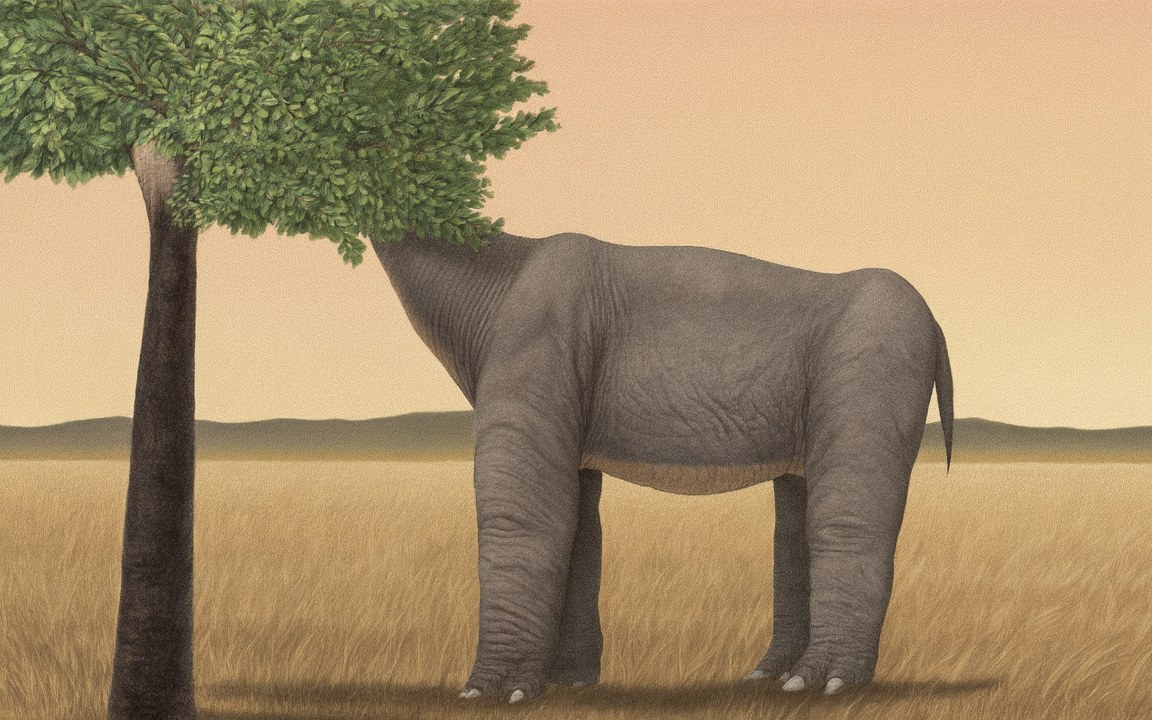
A huge, grey, wrinkled, hornless mammal on long, pillar-like legs standing side-on under a tree on a dry, golden plain at sunset, its raised neck hidden with its head in the leaves, an impression of Paraceratherium, one of the largest land mammals that ever lived.

Lost GiantsPaleogene

Paraceratherium

A hornless rhinoceros relative that stood far taller than an elephant and browsed the tops of trees

About 34 to 23 million years ago Reconstruction, not a photograph
Lived about 34 to 23 million years ago the Oligocene [1]
Shoulder height about 4.8 m for the largest individuals [1]
Length about 7.4 m an older figure of 8.2 m is thought exaggerated [1]
Weight about 9 to 20 tonnes a 2022 study gives 9 to 15 by species; older estimates reach 15 to 20 at most [1]
Skull up to about 1.3 m long with a neck of 2 to 2.5 m [1]
Where across Eurasia from China and Mongolia to Pakistan, Kazakhstan, Turkey and the Balkans [1]
Diet leaves, soft plants and shrubs browsed from high branches [1]
Named 1911, by Forster-Cooper also known as Baluchitherium and Indricotherium [1]
Living relatives rhinoceroses it had no horn [4]

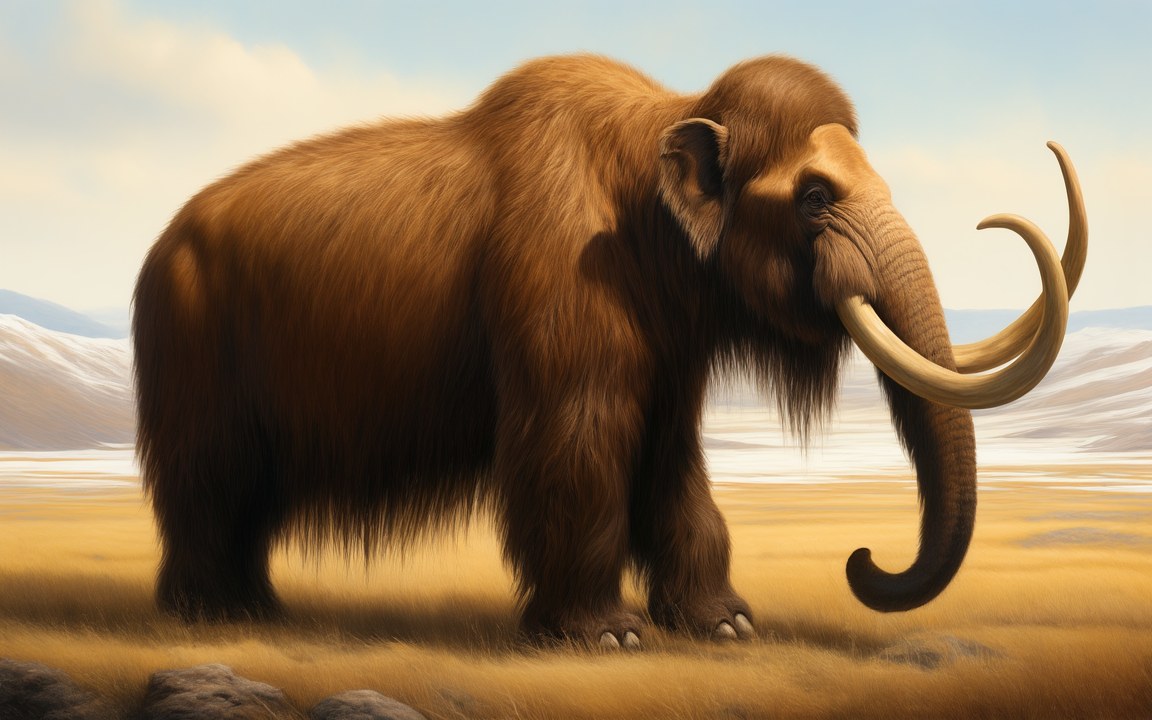
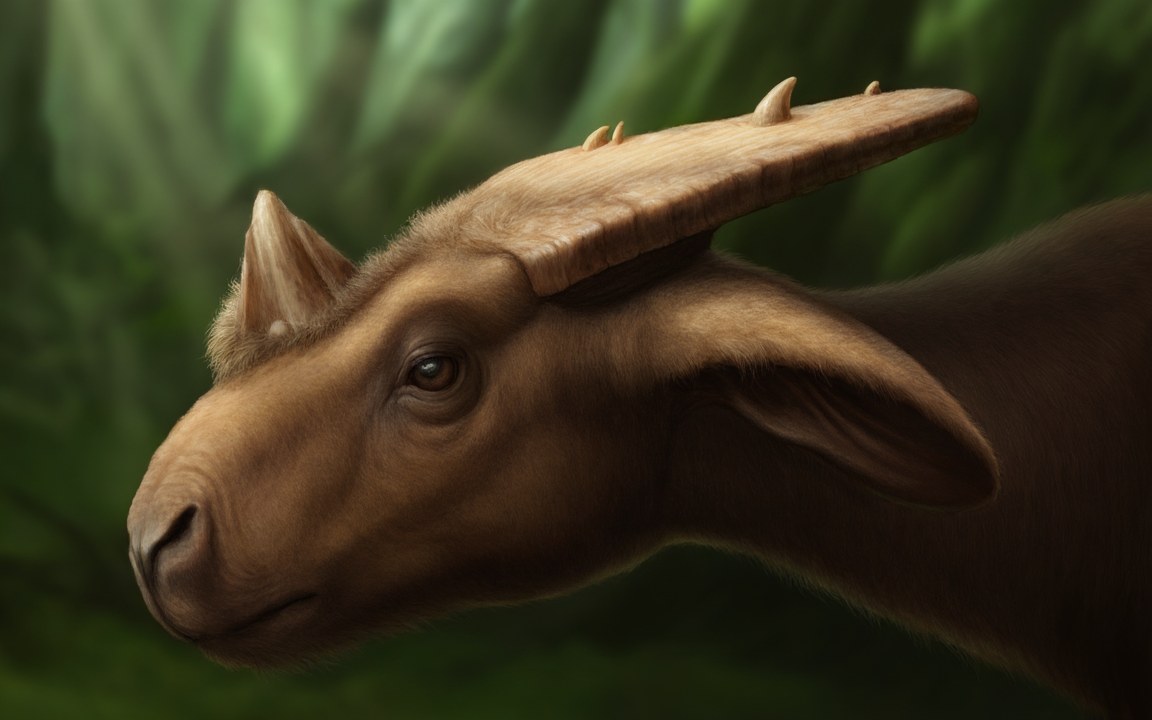
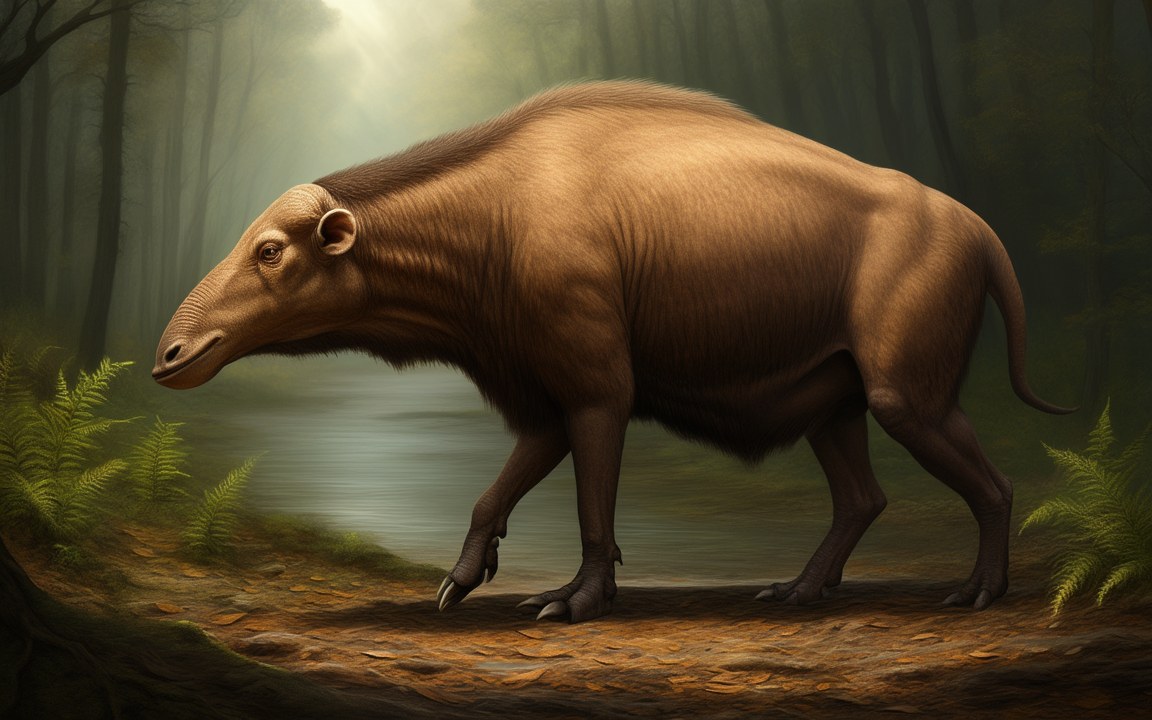
About the pictures. Two paintings built on the skeleton show a hornless body on tall, pillar-like legs with the neck raised into a tree to browse: one on a golden plain whose grass is imagined, the other from behind beside water. The head is hidden in the leaves on purpose: the skull leaves room for either a thick grasping lip or a short trunk, and the paintings do not choose. The leaves also hide most of the neck, so its length does not show. The third painting is an empty landscape of Central Asian dry country, its plants imagined. No skin is known, so the grey, wrinkled hide is borrowed from living rhinos.

Paraceratherium was a hornless relative of the rhinoceroses, and one of the largest mammals ever to walk on land. It lived across Eurasia, from China to the Balkans, between about 34 and 23 million years ago, in the epoch called the Oligocene, and the biggest individuals stood about 4.8 m at the shoulder, half again as tall as a large African elephant. With a long neck on top of that, it could feed from branches beyond the reach of smaller animals.

One animal, many names

The first fossils were described in 1908 from the Bugti Hills of what is now Pakistan, and the name Paraceratherium was given in 1911. Over the next decades, more bones turned up in Mongolia, China, Kazakhstan and elsewhere, and several of them were given names of their own. Two of them, Baluchitherium and Indricotherium, became famous in their own right. A 1989 revision placed them all in one genus, and Paraceratherium, as the oldest name, took precedence, although some later studies keep Indricotherium apart.

How big

Early estimates made it enormous: more than 8 m long and up to 30 tonnes. Those figures are now thought exaggerated. Current estimates put the largest individuals at about 4.8 m tall at the shoulder and about 7.4 m long, with weights of about 9 to 20 tonnes depending on the study and the species. Its skull alone was up to about 1.3 m long, and its neck 2 to 2.5 m.

It was built for height as well as bulk. The legs were long and straight like pillars, and the neck carried the head up into the trees, where it browsed on leaves, soft plants and shrubs. At the front of the mouth it had one pair of tusk-like incisors in each jaw, and it had lost its canines altogether.

A lip or a trunk?

Whether Paraceratherium had a trunk is still argued. The bones of its nose show a very deep notch, which means some kind of soft, mobile structure sat there. Many reconstructions give it a thick grasping lip. A study in 2021, which described a new species, Paraceratherium linxiaense, from about 26.5 million years ago in the Linxia Basin of Gansu, China, read the same notch as a sign of a short trunk. No skin or soft tissue is known, so the question cannot yet be settled.

The same study suggested that during the Oligocene the area of today’s Tibetan Plateau was lower than it is now, allowing these giants to move freely along the eastern shore of the ancient Tethys Ocean.

Life and death of a giant

Fully grown, Paraceratherium was probably too big for any predator on land. It may have lived in small herds, perhaps made up of females and their young, and its calves would have been vulnerable. Bite marks on some bones suggest that very large crocodiles may have preyed on even adults.

It disappeared at the end of the Oligocene, about 23 million years ago, and nobody knows why. One suggestion is that early relatives of elephants, arriving from Africa, changed the vegetation it relied on. Others point out that the two rarely lived side by side, and link its end instead to the arrival of new large predators and plant-eaters in Asia at the start of the next epoch, the Miocene.
Where it sits in deep time

Paraceratherium: About 34 to 23 million years ago, in the Paleogene.

Paraceratherium

Earth forms, 4.57 billion years agoToday

Each step to the right is ten times closer to today, so the last few million years get as much room as the first billion.

If Earth's history were one day

Squeeze all of Earth's history, about 4.6 billion years, into 24 hours, starting at midnight. Paraceratherium runs from 23:49:17 to 23:52:45, ending 7 minutes before midnight.

On this clock one second is about 52 862 years. All of written history fits into the last tenth of a second.

How big

Shoulder height of the largest Paraceratherium next to a male African bush elephant and a person.

Reconstructions

A huge, grey, wrinkled, hornless mammal on long, pillar-like legs standing side-on under a tree on a dry, golden plain at sunset, its raised neck hidden with its head in the leaves, an impression of Paraceratherium, one of the largest land mammals that ever lived. AI-generated painting.
The huge grey body and pillar-like legs of a giant hornless mammal standing under a broad tree with its head and neck hidden in the foliage, an impression of Paraceratherium browsing about 30 million years ago. AI-generated painting.
A wide, dry plain of pale earth with sparse shrubs and tufts of grass, a few broad-crowned trees and low brown hills under a hazy sky, an impression of the dry country of Central Asia where Paraceratherium lived about 30 million years ago. AI-generated painting.

Questions people ask

How big was Paraceratherium?

The largest stood about 4.8 m at the shoulder and were about 7.4 m long. Weight estimates range from about 9 to 20 tonnes depending on the study and the species. A large male African bush elephant stands about 3.2 m at the shoulder.

Was Paraceratherium the largest land mammal ever?

It is one of the largest known. Exactly where it ranks depends on whose estimates you use. A 2016 study argues that two extinct elephant relatives, Palaeoloxodon namadicus and Mammut borsoni, matched or surpassed it.

Was Paraceratherium a rhino?

It was a hornless relative of the rhinoceroses. A 2021 study of a new species from China placed it closer to true rhinos than had been thought.

What did Paraceratherium eat?

Leaves, soft plants and shrubs, browsed from branches high above the ground, much as a giraffe feeds today.

Why did Paraceratherium go extinct?

Nobody knows. One idea is that elephant relatives arriving from Africa changed the habitats it depended on; another links its end to new large predators and plant-eaters entering Asia at the start of the Miocene, about 23 million years ago.

Sources

  1. Wikipedia: Paraceratherium
  2. Wikipedia: African bush elephant
  3. Larramendi (2016), Shoulder height, body mass, and shape of proboscideans, Acta Palaeontologica Polonica 61, 537–574
  4. Deng et al. (2021), An Oligocene giant rhino provides insights into Paraceratherium evolution, Communications Biology 4, 639
  5. Lu & Deng (2025), Life history of a new Paraceratheriid from the Early Oligocene of Northwest China, Scientific Reports 15, 28740