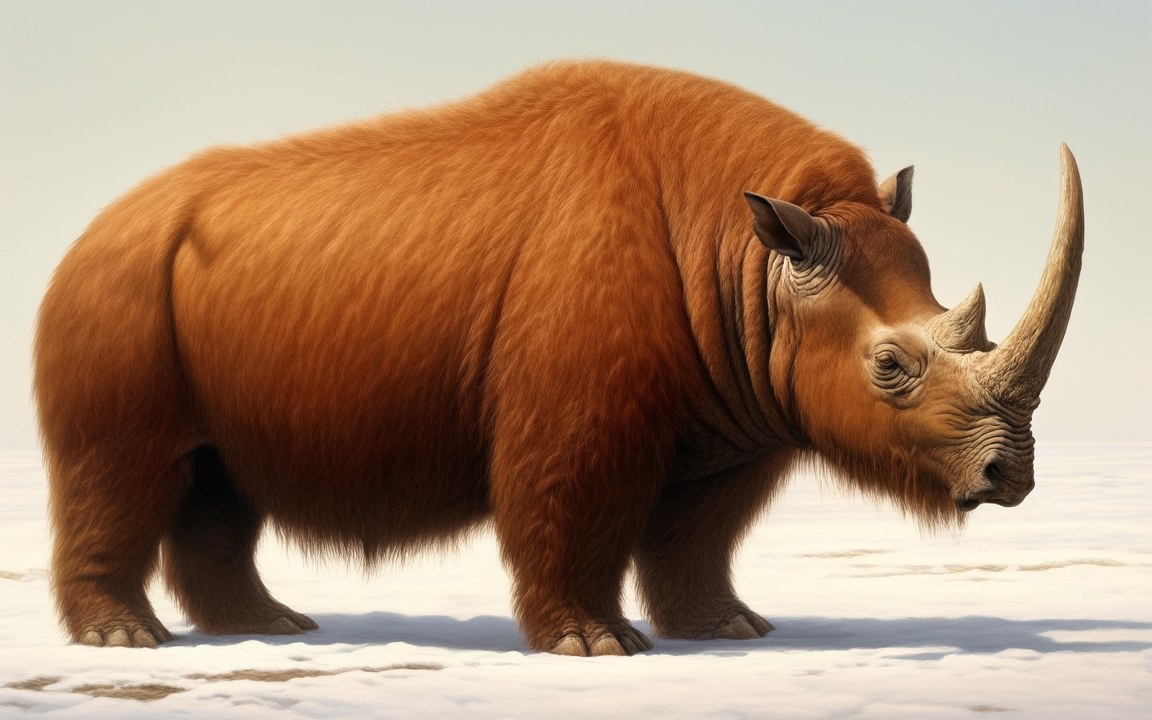
About the pictures. Four scenes painted from frozen carcasses and Ice Age cave art: a rhino side-on on snow, one grazing on a frosty steppe, a portrait of the head with frost on the horn, and one walking beside a meltwater stream in spring. All show long hair over a thick undercoat and a long front horn with a smaller second horn behind it; the full-body views add short legs and a raised hump. Frozen coats are brown, so the orange-red of some of these paintings is probably too strong. A hump has been found on only one frozen young animal, so whether adults always carried one is uncertain. The dark band across the body in many cave paintings is left out, as nobody knows if it was real.
The woolly rhinoceros was the mammoth’s companion on the cold grasslands of Ice Age Eurasia. It was a heavily built rhino, up to about 3.6 m long, covered in long brown hair, with a front horn that could be well over a metre long. People painted it in the caves of France, and several of its bodies have come out of the frozen ground of Siberia with skin and hair intact. Its last reliable bones are about 14 000 years old.
Built for the steppe
Frozen carcasses show long, coarse guard hairs over a thick undercoat, shorter hair on the legs, small ears up to 24 cm long and a tail of 45 to 50 cm. Adults were brown, and young animals a lighter brown. Its head hung low, close to the ground, which suited an animal that grazed mostly on grasses and sedges. Chemical traces in its horns suggest it switched to browsing shrubs in winter.
The front horn was often flattened and reached forward. In adults it was usually 1 to 1.35 m long, and the longest on record measures 164.7 cm along its curve. Wear on the horn suggests the rhino may have used it to brush snow off the grass beneath.
The hump
Ice Age artists drew the woolly rhinoceros with a raised hump over its shoulders and a low head, and many drawings show a dark band across the body. For a long time it was unclear whether the hump was real. In 2024 researchers described a frozen young rhino from Yakutia, about four years old, with a hump 36 cm long and 13 cm high, filled with white fat. It was the first reliable evidence from soft tissue, and it showed that the painters at Chauvet had drawn what they saw. With only one such body, though, nobody knows whether adults carried the hump all year round.
Where it came from
Its family line goes back about 3.7 million years to a relative from Tibet. The woolly rhinoceros itself appeared around 450 000 years ago and spread across northern Eurasia, from most of Europe to the far northeast of Siberia. It seems never to have crossed into North America, although the mammoth did. A 2026 study of 29 mitochondrial and 14 nuclear genomes found that its genetic diversity arose mainly in the temperate middle latitudes of East Asia rather than in Siberia, and that warm interglacial periods caused its populations to crash.
The end
The last reliable bones are about 14 200 years old in the Urals and about 14 000 years old in northeastern Siberia, around the time a sudden warming began about 14 700 years ago. As the climate changed, its open grassland turned to shrubland and the snow grew deeper. Environmental DNA from about 9 800 years ago hints that a few may have lasted longer, but DNA in permafrost can be reworked into younger layers, and the claim is disputed.
How much people contributed is disputed. A 2024 model that combined fossils, ancient DNA and simulations over 52 000 years found that low but sustained hunting, together with cooling, pushed the species south and trapped it in scattered, deteriorating habitats, and it put the final extinction at around 10 000 years ago. Genome studies point the other way. In 2026 researchers read the genome of a 14 400-year-old piece of rhino from the stomach of a frozen wolf pup, and found no sign of inbreeding or a slow decline. The population seems to have stayed healthy until shortly before the end, which suggests a rapid collapse driven by the warming climate.
Where it sits in deep time
Woolly rhinoceros: About 450 000 to 14 000 years ago, in the Pleistocene.
Each step to the right is ten times closer to today, so the last few million years get as much room as the first billion.
23:59:51.5
If Earth's history were one day
Squeeze all of Earth's history, about 4.6 billion years, into 24 hours, starting at midnight. Woolly rhinoceros runs from 23:59:51.5 to 23:59:59.74, ending 0.26 seconds before midnight.
On this clock one second is about 52 862 years. All of written history fits into the last tenth of a second.
The last minute, enlarged
23:59:00midnight
How big
Length and shoulder height of the woolly rhinoceros next to a person.
Length, head to tail, up to3.6 m
Shoulder height, up to1.6 m
Front horn, adult, up to about1.35 m
Person, for scale1.7 m
Some studies give shoulder heights up to about 1.9 m and weights up to about 2.9 tonnes.
Reconstructions
A stocky rhinoceros covered in thick, reddish-brown hair standing side-on on snow, with a long, upward-curving front horn on the tip of its nose and a short second horn behind it, an impression of a woolly rhinoceros. AI-generated painting.A shaggy, reddish-brown woolly rhinoceros grazing with its head down on a frosty, snow-patched steppe, its long front horn curving up in front of its face and a short second horn behind it, an impression of a woolly rhinoceros in Ice Age Siberia. AI-generated painting.Close-up of the head of a woolly rhinoceros in profile, covered in reddish-brown hair, with one very long horn sweeping forwards and upwards from the tip of its nose and a short second horn behind it, frost on the horn, an impression of a woolly rhinoceros in an Ice Age winter. AI-generated painting.A stocky rhinoceros covered in long, shaggy reddish-brown hair walking beside a shallow meltwater stream on a green steppe, patches of old snow on the gravel, with one long, forward-sweeping horn and a short second horn on its nose, an impression of a woolly rhinoceros in spring. AI-generated painting.
Questions people ask
How big was the woolly rhinoceros?
About 3.2 to 3.6 m long and 1.45 to 1.6 m tall at the shoulder, weighing up to about 2 tonnes. Some studies give larger figures, up to about 1.9 m and 2.9 tonnes.
How long was its horn?
The front horn of an adult was usually 1 to 1.35 m long, often flattened and pointing forward. The longest on record measures 164.7 cm along its curve. Wear on the horn suggests it may have been used to sweep snow away from grass.
Why did the woolly rhinoceros go extinct?
Warming after about 14 700 years ago turned its open grassland into shrubland and brought deeper snow. A 2024 model found that steady human hunting also helped push it to the brink, but a 2026 genome study saw no slow decline before the end, which points to a rapid collapse driven by climate.
Did woolly rhinos live in North America?
Apparently not. Unlike the woolly mammoth, it seems never to have crossed into North America. Its most easterly remains come from Chukotka, at the far northeastern tip of Siberia.
Did the woolly rhinoceros have a hump?
At least sometimes. In 2024 researchers described a frozen young rhino from Yakutia with a hump of fat over its shoulders, 36 cm long, just as Ice Age artists painted it on the walls of Chauvet cave.