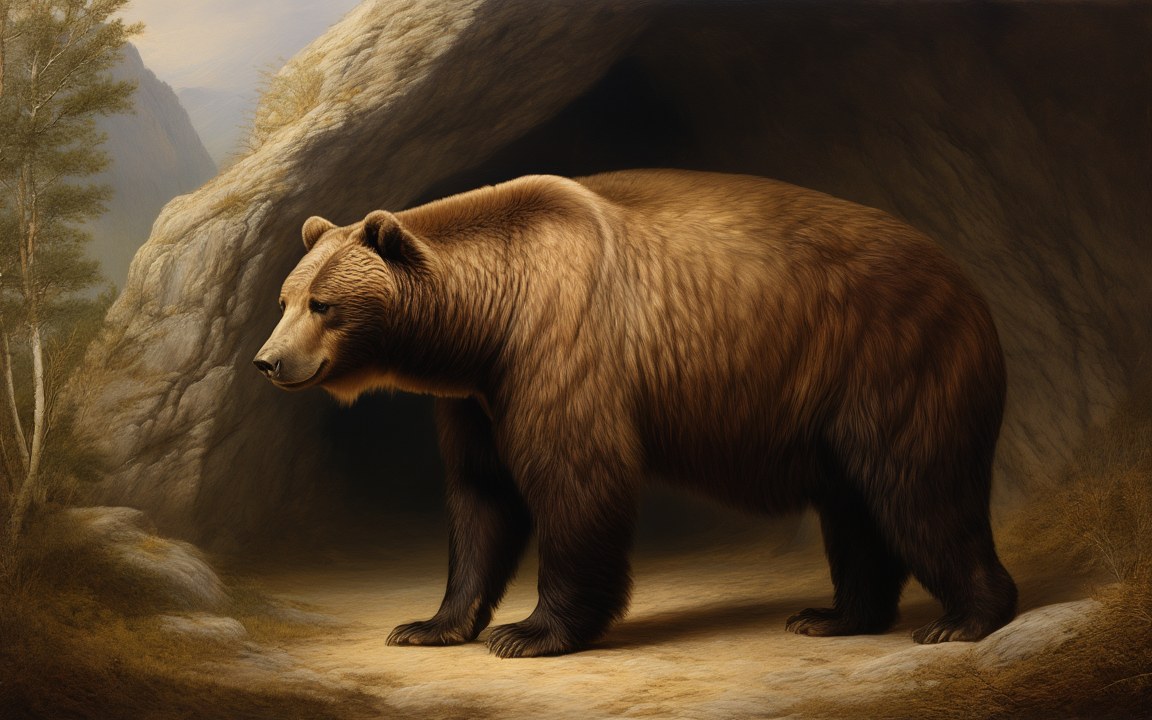
A huge, heavy brown bear standing at the mouth of a limestone cave in a wooded mountain valley in soft light, an impression of a cave bear in Ice Age Europe.

Lost GiantsPleistocene

Cave bear

A bear as big as the largest alive today, with a domed head and teeth for grinding plants

About 250 000 to 24 000 years ago Reconstruction, not a photograph
Lived about 250 000 to 24 000 years ago its lineage, starting with Ursus deningeri, appears about 1.2 to 0.8 million years ago [1]
Length up to about 2 m [1]
Weight, males about 350 to 600 kg as cited from a 1999 limb-bone study by Christiansen [1]
Weight, females about 225 to 250 kg [1]
Range Spain and the British Isles to the Caucasus and northern Iran most remains come from the Pyrenees, Alps and Carpathians [1]
Diet mostly plants some meat, bone and insects, especially before winter [1]
Winter traces about 300 hollows in Chauvet Cave 80 cm to almost 1.5 m across, usually 30 to 50 cm deep [3]
Named 1794, by Rosenmüller Esper described skeletons in 1774 and took them for polar bears [1]
Youngest DNA date 23 907 to 23 461 years ago a bone from Trene, Italy [6]
DNA in brown bears today 0.9 to 2.4 per cent of the genome, in every brown bear studied [7]

About the pictures. Three paintings show a heavy bear standing at the mouth of a limestone cave, sleeping on a dark cave floor, and eating tall herbs in a mountain meadow below pines and grey peaks. The stout body, thick legs and upland setting follow skeletons and the places where its bones are found, and the sleeping bear follows the resting hollows in caves such as Chauvet. Fossil skulls are very broad and domed, with a steep forehead, while the faces here are longer and straighter, closer to a brown bear's. The shoulder hump is imagined, and so is the brown coat, borrowed from living bears because the real colour is unknown.

The cave bear, Ursus spelaeus, was a heavy, mostly plant-eating bear that lived in Europe and as far east as northern Iran, from about 250 000 to 24 000 years ago. Large males matched or outweighed the biggest bears alive today. It spent its winters underground, and so many died there that some caves hold thousands of its bones, making it one of the best-known animals of the Ice Age. Fragments of its DNA still survive in living brown bears.

Winters underground

Cave bears kept to low mountain country rich in limestone caves, with forest or forest edge, and they avoided open plains. In the cold months they went underground. Chauvet Cave in France has about 300 resting hollows, 80 cm to almost 1.5 m across and usually 30 to 50 cm deep, worn by bears returning to the same spots. The French culture ministry’s account describes a state of semi-lethargy, not true hibernation, while other studies use the word hibernation.

Death in the den was common, mainly among animals that had failed during the summer through inexperience, sickness or age. Their bones show spinal fusion, tumours, rickets and signs of tuberculosis. The numbers once suggested herds, but the piles built up over 100 000 years or more, so about two deaths a year in a cave would account for them.

Early finds were badly misread. Esper, who described skeletons in 1774, thought they were polar bears, while others of his time considered apes, dragons and unicorns. During the First World War, earth from these caves was dug out for its phosphate.

A head built for chewing

Below the neck the skeleton resembles a brown bear’s, with long thighs, massive shins and in-turned feet. The head is the difference: a very broad, domed skull with a steep forehead. Through time the front premolars shrank and disappeared, the last premolar grew more like a molar, and the last molar lengthened and gained extra cusps. Those changes improved its ability to chew tough vegetation.

Males far outweighed females, at about 350 to 600 kg against 225 to 250 kg, and the species grew larger in glacial periods and smaller in warmer ones.

Plant-eater, with exceptions

Low nitrogen-15 and carbon-13 in its bones point to a largely plant diet, foraged mainly in forest. The picture has become less tidy. Tooth wear shows that feeding habits differed by region: bears high in the Totes Gebirge swallowed sand along with alpine plants, while bears in Belgium ate bone, insects and meat before winter. One isotope study found omnivory on a par with modern brown bears.

In 2025 Meleg and colleagues combined isotopes and ancient DNA for bears from the Romanian Carpathians. Individual diets varied widely, and the variation did not follow population, sex, period, climate or place. They concluded that diet was shaped by each bear’s foraging experience and was not inherited.

Two stories that did not hold

Excavations at Drachenloch in Switzerland between 1917 and 1923 uncovered a low wall of limestone slabs enclosing bear skulls, read as proof of prehistoric bear worship. In 2004 the archaeologist Insoll questioned whether people had made the arrangement at all, and called the evidence for such rites “far from convincing”.

More recently, a well-preserved carcass from the Lyakhovsky Islands, recovered in 2020, was announced as a cave bear about 30 000 years old. A new necropsy reported in 2023 identified a young brown bear about 3 500 years old.

A long decline

A 2010 genetic study led by Stiller found that cave bear numbers began falling about 25 000 years before extinction, while brown bears held steady. The authors concluded that neither climate nor hunting alone could explain this, and suggested a mix of causes that included competition with people for caves. A 2019 study led by Gretzinger, with 59 new mitochondrial genomes, found a sharper fall from about 40 000 years ago as modern humans spread through Europe, and saw support for a potentially significant human role. Others reply that people were too few to pose such a threat.

Most radiocarbon dates end around 28 000 to 26 000 years ago, and a few relict populations lasted longer. The youngest DNA sequence, from Trene in Italy, is 23 907 to 23 461 years old.

The line did not vanish entirely. Cave bears interbred with brown bears, and a 2018 study led by Barlow found that they contributed 0.9 to 2.4 per cent of the genomes of all the living brown bears it examined.
Where it sits in deep time

Cave bear: About 250 000 to 24 000 years ago, in the Pleistocene.

Cave bear

Earth forms, 4.57 billion years agoToday

Each step to the right is ten times closer to today, so the last few million years get as much room as the first billion.

If Earth's history were one day

Squeeze all of Earth's history, about 4.6 billion years, into 24 hours, starting at midnight. Cave bear runs from 23:59:55.3 to 23:59:59.55, ending 0.45 seconds before midnight.

On this clock one second is about 52 862 years. All of written history fits into the last tenth of a second.

How big

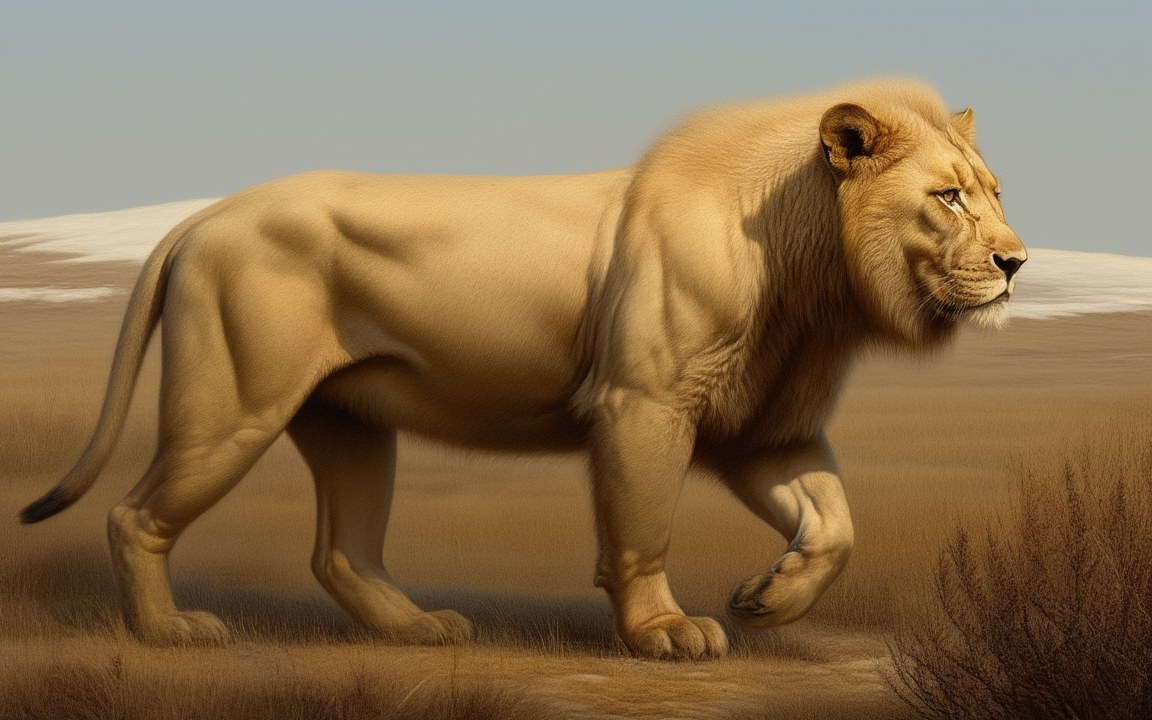
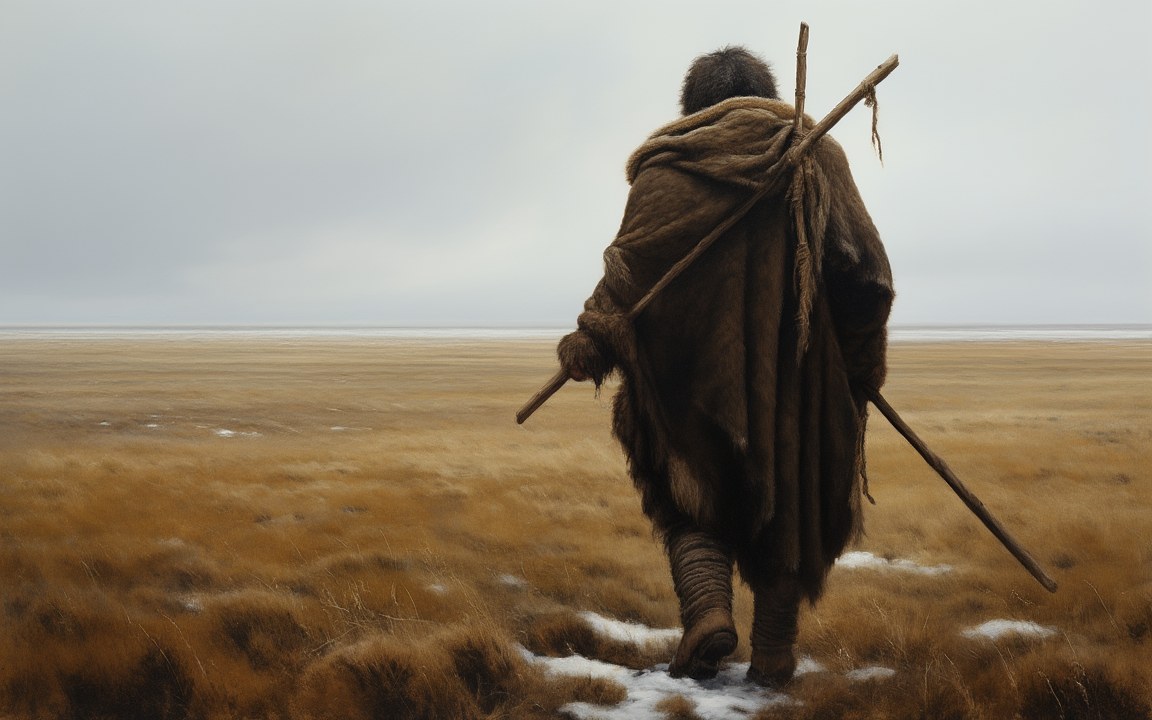
Greatest body length given for a cave bear, next to the height of a person.

The length comes from a 1999 popular encyclopedia cited on Wikipedia.

Reconstructions

A huge, heavy brown bear standing at the mouth of a limestone cave in a wooded mountain valley in soft light, an impression of a cave bear in Ice Age Europe. AI-generated painting.
A large brown bear sleeping curled up on the floor of a dark cave, lit by faint light from the entrance, an impression of a cave bear in its winter rest in Ice Age Europe. AI-generated painting.
A huge, heavy brown bear eating tall herbs in a mountain meadow, pines and grey limestone peaks behind, an impression of a cave bear feeding on plants in Ice Age Europe. AI-generated painting.

Questions people ask

How big was a cave bear?

Estimates for males run from about 350 to 600 kg and for females from about 225 to 250 kg, with a body up to about 2 m long. That made large males comparable to, or larger than, the largest bears alive today. Females were much smaller.

What did cave bears eat?

Mostly plants, as their bone chemistry and grinding teeth show. Some also ate meat, bone and insects, especially in the weeks before winter. A 2025 study found that individuals in the Romanian Carpathians differed widely in diet, probably through experience and not through inheritance.

When and why did the cave bear go extinct?

About 24 000 years ago. Genetic studies show a long decline, with a sharper fall from about 40 000 years ago as modern humans spread through Europe. Competition for caves, hunting and climate are all discussed, and none has been shown to be the sole cause.

Is the cave bear related to the brown bear?

Yes. The two lines split about 1.2 to 1.5 million years ago, then interbred later. A 2018 study found that cave bears contributed 0.9 to 2.4 per cent of the genomes of all the living brown bears it examined.
Did Neanderthals worship cave bears?

The evidence is weak. The idea of a bear cult rests on finds such as a stone chest of skulls at Drachenloch in Switzerland, but the archaeologist Insoll doubted that people arranged it and called the evidence for such rites 'far from convincing'.

Was a frozen cave bear found in Siberia?

No. A carcass from the Lyakhovsky Islands, recovered in 2020, was first taken for a cave bear about 30 000 years old. A new necropsy reported in 2023 showed it was a young brown bear about 3 500 years old.

Sources

  1. Wikipedia: Cave bear
  2. Christiansen (1999), What size were Arctodus simus and Ursus spelaeus (Carnivora: Ursidae)?, Annales Zoologici Fennici 36, 93–102
  3. French Ministry of Culture, The Chauvet-Pont d'Arc cave: bear hollows
  4. Meleg et al. (2025), Ancient biomolecules suggest a learned foraging strategy in extinct cave bears, iScience 28, 113920
  5. Stiller et al. (2010), Withering away: 25,000 years of genetic decline preceded cave bear extinction, Molecular Biology and Evolution 27, 975–978
  6. Gretzinger et al. (2019), Large-scale mitogenomic analysis of the phylogeography of the Late Pleistocene cave bear, Scientific Reports 9, 10700
  7. Barlow et al. (2018), Partial genomic survival of cave bears in living brown bears, Nature Ecology & Evolution 2, 1563–1570
  8. Nield (2023), Ancient Siberian bear reveals an unexpected twist on close inspection, ScienceAlert