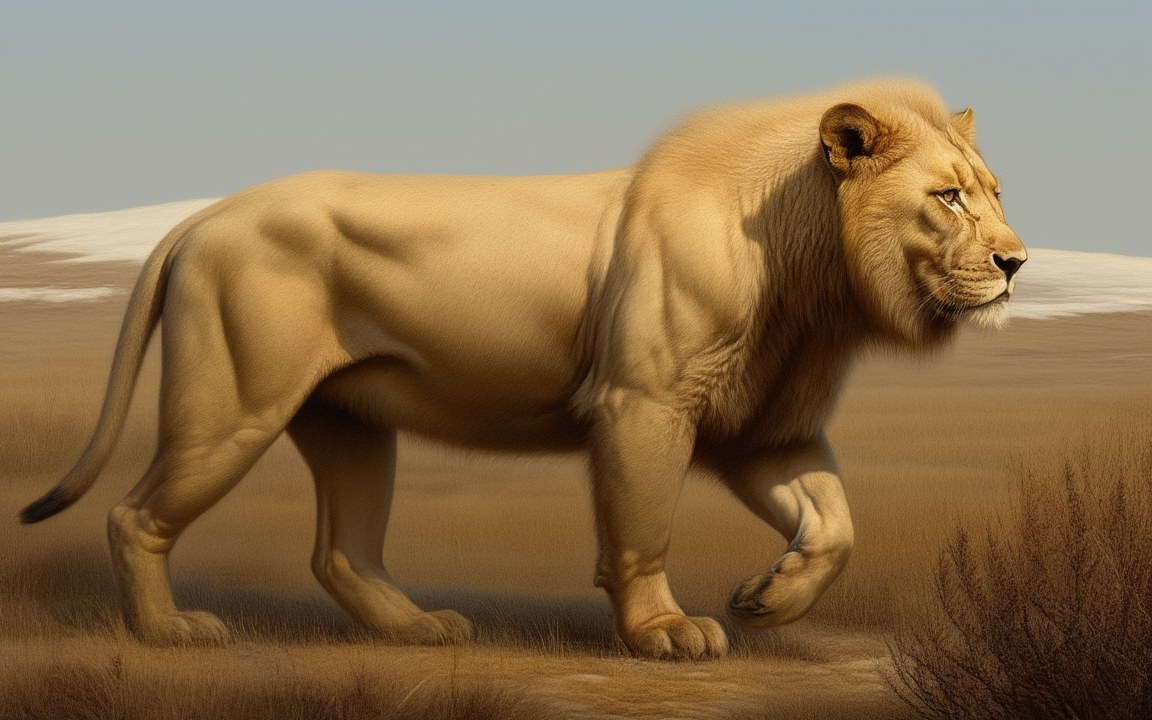
A large, muscular lion with a pale tawny coat, a thick ruff of fur on the neck and a dark-tipped tail, walking across a dry steppe with patches of snow, an impression of a cave lion of Ice Age Europe.

Lost GiantsPleistocene

Cave lion

A separate species of lion that shrank through the last Ice Age and left its bones in other animals' dens

About 300 000 to 13 000 years ago Reconstruction, not a photograph
Lived about 300 000 to 13 000 years ago the wider lineage, sometimes split off as Panthera fossilis, goes back about 700 000 years [1]
Size, Late Pleistocene 2 to 2.1 m long 1.1 to 1.2 m at the shoulder [1]
Size, early form 2.5 to 2.9 m long some individuals; 400 to 500 kg and 1.4 to 1.5 m at the shoulder [1]
Size, last populations about 70 to 90 kg 1.2 to 1.3 m long, 70 to 75 cm at the shoulder [1]
Range western Europe to Alaska and the Yukon also north-east China and Japan [1]
Mane none, or a very small one inferred from cave art, not from soft tissue [1]
Coat slightly lighter than a modern lion's, over a very thick undercoat hair from Chukotka, identified by DNA [6]
Prey reindeer prominent from bone chemistry; also horse, mammoth and cave bear [1]
Named 1810, by Goldfuss from a skull found in the Zoolithenhöhle, Bavaria [1]
Closest living relative the modern lion the two lines split about 500 000 to 1 million years ago [1]

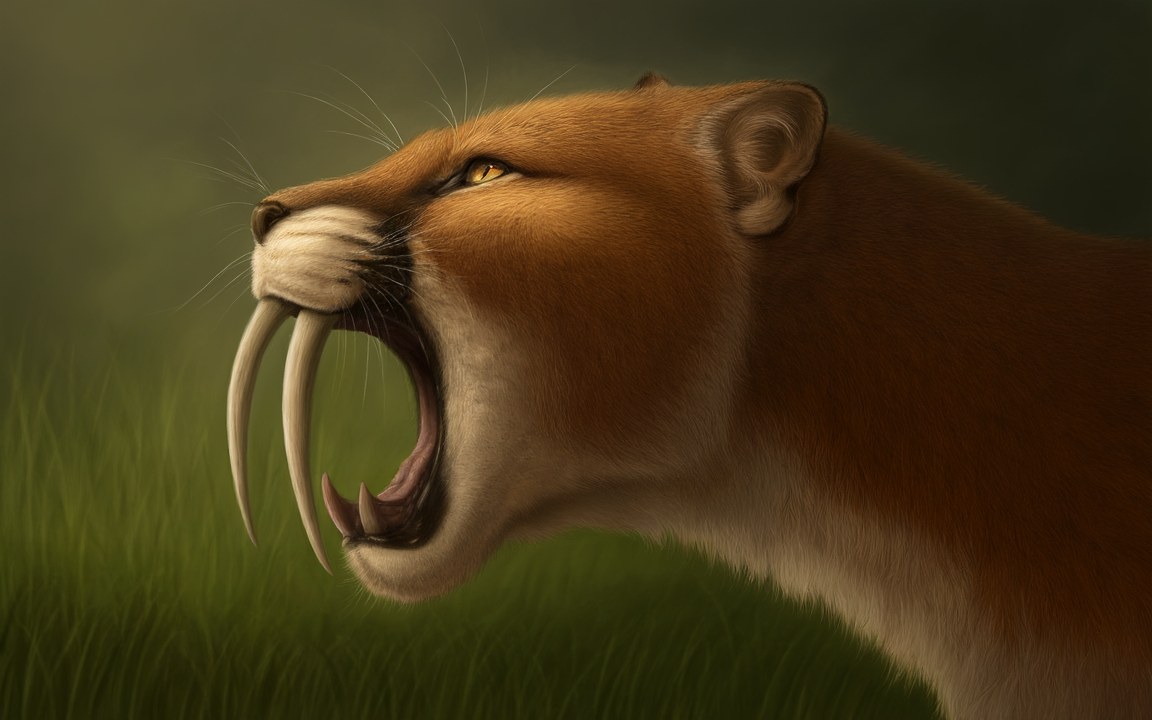
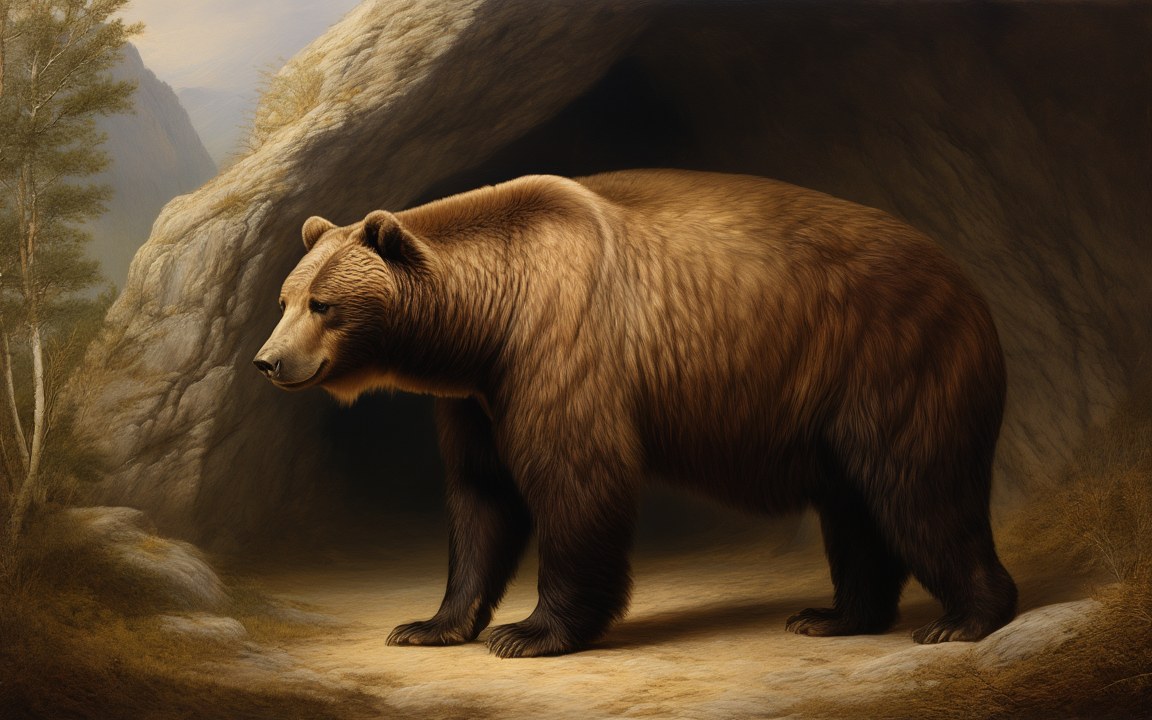
About the pictures. Four paintings show the lion walking over dry steppe with snow patches, a head in profile, the animal lying in grass with antlered deer far off, and the animal resting on a rock ledge at a cave mouth. The build follows skeletons, the pale coat follows frozen cubs and hair from Chukotka, and the lack of a full mane follows cave art; the thick neck ruff on the walking lion is the most that art allows. The cave is an exception, because the species kept mostly to open country. A living cat carries less visible muscle than the walking lion, and its forelimb is shorter than the one stretched out in the grass. The exact shade, the dark tail tip and the size of the ears are imagined.

The cave lion, Panthera spelaea, was a big cat closely related to the modern lion but genetically a separate species. From about 300 000 to 13 000 years ago it ranged across the mammoth steppe, from western Europe through Siberia and over the Bering land bridge into Alaska and the Yukon. It was one of the main predators of that world, and a skeleton from Germany has been called the earliest direct evidence of people killing a large predator. Its name is a historical accident: it describes where the bones turned up, not where the animal lived.

Named after the wrong place

Goldfuss named the species in 1810 from a skull found in the Zoolithenhöhle, a cave in Bavaria, and many more bones have come out of caves since. Yet the lion probably used caves only rarely, if at all, and it also lived in regions that have none. Its home was steppe and grassland, with some open woodland.

The bones got underground in other ways. Hyenas seem to have dragged in lions killed in fights over carcasses. Weak or sick adults may have died after going into caves to hunt hibernating bears or steal food from hyenas.

Chemical traces in bones from Europe and eastern Beringia show that reindeer were especially important prey. A frozen steppe bison from Alaska, Blue Babe, has bite marks of the right size and a fragment of lion tooth in its hide.

From giant to dwarf

Some early members of the lineage, often split off as Panthera fossilis, are estimated at 2.5 to 2.9 m long and 400 to 500 kg, among the largest cats that ever lived. Late Pleistocene lions were smaller, at 2 to 2.1 m long, and they kept shrinking. A 2024 paper by Marciszak and Gornig describes a gradual decline that sped up late in the last glaciation. The final populations are put at only 70 to 90 kg and 70 to 75 cm at the shoulder, the size of small modern lions, which may have left them more exposed to wolves.

Frozen cubs and a missing mane

Two cubs from the Semyuelyakh River in Yakutia, a female named Sparta and a male named Boris, were 1 to 2 months old when they died. They lay close together but were not littermates: their uncalibrated radiocarbon ages are about 28 000 and 43 400 years. Sparta’s fur is greyish to light brown and Boris’s a lighter greyish yellow, which led the authors to suggest that coats grew paler with age and suited snowy country. Hair from an adult found by the Malyi Anyui River in Chukotka is similar to a modern lion’s but slightly lighter, over a very thick undercoat.

For the mane, the evidence is art. A drawing in Chauvet Cave shows two lions walking together, and the larger, drawn with a scrotum, has no mane. Whether they lived in prides is unresolved. Guthrie argued from the missing manes for solitary animals or small family groups, Yamaguchi and colleagues rejected that reasoning, and a 2024 paper by Sabol and Puzachenko called the question open.

Spears and carvings

The Siegsdorf skeleton in Germany, about 48 000 years old, is an old male of medium size. A 2023 study led by Russo concluded from a puncture in a rib that it was killed with a wooden thrusting spear, probably by Neanderthals, and cut marks show it was butchered. Toe bones at least 190 000 years old from Einhornhöhle suggest a lion skin carried into the cave, and at Scladina in Belgium, about 130 000 years ago, Neanderthals made tools from a lion’s shin bone. Modern humans later painted lions at Chauvet and Lascaux and carved the lion-headed figure of Hohlenstein-Stadel, 41 000 to 35 000 years old.

Separate lineage, shared end

A 2026 study of 12 genomes led by Stanton confirmed that cave and modern lions were distinct lineages, with some ancient gene flow. Sun and colleagues reported in 2026 that every Japanese “tiger” fossil yielding molecular data was in fact a cave lion.

From 111 radiocarbon dates, Stuart and Lister placed the extinction at about 14 000 to 14 500 years ago in Eurasia and about a thousand years later in Alaska and the Yukon. Russo’s paper mentions fossils about 12 500 years old in Central Europe. Stuart and Lister linked the end to a warming about 14 700 years ago that spread shrubs and trees over open ground, with falling prey numbers possibly contributing. The role of people remains unclear.
Where it sits in deep time

Cave lion: About 300 000 to 13 000 years ago, in the Pleistocene.

Cave lion

Earth forms, 4.57 billion years agoToday

Each step to the right is ten times closer to today, so the last few million years get as much room as the first billion.

If Earth's history were one day

Squeeze all of Earth's history, about 4.6 billion years, into 24 hours, starting at midnight. Cave lion runs from 23:59:54.3 to 23:59:59.75, ending 0.25 seconds before midnight.

On this clock one second is about 52 862 years. All of written history fits into the last tenth of a second.

How big

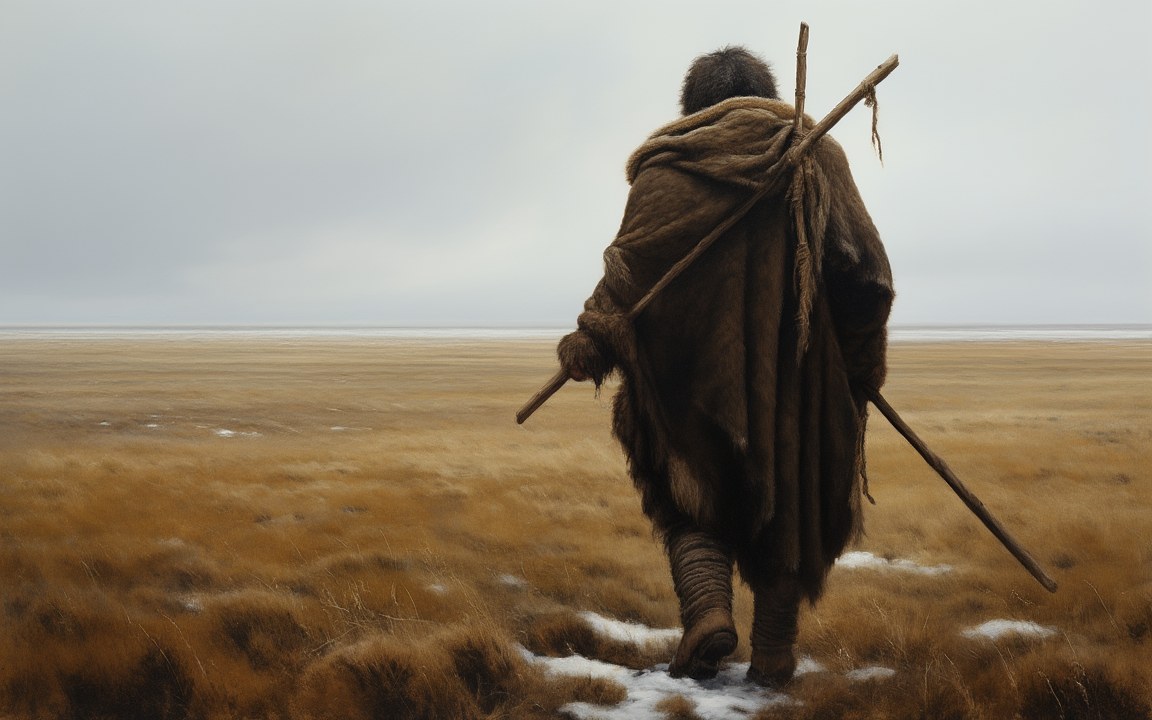
Body length of cave lions at three points in their history, next to the height of a person.

Reconstructions

A large, muscular lion with a pale tawny coat, a thick ruff of fur on the neck and a dark-tipped tail, walking across a dry steppe with patches of snow, an impression of a cave lion of Ice Age Europe. AI-generated painting.
Close-up of the head of a maneless lion in profile, with amber eyes and pale tawny fur, against a pale, cold sky, an impression of the head of a cave lion of Ice Age Europe. AI-generated painting.
A maneless, pale tawny lion lying low in dry golden grass with its head raised, a herd of deer far off on the plain, an impression of a cave lion watching prey on the steppe of Ice Age Europe. AI-generated painting.
A maneless, pale tawny lion lying on a rocky ledge at the mouth of a cave with snow on the rocks, looking out over a wide, cold plain, its long tail hanging over the stone, an impression of a cave lion of Ice Age Europe. AI-generated painting.

Questions people ask

Did cave lions live in caves?

Rarely, if ever. They lived mostly on open steppe and grassland, and also in regions with no caves. Their bones ended up in caves because hyenas dragged in dead lions, and because some lions entered bear and hyena dens and died there.

How big was the cave lion?

It depends on when. Some early individuals are estimated at 2.5 to 2.9 m long and 400 to 500 kg. Late Pleistocene cave lions were 2 to 2.1 m long and 1.1 to 1.2 m at the shoulder. The last populations were only about 70 to 90 kg, the size of small modern lions.

Did cave lions have manes?

Probably not, or only very small ones. A drawing in Chauvet Cave shows a male lion, marked as male by its scrotum, with no mane. This rests on Ice Age art, not on preserved soft tissue.

Is the cave lion the same species as the modern lion?

No. Ancient DNA shows two separate lineages that split about 500 000 to 1 million years ago. They did sometimes interbreed: a 2026 study found 3.2 to 4.4 per cent modern lion ancestry in a cave lion about 20 000 years old.

Did Neanderthals hunt cave lions?

At least once. A skeleton about 48 000 years old from Siegsdorf, Germany, has a puncture in a rib that a 2023 study attributes to a wooden thrusting spear, and cut marks on other bones show it was butchered.

When did the cave lion go extinct?

Radiocarbon dates place the end at about 14 000 to 14 500 years ago across Eurasia and about a thousand years later in Alaska and the Yukon. A 2023 paper mentions fossils as young as about 12 500 years in Central Europe. Stuart and Lister think spreading shrubs and trees after a warming about 14 700 years ago the likely cause, though it remains unsettled.

Sources

  1. Wikipedia: Panthera spelaea
  2. Marciszak & Gornig (2024), From giant to dwarf: a trend of decreasing size in Panthera spelaea (Goldfuss, 1810) and its likely implications, Earth History and Biodiversity 1, 100007
  3. Russo et al. (2023), First direct evidence of lion hunting and the early use of a lion pelt by Neanderthals, Scientific Reports 13, 16405
  4. Abrams et al. (2025), Earliest evidence of Neanderthal multifunctional bone tool production from cave lion (Panthera spelaea) remains, Scientific Reports 15, 24010
  5. Boeskorov et al. (2021), The preliminary analysis of cave lion cubs Panthera spelaea (Goldfuss, 1810) from the permafrost of Siberia, Quaternary 4, 24
  6. Chernova et al. (2016), Morphological and genetic identification and isotopic study of the hair of a cave lion (Panthera spelaea Goldfuss, 1810) from the Malyi Anyui River (Chukotka, Russia), Quaternary Science Reviews 142, 61–73
  7. Stanton et al. (2026), Paleogenomes reveal the evolutionary relationship between modern and cave lions, Cell 189, 4425–4436
  8. Sun et al. (2026), The Japanese Archipelago sheltered cave lions, not tigers, during the Late Pleistocene, PNAS 123, e2523901123
  9. Stuart & Lister (2011), Extinction chronology of the cave lion Panthera spelaea, Quaternary Science Reviews 30, 2329–2340