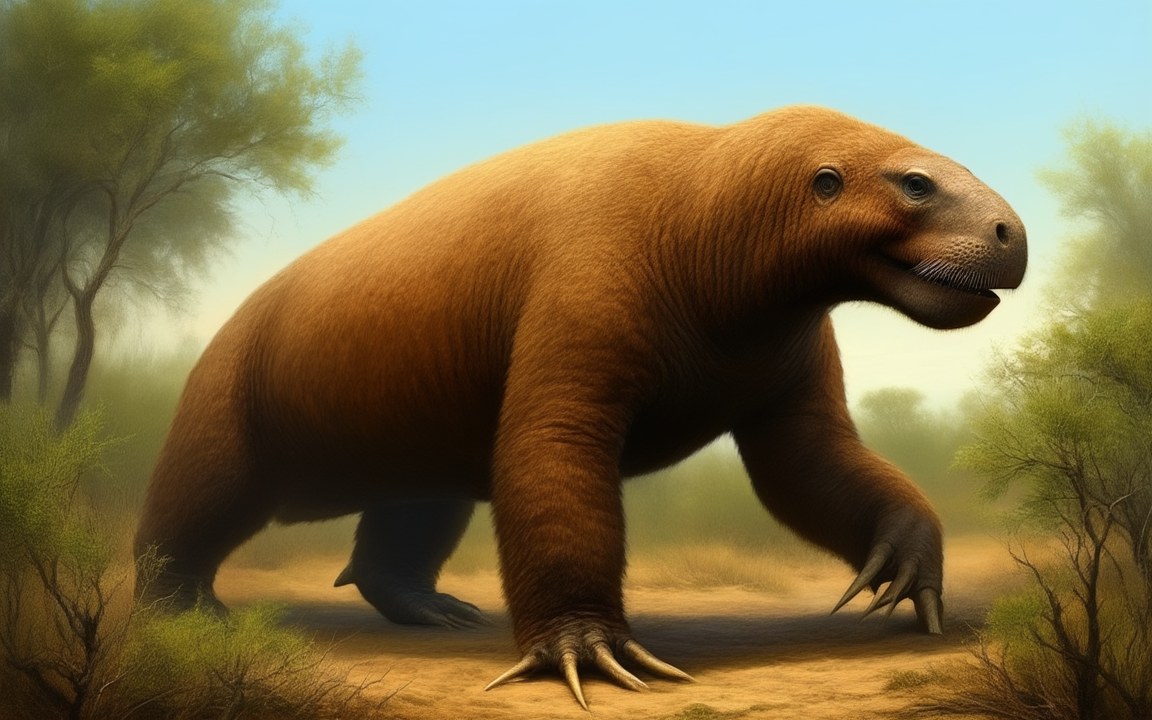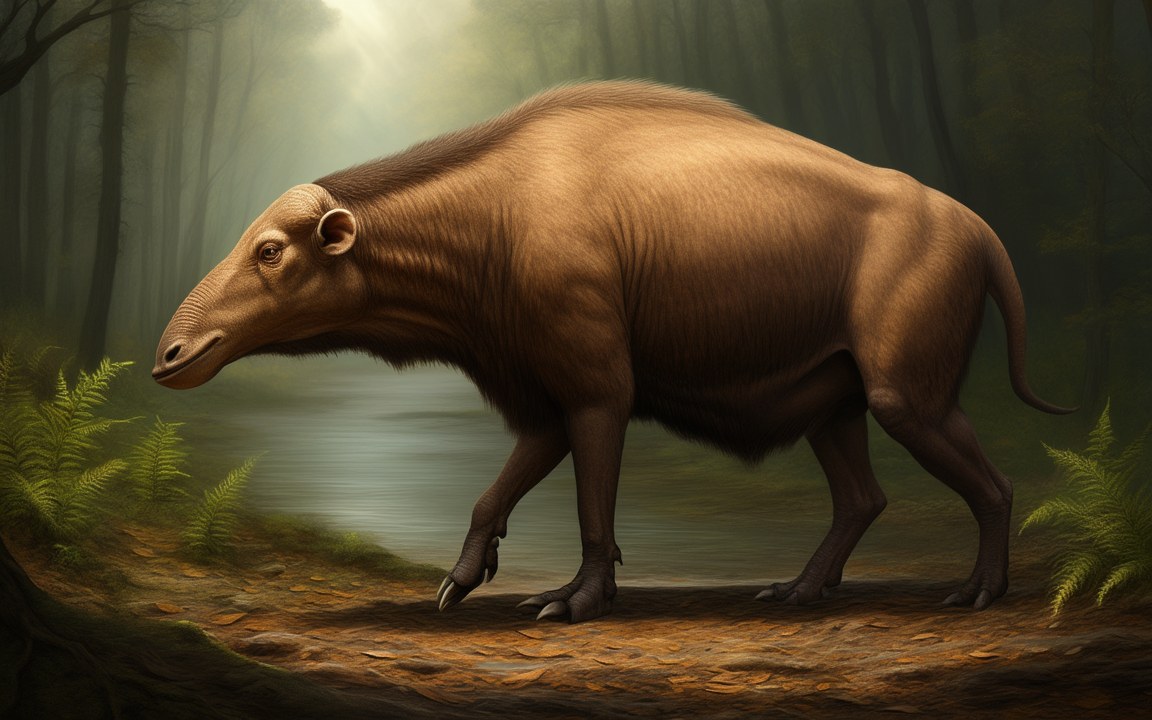
A heavy brown animal with a long, hornless head, high shoulders and a back sloping down to its hips, walking on clawed feet along a misty forest stream among ferns, an impression of Chalicotherium in Europe about 10 million years ago.

Lost GiantsNeogene

Chalicotherium

A hoofless relative of horses and rhinos that walked on its knuckles and hooked branches down with long, clawed arms

About 10 million years ago, from dated finds of its best-known species Reconstruction, not a photograph
Dated finds about 10 million years ago Chalicotherium goldfussi at Höwenegg, 10.3 million years, and Eppelsheim, about 9.5 million, both in Germany; these date two sites, not the whole life of the species [7]
Whole genus much longer, but sources differ 23 to 5.3 million years in English summaries, 16 to 7.75 million in German ones [1]
Whole family about 34 to 1 million years ago in Eurasia, Africa and North America [2]
Size often quoted as about 1 500 kg and 2.6 m at the shoulder no published study is cited for these figures [1]
Gait on its knuckles bony growths on the backs of the finger bones supported pads [1]
Feet three digits, all clawed claws deeply cloven; only the hind claws could be retracted [3]
Diet leaves, twigs and bark from tooth wear in C. goldfussi [1]
Habitat moist, closed-canopy forest true of its subfamily, the chalicotheriines [2]
Named 1833, by Kaup 'gravel beast', usually taken as a reference to its pebble-like teeth [1]
Relatives horses, rhinoceroses and tapirs all odd-toed ungulates, but chalicotheres had a family of their own [2]

About the pictures. Painted from skeletons and foot bones of Chalicotherium and its close relative Anisodon: a long, hornless head, high shoulders and big claws, in Europe about 10 million years ago. The animal walking by a forest stream stands on its front claws, with arms about as long as its legs, where the real animal had much longer arms and walked on its knuckles with the front claws folded back. The head with a leafy twig fits the soft lips that adults used to crop food. The forest setting follows evidence for moist, closed woodland; hair, colour, ears and exact plants are imagined.

Chalicotherium was a hoofless relative of horses, rhinoceroses and tapirs: a heavy animal with a horse-like head, very long arms ending in large claws, and short hind legs, so that its back sloped down steeply to its hips. Its best-known species, Chalicotherium goldfussi, lived in the forests of Europe about 10 million years ago, in the Late Miocene. At first sight it looks like a cross between a horse and a gorilla, and working out that its parts belonged together took most of the 19th century.

On its knuckles

Bony growths on the backs of its finger bones supported pads, and they are the main evidence that Chalicotherium walked on its knuckles. Its front claws could not be retracted, unlike those on its hind feet, so it folded them back towards the wrist as it walked, as anteaters do today. That spared the claws from wear but put most of its weight on the hind legs, and it was probably not a fast runner. Each foot had three digits, ending in claws deeply cloven at the tip.

Those hands were under strain. In 2025 Kampouridis and colleagues studied a fused pair of finger bones from Höwenegg in Germany. They found that chalicotheriines, the subfamily to which Chalicotherium belongs, restricted movement in some finger joints with a notched joint, and suggested that the stress of using such large claws may explain it, although they could not rule out disease in that one individual.

Claws for branches, not roots

Some early palaeontologists thought the claws dug up roots and tubers. Bones and teeth both argue against this. The forearm bones were fused, leaving little room for the twisting that digging needs, and the teeth were made for soft food. As adults these animals shed their incisors and upper canines, cropped with muscular lips and gum pads, and chewed on square, low-crowned molars. Tooth wear in Chalicotherium goldfussi points to leaves, twigs and bark, and in its relative Anisodon also to fruit and seeds.

The long arms and mobile shoulders let it reach up and hook branches towards its mouth, and its pelvis and hind legs allowed it to stand upright. Thickened patches on the hip bones show that it sat on its haunches for long periods, probably while feeding, as gelada monkeys do. The claws may also have served as weapons. Similar builds evolved separately in ground sloths, gorillas and giant pandas.

Claws without an owner

The first chalicothere claw bones, from near Eppelsheim in Germany, were taken by Cuvier in 1822 for those of a giant pangolin. In 1833 Kaup named Chalicotherium from teeth found in the same place, but gave the claws to Deinotherium, whose fossils come from the same sands. Lartet named limb bones from Sansan in France Macrotherium in 1837, again thinking of a giant pangolin, and in 1849 Blainville gave skull remains from that site to an unrelated hoofed mammal. Only in 1890 did Filhol describe a complete skeleton from Sansan that showed the parts belonged to one animal.

Fossils remain scarce. Complete skeletons are known only for Moropus in North America and Anisodon in Europe, so the picture of Chalicotherium is partly filled in from these relatives. A rock fissure at Devínska Nová Ves in Bratislava has yielded more than 1 500 bones of at least 60 individuals of Anisodon grande, probably animals that fell in one at a time.

How big, and how old

Size is the weakest part of the record. About 1 500 kg and 2.6 m at the shoulder are the figures usually quoted for Chalicotherium goldfussi, and German summaries add 1.8 m for females, but none of them cites a study that measured these animals. For scale, Moropus stood up to about 2.4 m, and one specimen has been estimated at 1 179 kg.

Its age is pinned down better by site than by genus. Zapfe described Chalicotherium goldfussi from Höwenegg, in beds dated to 10.3 million years. The Eppelsheim sands are usually put at about 9.5 million years, although a 2012 study by Böhme and colleagues argued that they mix fossils covering at least six million years. These two sites date finds, not the whole life of the species, which is known from the late Middle to the early Late Miocene of Europe. The genus lasted much longer, by figures that differ between summaries. The family as a whole lasted from about 34 to 1 million years ago, and its last members survived in Asia and Africa into the Early Pleistocene.
Where it sits in deep time

Chalicotherium: About 10 million years ago, from dated finds of its best-known species, in the Neogene.

Chalicotherium

Earth forms, 4.57 billion years agoToday

Each step to the right is ten times closer to today, so the last few million years get as much room as the first billion.

If Earth's history were one day

Squeeze all of Earth's history, about 4.6 billion years, into 24 hours, starting at midnight. Chalicotherium runs from 23:56:45 to 23:57:00, ending 3 minutes before midnight.

On this clock one second is about 52 862 years. All of written history fits into the last tenth of a second.

Reconstructions

A heavy brown animal with a long, hornless head, high shoulders and a back sloping down to its hips, walking on clawed feet along a misty forest stream among ferns, an impression of Chalicotherium in Europe about 10 million years ago. AI-generated painting.
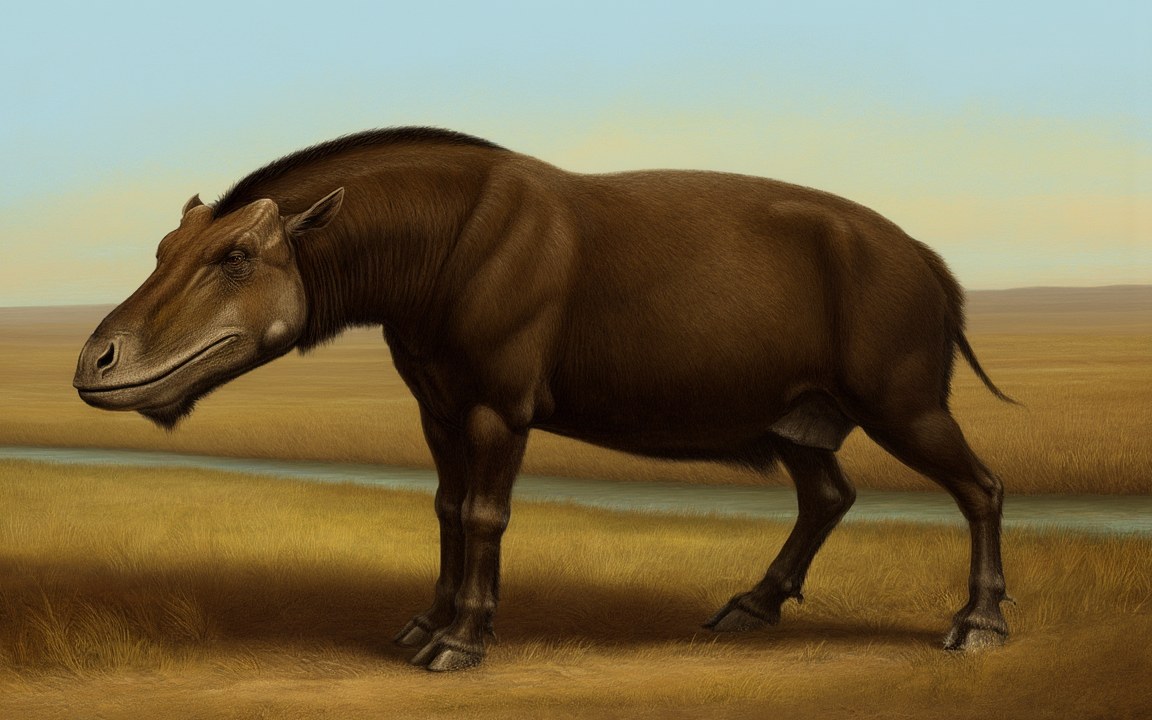
Close-up of a long, narrow brown head with a soft muzzle, a dark eye and upright ears, holding a leafy twig in its lips against a green forest, an impression of the head of Chalicotherium, an extinct clawed plant-eater. AI-generated painting.

Questions people ask

What is a chalicothere?

A member of the Chalicotheriidae, an extinct family of odd-toed ungulates related to horses, rhinoceroses and tapirs. Unlike those animals, chalicotheres had claws in place of hooves. Chalicotherium itself belonged to the subfamily with very long arms and short legs; the other subfamily, which includes Moropus, had limbs of about equal length.

Why did Chalicotherium have claws?

Most probably to hook branches within reach and rake food towards its mouth, and perhaps for defence. Its long arms and mobile shoulders suit reaching, and it could rear up or sit on its haunches while feeding. It walked on its knuckles, which spared the claws from wear.

Did chalicotheres dig with their claws?

Probably not. Some early palaeontologists thought so, but the fused forearm bones left little room for the twisting that digging needs, and the teeth were suited to soft food. Tooth wear points to leaves, twigs, bark, fruit and seeds.

How big was Chalicotherium?

Figures of about 1 500 kg and 2.6 m at the shoulder are often quoted for Chalicotherium goldfussi, but no published study is cited for them, so they should be treated with caution. Its North American relative Moropus reached about 2.4 m at the shoulder, and one specimen has been estimated at 1 179 kg.

When did Chalicotherium live?

Dated finds of its best-known species, Chalicotherium goldfussi, are about 10 million years old, from the Late Miocene of Germany, and the species is known from the late Middle to the early Late Miocene of Europe. The genus lasted much longer, though ranges differ between sources: 23 to 5.3 million years in some, 16 to 7.75 million in others.

When did chalicotheres go extinct?

They had largely gone from North America and Europe by about the end of the Miocene, about 5 million years ago. The last survived in Africa and Asia into the Early Pleistocene, and Hesperotherium in China may have lasted until about 1 million years ago.

Sources

  1. Wikipedia: Chalicotherium
  2. Wikipedia: Chalicotheriidae
  3. Wikipedia (German): Chalicotherien
  4. Wikipedia (German): Chalicotherium
  5. Wikipedia: Moropus
  6. Kampouridis, Kyriakouli & de Souza Ferreira (2025), Unique pathological phalangeal fusion in the chalicothere subfamily Chalicotheriinae and the interphalangeal immobilization in chalicotheres, The Science of Nature 112, 59
  7. Munk et al. (2007), Excavations at the Late Miocene MN9 (10.3 Ma) locality of Höwenegg (Hegau), Southwest-Germany, 2004–2006, Carolinea 65, 5–13
  8. Böhme et al. (2012), The antiquity of the Rhine River: stratigraphic coverage of the Dinotheriensande (Eppelsheim Formation) of the Mainz Basin, PLoS ONE 7, e36817
  9. Xafis et al. (2020), Palaeodietary traits of large mammals from the middle Miocene of Gračanica, Palaeobiodiversity and Palaeoenvironments 100, 457–477
  10. Kampouridis et al. (2024), Disparate occurrences of a chalicotheriine and a schizotheriine chalicothere at the Late Miocene hominid locality Hammerschmiede (Germany), Paläontologische Zeitschrift 98, 313–329