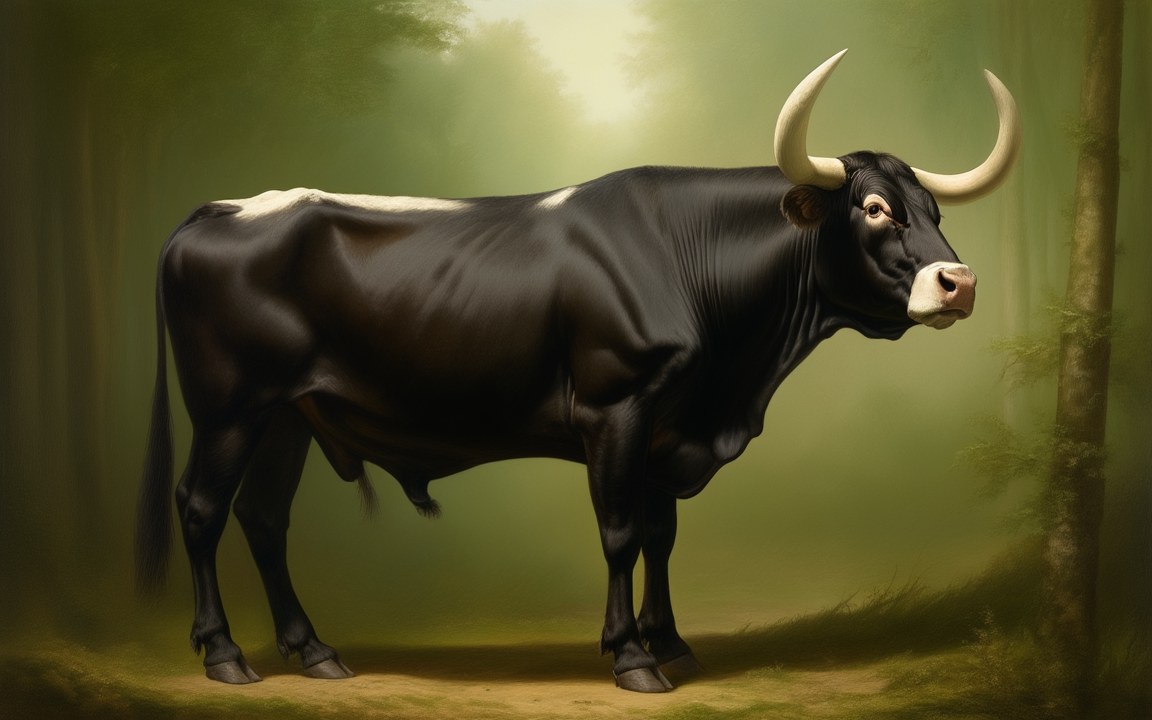
Every cow alive today descends from the aurochs, a wild ox that was taller and longer-legged than most of its domestic offspring. For hundreds of thousands of years it roamed the forests, wetlands and grassy plains of Europe, North Africa and Asia. People painted it on the walls of caves like Lascaux and Chauvet, tamed it, and finally hunted and crowded it out. The last one, a cow, died in a royal forest in Poland in 1627, two centuries before the first photograph.
What it looked like
An aurochs bull stood up to about 1.8 m at the shoulder, on legs much longer and more slender than a modern cow’s, with a big, long skull and an athletic body. Its horns were its most striking feature: up to 80 cm long and as much as 20 cm thick, they grew forward at an angle to the face and curved three ways, first up and out, then forward and in, and finally inward and up at the tips.
Unusually for an extinct animal, its colours were described by people who saw it alive. The 16th-century diplomat Herberstein wrote that it was pitch-black with a grey streak along the back. Bulls were black with a pale stripe along the spine and a pale muzzle; cows were reddish-brown, also with a light muzzle, and calves were probably chestnut. The hair on the forehead was long and curly.
The last herd
By the 13th century the aurochs survived only in small numbers in Eastern Europe. Its last stronghold was the royal forest of Jaktorów in Masovia, where the Polish kings kept the sole right to hunt it. Even there it dwindled. There were about 50 animals in the middle of the 16th century, only four by 1601, and the last, a cow, died of natural causes in 1627. Hunting, the clearing of forests and grazing by domestic livestock had squeezed it out. A horn core from Sofia, in Bulgaria, dated to the late 17th or early 18th century, hints that a few may have lasted longer somewhere else.
The ancestor of our cattle
About 10 500 years ago, people in what is now southeastern Turkey and northern Syria tamed a small number of aurochs, about 80 animals according to one genetic study. Their descendants became ordinary cattle. Aurochs in India were domesticated separately, probably 10 000 to 8 000 years ago, and gave rise to humped zebu cattle.
A 2024 study read 38 aurochs genomes from bones spanning about 50 000 years, from Siberia to Britain. It found that European and northern Asian aurochs split about 100 000 years ago and did not meet again until the end of the Ice Age, that domestication drew on very few animals, and that wild bulls kept breeding into domestic herds afterwards. As a result, four separate aurochs ancestries survive in cattle today.
Can it come back?
Since the 1920s, breeders have tried to recreate the aurochs by crossing cattle breeds. The first attempt produced Heck cattle, which critics call at best a vague look-alike. Newer projects such as Taurus cattle in Germany, the Tauros Programme, started in 2008, and the Uruz Project, started in 2013, all use Sayaguesa cattle among their crosses, and Tauros herds now graze in several European countries. Their animals can look much more like aurochs, but a similar appearance does not mean a similar genome, and the real aurochs remains extinct.