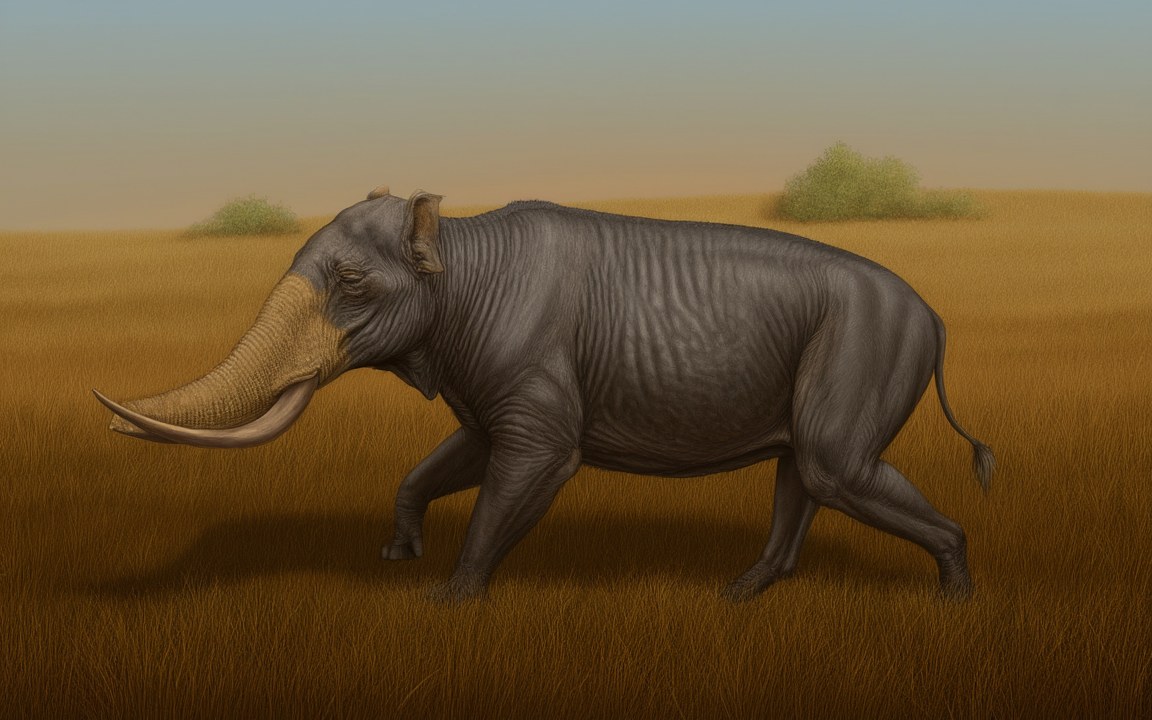
Platybelodon was a shovel-tusked relative of elephants that lived in Asia and the Caucasus during the Miocene, from about 17 million years ago. Its very long lower jaw ended in a pair of flat tusks lying side by side, which together look like the blade of a spade. That blade was first read as a scoop for water plants. Later work points to something closer to a scythe, used together with a trunk that could coil and grip, and a 2023 study calls Platybelodon the first known proboscidean to combine grazing with a trunk of that kind.
A shovel that cut
The first remains came from the Tchokrak beds of the Kuban region, in the North Caucasus, in 1927: a partial skull and a nearly complete lower jaw. Borissiak named them in 1928 and pictured an animal feeding in swampy ground, holding water plants in its spoon-shaped jaw and clearing away the mud with an enlarged upper lip. Early workers thought it had no trunk at all, only a lip like a hippopotamus’s.
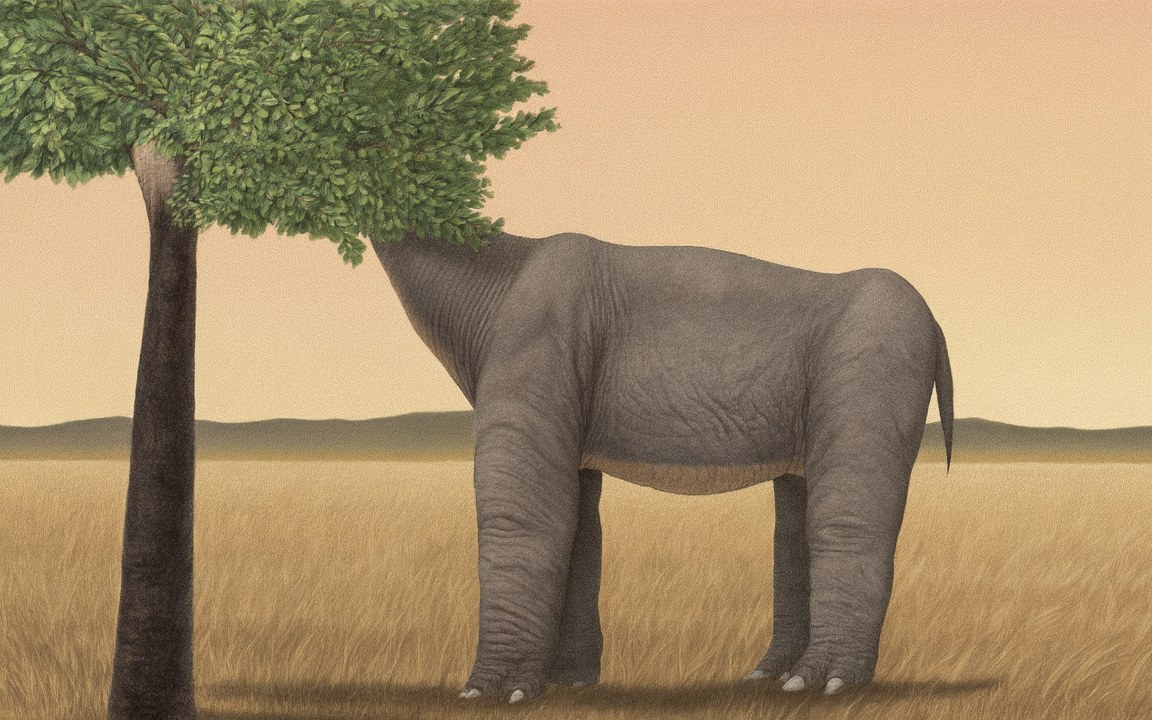
Wear on the teeth argued against this. It suggests that the lower tusks stripped bark from trees, and that their sharp front edge worked like a scythe, with the trunk holding a branch against the blade.
In 2023 a team led by Li tested the jaw with finite element analysis, a computer method that calculates how a structure bears a load, and compared it with the jaws of two other proboscideans. Platybelodon’s came out as “specifically suited for cutting vertically growing plants” and much less efficient than the others at cutting horizontal twigs. The picture that follows is of an animal wrapping its trunk around a clump of grass, pulling it taut and slicing through the stems, while still feeding from trees as well.
Reading a trunk from bone
No trunk survives, so its form has to be inferred. In Platybelodon the nasal opening is greatly enlarged, leaving a very broad area for the muscle that drives the trunk. From this, Li and colleagues infer a long, strong and flexible organ able to coil round plants and grasp them.
The neighbours give that result its weight. Between 17 and 15 million years ago northern China held three kinds of long-jawed proboscidean. Choerolophodon had a jaw better suited to branches and a short, primitive trunk. Gomphotherium had a versatile jaw and a rather elephant-like trunk. Platybelodon had the grass-cutting jaw. The study’s wider argument is in its title: over the course of elephant evolution, the trunk replaced the long lower jaw as the main feeding organ.
Males, females and a light build
Platybelodon was fairly small for a proboscidean, and far smaller than North American shovel-tuskers such as Amebelodon. Its exact dimensions are unclear. Females of P. grangeri may have stood about 1.8 m at the shoulder and males about 2.2 m. In 2026 Larramendi and Ferretti, comparing it with living proboscideans, estimated about 1 500 kg for females and 2 700 kg for males. They suggest the largest species was P. beliajevae, at about 3 500 kg and 2.4 m, although it is known only from fragments.
The sexes differed sharply. One male skull measures 110.7 cm against 88.2 cm for one female. Males had heavier upper tusks, thought to have been used in fights, a longer jaw and signs of a stronger trunk. Bones from below the neck are scarce, but a hind foot suggests that most of the weight rested on the fourth metatarsal, one of the long foot bones, an unusual stance for a proboscidean that may mean a lighter, quicker animal.
Into open country, and out
At Tongxin in China it first appears about 17.3 million years ago, and it quickly replaced the more primitive Protanancus. Carbon isotopes in tooth enamel from Junggar show a distinct shift at about 16 million years ago, which Li and colleagues read as a move into more open habitats. After about 14.5 million years ago, as central Asia dried and open country spread, it outcompeted the other long-jawed proboscideans of northern China. Its remains also come from the North Caucasus, Mongolia and other Chinese basins, with an unnamed species at Loperot in Kenya.
The end is known less precisely. Li and colleagues say it did not survive to the Late Miocene in northern China, while other summaries run the genus to about 10 million years ago. The Chinese Academy of Sciences, reporting on the 2023 study, links its extinction to the Tortonian hyperthermal, a warm event of the Late Miocene. Climate is the common thread, but neither the date nor the cause is settled.