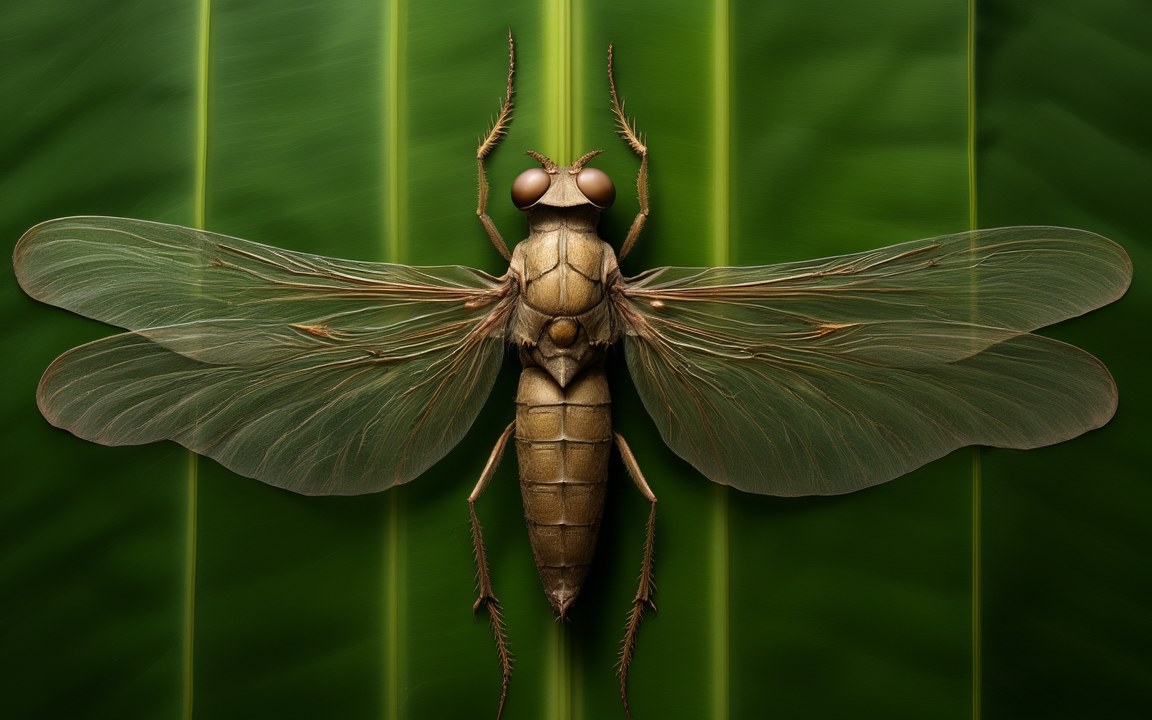
A giant insect with four broad, veined, clear wings spread flat, a long, segmented brown body, huge eyes and spiny legs, resting on a broad green leaf and seen from directly above, an impression of the griffinfly Meganeura about 300 million years ago.

Lost GiantsCarboniferous

Meganeura

A predatory griffinfly about 70 cm across the wings, patrolling open air 300 million years ago

About 304 to 299 million years ago Reconstruction, not a photograph
Lived about 304 to 299 million years ago Gzhelian stage, late Carboniferous [1]
Wingspan about 65 to 75 cm about 700 mm in Nel et al. 2018; 680 mm in Tillyard's 1917 estimate [1]
Single wing up to 32 cm long [1]
Body length almost 40 cm Garrouste and Nel; Wikipedia gives 60 to 75 cm, nearly the wingspan [7]
Weight estimates from 17.8 g to 150 g May 1982 at the low end, about 60 g from Paul 2002, 100 to 150 g from Cannell 2018 [1]
Group griffinflies (Meganisoptera) not true dragonflies, and only distantly related [1]
Food other insects caught in flight with spined legs [6]
Close rival Meganeuropsis permiana wingspan up to 71 cm, early Permian of Kansas [3]
Fossils Commentry, France first found in 1880; all valid specimens are in Paris [1]
Named 1884, by Brongniart as Dictyoneura monyi; given its own genus in 1885 [1]

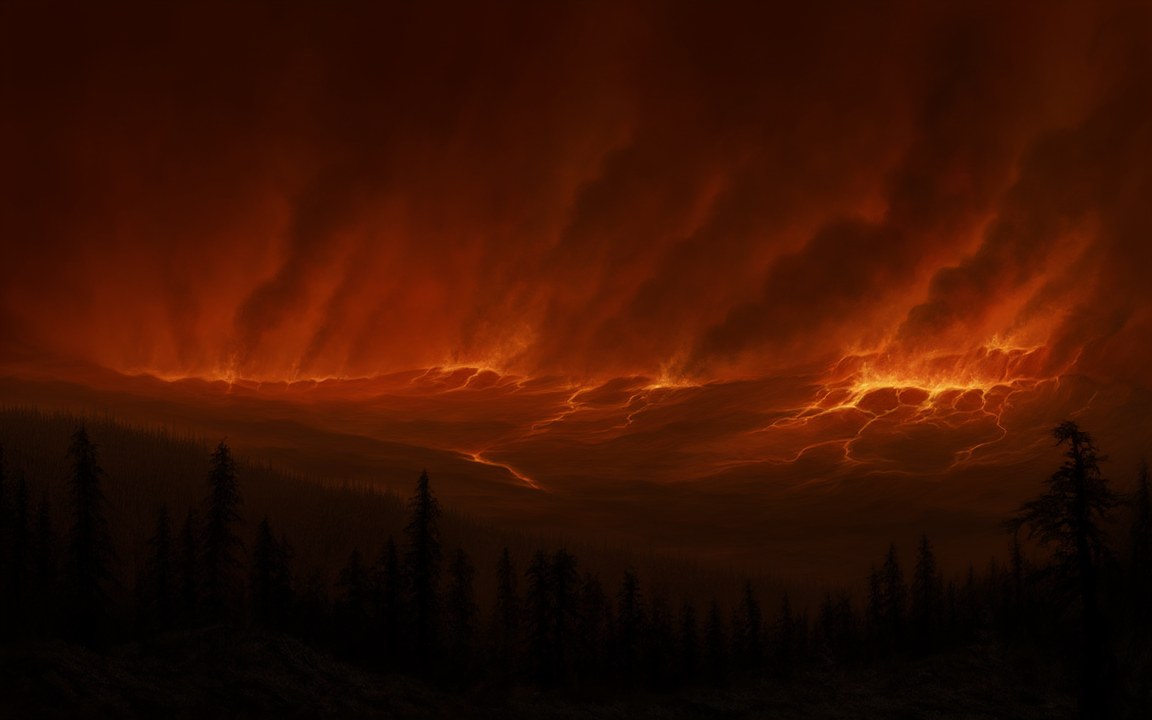
About the pictures. Two paintings show the insect, resting on a broad leaf seen from above and in silhouette over ferns at dusk. The huge eyes, spined legs, long wings held out to the sides and an abdomen about as thick as the thorax follow fossils of Meganeura and its close relative Meganeurites. An insect has six legs, and only four show on the leaf; in relatives the eyes met along the top of the head, where this painting sets them apart. In the silhouette only three of the four wings can be seen. Colours, the leaf, the ferns and the light are imagined.

Meganeura was an insect with a wingspan of about 70 cm that hunted over what is now central France about 300 million years ago, late in the Carboniferous. It is often called a giant dragonfly, but it was a griffinfly, from an extinct order only distantly related to dragonflies. It is one of the largest flying insects ever found, and its size lies at the centre of a long argument about how insects could once grow so large, an argument that a 2026 study has reopened.

A griffinfly, not a dragonfly

Griffinflies, formally Meganisoptera, looked enough like dragonflies to be named Protodonata at first. In 2005 Grimaldi and Engel proposed “griffenfly”, now often spelled griffinfly, because the two groups are so far apart. The differences show in the wings. Griffinflies had no pterostigma, the thickened patch of cells that stands out near a dragonfly’s wingtip, and they had a simpler pattern of veins and no nodal flexion structures. In Meganeura the thorax and abdomen were about equally thick, unlike the slim abdomen of a modern dragonfly.

The fossils come from the coal mines of Commentry, where they were first found in 1880. The mining engineer Fayol passed giant insects to Brongniart, who in 1884 named a four-winged specimen Dictyoneura monyi after Mony, the recently deceased manager of the mines. A year later he gave it its own genus, Meganeura, meaning “large vein”. In 1943 Carpenter showed that half of Brongniart’s six specimens were counterparts of the other half, leaving three individuals in his collection. Its overall anatomy is still poorly known, so much of the detail comes from close relatives.

The size, checked

The wingspan is well agreed. Published figures run from about 65 to 75 cm: Nel and colleagues give about 700 mm, Garrouste and Nel 70 cm, and an estimate by Tillyard from 1917 gives 680 mm. A single wing reached 32 cm. For comparison, the largest dragonfly alive today does not exceed about 20 cm. Meganeura may not hold the record outright, because Meganeuropsis permiana, from the early Permian of Kansas, had a wing of 330 mm and a wingspan of up to 710 mm.

The rest is less secure. Garrouste and Nel give a body almost 40 cm long, while Wikipedia gives up to 60 to 75 cm, nearly the wingspan. Meganeuropsis, about the same width across the wings, was almost 43 cm long, which fits the lower figure. Estimates of mass are further apart: 17.8 g from May in 1982, who thought it might be too low, about 60 g from Paul in 2002, and 100 to 150 g from Cannell in 2018.

A hawker in open air

Much of what is known about how it lived comes from Meganeurites gracilipes, a relative from the same beds at Commentry. Nel and colleagues found enlarged compound eyes that met along the midline for much of their length, strong jaws with sharp teeth, and strong spines on the lower legs and feet; thorax and legs together worked as a “flying trap”. They concluded that these insects were hawkers, patrolling above rivers, lakes, open forest or even the canopy, because such long wings would have been a handicap among dense trees. The food was mainly other insects.

They were not agile fliers by modern standards. Without nodal flexion structures they probably could not make the abrupt turns of a dragonfly, and like other early groups they could not fold their wings back over the abdomen. Cannell suggested a wingbeat of about 3 per second, against 18 for the largest living dragonfly, with short bursts of flight and much time spent perching.

The oxygen question

In 1911 Harlé proposed that Meganeura could fly only because the air then held more oxygen than today’s 20 per cent. The idea has since found some support, but it has a stubborn problem: griffinflies with a wingspan of 45 cm lived in the late Permian of Lodève, France, when oxygen had already fallen.

In 2026 Snelling and colleagues reported in Nature that tracheoles, the fine air tubes in flight muscle, fill only about 1 per cent of the muscle or less in most insects, and concluded that oxygen supply there does not limit size. Some scientists reply that oxygen flow elsewhere in the body might still matter. Other explanations include the lack of flying vertebrate predators, proposed by Bechly in 2004, and the mechanical limits of the exoskeleton. The question remains open.

Where it sits in deep time

Meganeura: About 304 to 299 million years ago, in the Carboniferous.

Meganeura

Earth forms, 4.57 billion years agoToday

Each step to the right is ten times closer to today, so the last few million years get as much room as the first billion.

If Earth's history were one day

Squeeze all of Earth's history, about 4.6 billion years, into 24 hours, starting at midnight. Meganeura runs from 22:24:09 to 22:25:44, ending 1 h 34 min before midnight.

On this clock one second is about 52 862 years. All of written history fits into the last tenth of a second.

How big

Wingspan of Meganeura next to the largest dragonfly alive today and the height of a person.

Reconstructions

A giant insect with four broad, veined, clear wings spread flat, a long, segmented brown body, huge eyes and spiny legs, resting on a broad green leaf and seen from directly above, an impression of the griffinfly Meganeura about 300 million years ago. AI-generated painting.
The dark silhouette of a giant insect with long wings and a long body flying above a fern forest against an orange sunset sky, an impression of the griffinfly Meganeura patrolling a Carboniferous forest. AI-generated painting.

Questions people ask

How big was Meganeura?

Its wingspan was about 65 to 75 cm, often given as about 70 cm, and a single wing could reach 32 cm. The largest dragonfly alive today does not exceed about 20 cm. Estimates of its body length disagree, from almost 40 cm to 60 cm or more.

Was Meganeura a dragonfly?

No. It was a griffinfly, from the extinct order Meganisoptera, which looked similar but was only distantly related to dragonflies and damselflies. Griffinflies lacked several features of true dragonflies' wings, including the pterostigma near the wingtip.

Was Meganeura the largest insect ever?

It was one of the two largest known. Meganeuropsis permiana, from the early Permian of Kansas, had a wingspan of up to 71 cm, so the two are about level on current figures.

Why were insects so big in the Carboniferous?

It is still debated. High oxygen was the classic explanation, but a 2026 study in Nature found that oxygen supply through the air tubes in flight muscle does not cap insect size. Other ideas include the lack of flying vertebrate predators and the mechanical limits of the exoskeleton.

What did Meganeura eat?

Mainly other insects. Its relatives had strong, sharply toothed jaws and spined legs that worked as a flying trap, which suggests it caught prey on the wing.

When did griffinflies go extinct?

At or near the end of the Permian. The Permian-Triassic crisis probably ended them, according to Garrouste and Nel. Meganeura itself is known only from the late Carboniferous.

Sources

  1. Wikipedia: Meganeura
  2. Wikipedia: Meganisoptera
  3. Wikipedia: Meganeuropsis
  4. Wikipedia: Palaeoptera
  5. Wikipedia: Pterostigma
  6. Nel et al. (2018), Palaeozoic giant dragonflies were hawker predators, Scientific Reports 8, 12141
  7. Garrouste & Nel (2018), Are the Paleozoic era's giant dragonflies still among us?, The Conversation
  8. Snelling et al. (2026), Oxygen supply through the tracheolar-muscle system does not constrain insect gigantism, Nature 653, 439–443
  9. Sci.News (2026), report on Snelling et al.
  10. University of Greifswald (2026), Atmospheric oxygen not decisive for the body size of insects