Castoroides, the giant beaver, was the largest rodent of Pleistocene North America and the largest beaver known, about 1.9 m long on average with front teeth up to 15 cm long. It lived from about 1.9 million to 11 500 years ago, from Alaska and Canada to Florida, and it depended on wetlands. Despite the name it was only a distant relative of today’s beaver, the two lines having split about 16 to 20 million years ago. Its bones point to a different kind of animal: an eater of water plants that has left no confirmed dam.
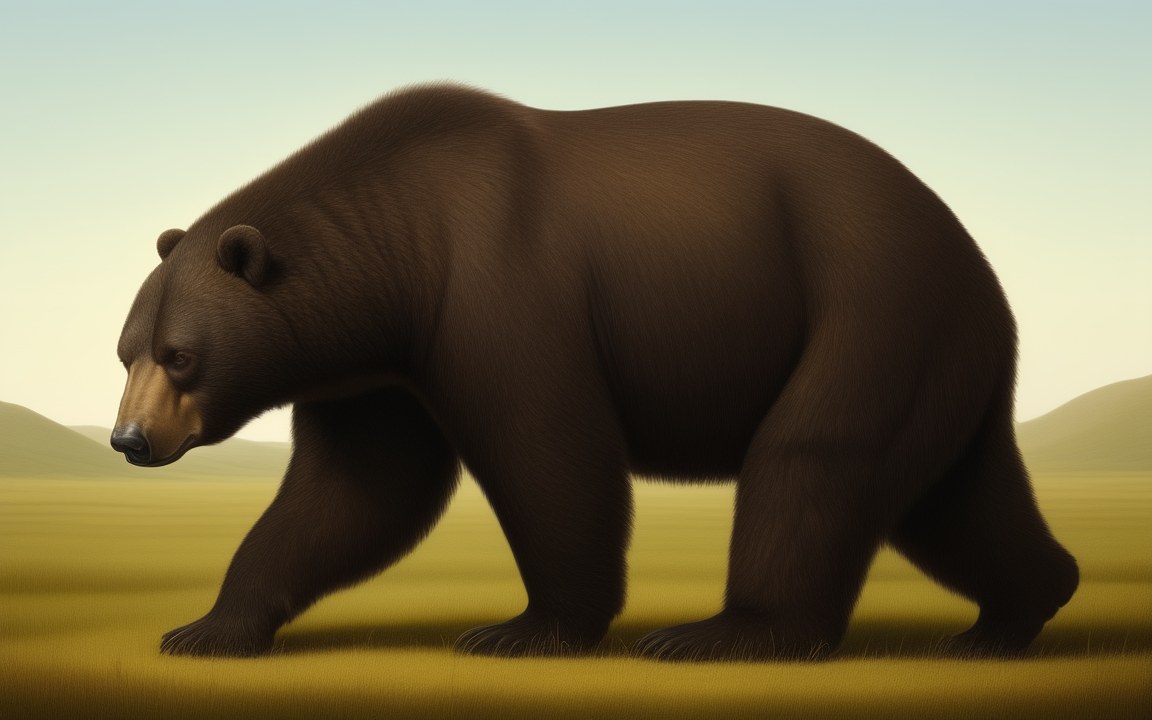
Not a modern beaver, enlarged
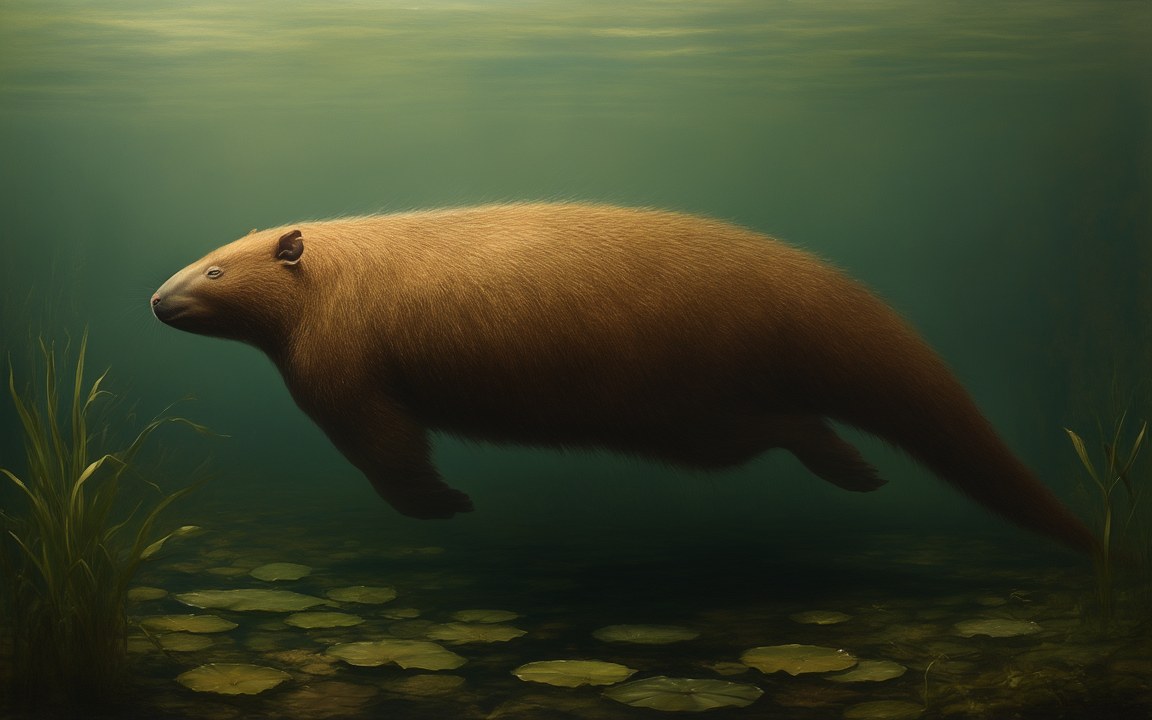
Castoroides carried a bulky body on short limbs, which made it poorly adapted to life on land. Its hind legs were shorter than a modern beaver’s and its hind feet much larger, though webbing can only be assumed. Features of the skull suggest it could stay under water for long spells.
Length is usually given as about 1.9 m on average and up to about 2.2 m. The Canadian Encyclopedia says more than 2 m without the tail, while modern beavers reach 1.3 m with theirs. Weight estimates run from 90 to 125 kg in older work down to about 77 kg in a later analysis, a figure that is disputed. A 2019 paper calls it “the one hundred kilogram giant beaver”. The tail, up to 65 cm long, was narrower in proportion than a modern beaver’s and may not have been paddle-shaped at all.
Ridged teeth, blunt tips
The incisors grew up to 15 cm long, and their outer surfaces carried prominent ridges in place of the smooth enamel of modern beavers. Those ridges would have acted like girders, supporting such long teeth, and a deep hollow in the lower jaw suggests a very powerful bite.
For felling trees, though, they were poor tools. The tips were blunt, without the thin chisel edge of a modern beaver’s, and the angle at which they left the skull made them ineffective for cutting, according to Plint and colleagues.
Bone chemistry and a diet of water plants
In 2019 Plint, Longstaffe and Zazula measured carbon and nitrogen isotopes in bone collagen from 11 giant beavers from the Yukon and Ohio, and compared them with muskrats, beavers and freshwater plants. The result pointed to a diet of mainly submerged water plants, with no support for tree leaves, bark or twigs. Giant and modern beavers seem to have had complementary diets.
No dam or lodge built by a giant beaver has been confirmed, nor any cut wood matching its teeth. That does not quite close the matter: The Canadian Encyclopedia notes that the chemistry cannot rule out building, and calls it an open question. The firmer conclusion is dependence. Wetlands gave the animal both its food and its shelter from predators.
Where the fossils turn up
The first fossils came from an Ohio peat bog in 1837, and Foster named the genus the next year. Finds concentrate near the Great Lakes, especially in Illinois and Indiana. Two species are recognised: Castoroides ohioensis across most of the continent, and Castoroides dilophidus in the south-east.
In the far north, at Old Crow in the Yukon, it most likely lived only in warm spells between 200 000 and 75 000 years ago, and it was probably gone from the region once glacial conditions set in around 70 000 years ago. In 2025 Minnesota made Castoroides ohioensis its state fossil. The statute records the names capa in Dakota and amik in Ojibwe.
The last wetlands
Its final stronghold was the lowlands south of the Great Lakes. The youngest known specimen, from Wayne County, New York, is 10 150 radiocarbon years old, or about 11 500 to 12 000 calendar years. As the Holocene warming began, shallow wetlands filled with sediment and deciduous trees replaced open mixed-conifer forest. Plint and colleagues see warmer, drier conditions as a likely contributor. They add, as a hypothesis still to be tested, that the modern beaver may have had an edge because it can engineer its own habitat.
People were there too: in New York, the last giant beavers overlapped with Palaeoindian culture by up to a thousand years. No bones show butchery, hunting or other use. Anishinaabe stories tell of giant beavers who “walked upright and stood as tall as the tallest man”, and the animal also features in Innu and Cree oral history. Many scholars think such stories may reflect encounters with the animal or with its fossils.