
A broad, grassy coastal plain at the foot of white chalk cliffs, the edge of a marsh with reeds in the foreground and wet sand flats and the sea beyond, an impression of Boxgrove in southern England about 500 000 years ago.

Human RelativesPleistocene

Homo heidelbergensis

A tall, heavy-browed human relative named from a single jaw, under a name researchers still argue over

About 700 000 to 200 000 years ago Reconstruction, not a photograph
Lived about 700 000 to 200 000 years ago depends on which fossils count; other accounts end it at 300 000, and the Smithsonian says it may reach back to 1.3 million [1]
Type fossil Mauer 1, a lower jaw heavily built, with no chin [1]
Found 21 October 1907 24 m down a sand pit near Heidelberg; named in 1908 [3]
Age of the jaw about 609 000 years give or take 40 000 [3]
Height men about 175 cm, women about 157 cm averages; other estimates are lower [1]
Weight men about 62 kg, women about 51 kg averages [1]
Brain about 1 300 cm³ for the Kabwe 1 skull from Zambia [4]
Range Europe and Africa the Smithsonian adds possibly China [1]
Best-known site Boxgrove, England about 500 000 years old, with flint tools and a butchered horse [21]
Other names Homo rhodesiensis, Homo bodoensis for some or all of the African fossils; bodoensis is rejected by other experts [8]

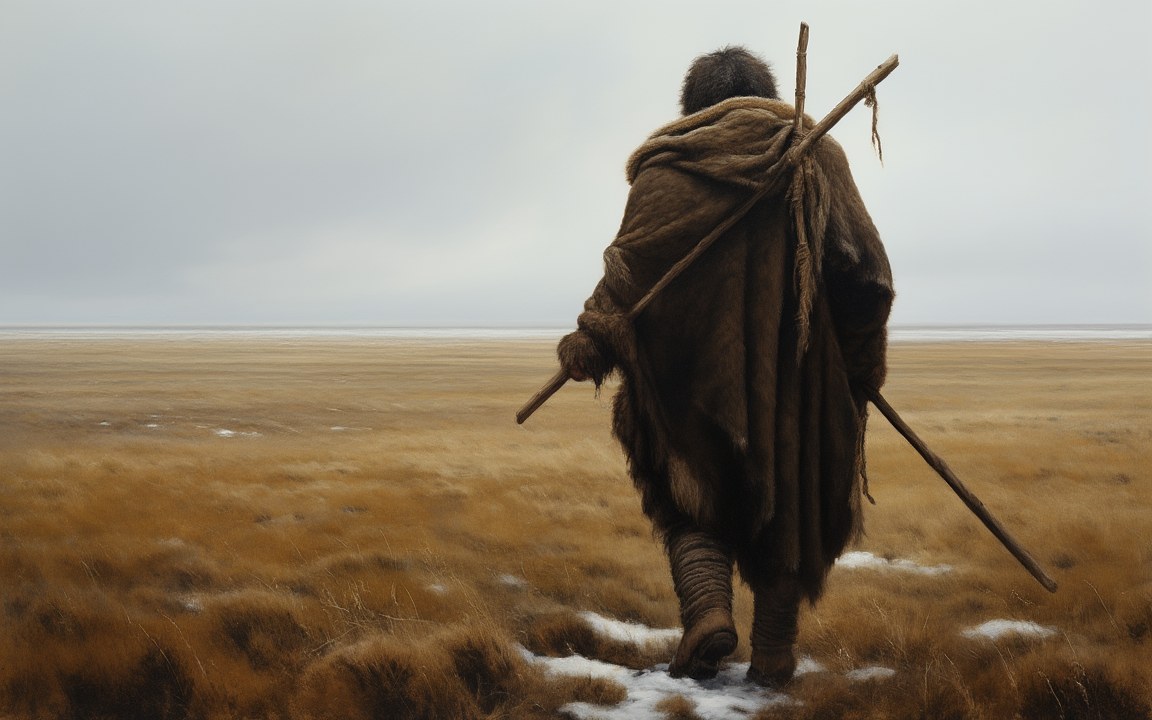
About the pictures. Three scenes from sites linked to the name: the chalk cliffs, grassy plain and marsh at Boxgrove in England about 500 000 years ago; a tall, heavily built person walking there, seen from behind, after the Boxgrove shin bone; and an elephant on a river sandbank, after the straight-tusked elephant whose bones lay in the same sands as the Mauer jaw. The real animal had a bony crest on top of its skull, which the painted one does not show. The exact plants and light are imagined. No skin, hair or clothing survives, so skin and hair colour are guesses, and the shaggy hide, fur-covered legs and soft shoes are invented.

Homo heidelbergensis is the name given to large-brained, heavily built people who lived in Europe and Africa from about 700 000 to 200 000 years ago. It rests on a single lower jaw dug from a sand pit near Heidelberg in Germany in 1907. For decades it was treated as the last common ancestor of Neanderthals and modern humans. Today researchers argue over which fossils belong under the name, whether it should be split, and whether that ancestor story still holds.

A species hung on one jaw

On 21 October 1907 the jaw, heavy and chinless, came out of the Grafenrain sand pit at Mauer, 24 m down in sands laid by the Neckar river. Schoetensack named it in 1908, the second fossil species placed in Homo after the Neanderthals. A 2010 study dated the layer to about 609 000 years, give or take 40 000. A straight-tusked elephant, a rhinoceros and a bison lay in the same sands.

A jaw makes a poor anchor, because few comparable jaws exist and it has few telling features. In 1983 Stringer revived the name for a wider group of skulls from Europe and Africa, which he saw as ancestors of both Neanderthals and modern humans. They include Kabwe 1 from Zambia, found in 1921, 324 000 to 274 000 years old, with a brain of about 1 300 cm³, and Bodo from Ethiopia, found in 1976 and about 600 000 years old.

Homo bodoensis and the muddle in the middle

Researchers call this confusion the muddle in the middle. In 2000 McBrearty and Brooks kept Homo heidelbergensis for Europe and revived Homo rhodesiensis, given to Kabwe in 1921, for African fossils they saw as ancestral to modern humans. DNA then cut into the European group: the 430 000-year-old Sima de los Huesos fossils from Spain, which the Smithsonian still lists under the name, proved closer to Neanderthals than to Denisovans. In Asia, the Harbin skull turned out in 2025 to be Denisovan, and Chinese skulls such as Dali and Jinniushan, placed with Homo heidelbergensis by some, may be too.

In 2021 a team led by Roksandic proposed a new species, Homo bodoensis, named after the Bodo skull. It would take most fossils from Africa and the eastern Mediterranean from 774 000 to 129 000 years ago, and many European ones would become Neanderthals. It would replace both older names, partly to avoid honouring Cecil Rhodes. In 2022 Delson and Stringer rejected it: the rules of zoological naming do not allow a valid name to be replaced because it has been used loosely or because it offends. Others objected too, and Roksandic’s team replied. So one skull can carry several names: Kabwe 1 is rhodesiensis to its first describer, heidelbergensis at the Smithsonian and bodoensis under the proposal.

Common ancestor, or not?

The Smithsonian still describes Homo heidelbergensis as the most likely common ancestor of Neanderthals and modern humans, with the two lines parting 350 000 to 400 000 years ago. Stringer is now less sure: “we no longer know where the ancestry of the Neanderthal lies”, he told Discover in 2022. A 2025 study he co-wrote, based on a reconstructed skull from Yunxian in China, puts the Neanderthal split at about 1.38 million years ago and the split between Homo longi and the line to modern humans at about 1.32 million, too early for Homo heidelbergensis as usually dated. It keeps heidelbergensis as one of five main large-brained branches of the past 800 000 years. That timing rests on an age of about a million years for the skull. A 2026 study dated the Yunxian skulls to about 1.77 million and left open how that changes the result.

Flint at Boxgrove, footprints on a volcano

Few leg bones exist, so its build is uncertain. A shin bone from Boxgrove in southern England, about 500 000 years old, suggests a man about 1.8 m tall and more robust than most people today. Boxgrove then lay below chalk cliffs 200 m high, by a grassy plain and a marsh. A group butchered a horse there and left more than 2 000 scatters of flint from shaping biface knives.

A 2025 study redated the wooden spears from Schöningen in Germany, which the Smithsonian lists at 400 000 years, to about 200 000 and linked them to Neanderthals. Tracks left in fresh volcanic ash at Roccamonfina in Italy about 349 000 years ago are tentatively credited to Homo heidelbergensis, though the team that studied them in 2020 left the species open.

Where it sits in deep time

Homo heidelbergensis: About 700 000 to 200 000 years ago, in the Pleistocene.

Homo heidelbergensis

Earth forms, 4.57 billion years agoToday

Each step to the right is ten times closer to today, so the last few million years get as much room as the first billion.

If Earth's history were one day

Squeeze all of Earth's history, about 4.6 billion years, into 24 hours, starting at midnight. Homo heidelbergensis runs from 23:59:46.8 to 23:59:56.2, ending 3.8 seconds before midnight.

On this clock one second is about 52 862 years. All of written history fits into the last tenth of a second.

How tall

Height estimates for Homo heidelbergensis next to a modern person.

Few leg bones exist. Another estimate puts people of this period at 165 to 170 cm on average.

Reconstructions

A broad, grassy coastal plain at the foot of white chalk cliffs, the edge of a marsh with reeds in the foreground and wet sand flats and the sea beyond, an impression of Boxgrove in southern England about 500 000 years ago. AI-generated painting.
A tall, heavily built person in a shaggy hide cloak, with fur-covered legs and soft shoes, seen from behind walking along a path through tall grass towards white chalk cliffs and a marsh, an impression of Homo heidelbergensis at Boxgrove about 500 000 years ago. AI-generated painting.
A huge grey elephant with long legs, large ears and gently curved tusks standing on a sandbank by a river among tall grasses, an impression of a straight-tusked elephant in southern Germany about 600 000 years ago. AI-generated painting.

Questions people ask

Is Homo heidelbergensis our ancestor?

Possibly, but it is no longer settled. The Smithsonian calls it the most likely common ancestor of Neanderthals and modern humans. Stringer said in 2022 that the ancestry of the Neanderthals is no longer known, and a 2025 study puts the splits between those lines more than a million years ago, which would be too early for the species as usually dated.

What is Homo bodoensis?

A species proposed in 2021 by a team led by Roksandic, named after the Bodo skull from Ethiopia, for most fossils from Africa and the eastern Mediterranean from 774 000 to 129 000 years ago. Delson and Stringer rejected it in 2022 as invalid under the rules of zoological naming.

How tall was Homo heidelbergensis?

The Smithsonian gives averages of 175 cm for men and 157 cm for women. A shin bone from Boxgrove suggests a man about 1.8 m tall, while another estimate puts people of this period at 165 to 170 cm. Few leg bones exist.

Where was Heidelberg Man found?

In the Grafenrain sand pit at Mauer, near Heidelberg in Germany, on 21 October 1907, at a depth of 24 m. Only the lower jaw was found, and it is about 609 000 years old.

Is Dragon Man Homo heidelbergensis?

No. The Harbin skull was named Homo longi in 2021, and in 2025 proteins and DNA identified it as a Denisovan. Other Chinese skulls once placed with Homo heidelbergensis, such as Dali and Jinniushan, may be Denisovan too.

Did Homo heidelbergensis use fire?

The Smithsonian credits it with hearths by 790 000 years ago at Gesher Benot Ya'aqov in Israel. In Europe, evidence of fire is scarce until about 300 000 to 400 000 years ago.

Sources

  1. Smithsonian Human Origins: Homo heidelbergensis
  2. Wikipedia: Homo heidelbergensis
  3. Wagner et al. (2010), Radiometric dating of the type-site for Homo heidelbergensis at Mauer, Germany, PNAS 107, 19726–19730
  4. Smithsonian Human Origins: Kabwe 1
  5. Smithsonian Human Origins: Bodo
  6. Roksandic et al. (2022), Resolving the 'muddle in the middle': The case for Homo bodoensis sp. nov., Evolutionary Anthropology 31, 20–29
  7. Archaeology (2021), Name change suggested for ancestors of modern humans (Roksandic et al.)
  8. Delson & Stringer (2022), The naming of Homo bodoensis by Roksandic and colleagues does not resolve issues surrounding Middle Pleistocene human evolution, Evolutionary Anthropology 31, 233–236
  9. Sarmiento & Pickford (2022), Muddying the muddle in the middle even more, Evolutionary Anthropology 31, 237–239
  10. Roksandic et al. (2022), Homo bodoensis and why it matters, Evolutionary Anthropology
  11. Meyer et al. (2016), Nuclear DNA sequences from the Middle Pleistocene Sima de los Huesos hominins, Nature 531, 504–507
  12. Wikipedia: Sima de los Huesos hominins
  13. Sci.News (2025), Harbin fossil belongs to Denisovan population, two new studies suggest (Fu et al., Science and Cell)
  14. Discover (2022), What did Neanderthals evolve from?
  15. Natural History Museum (2025), Analysis of reconstructed ancient skull pushes back our origins (Feng et al., Science 389)
  16. ScienceAlert (2025), A million-year-old skull just rewrote the origin story of humanity (Feng et al.)
  17. Archaeology Magazine (2026), 1.77-million-year-old Homo erectus skulls in China (Tu et al., Science Advances)
  18. Tu et al. (2026), The oldest in situ Homo erectus crania in eastern Asia: The Yunxian site dates to ~1.77 Ma, Science Advances 12, eady2270
  19. Natural History Museum: Boxgrove tibia (Google Arts & Culture)
  20. Current Archaeology: Boxgrove
  21. Archaeology (2020), 500,000-year-old butchering site in England analyzed
  22. Hutson et al. (2025), Revised age for Schöningen hunting spears indicates intensification of Neanderthal cooperative behavior around 200,000 years ago, Science Advances 11, eadv0752
  23. University of York (2025), Age of Schöningen spears revised to 200,000 years
  24. Wikipedia: Ciampate del Diavolo
  25. ScienceAlert (2020), Mysterious footprints indicate Neanderthals climbed a volcano right after it erupted (Panarello et al., Journal of Quaternary Science)
  26. Wikipedia: Straight-tusked elephant