About 74 000 years ago a volcano in northern Sumatra erupted on a scale unmatched in the past 2 million years. It released at least 2 800 km³ of material, spread ash across South Asia and the Indian Ocean, and collapsed into a caldera about 100 km long, now filled by Lake Toba. Because traces of its ash turn up as far away as South Africa, the eruption also works as a time marker, allowing climate and human remains on different continents to be compared at one moment.
Ash from Sumatra to South Africa
Rose and Chesner estimated about 2 000 km³ of hot flows on the ground and about 800 km³ of ash, most of it falling to the west. A later estimate raises the total to 3 800 km³ of dense rock. Inside the caldera the flows are more than 600 m thick, and outside it they covered 20 000 to 30 000 km² to a depth of nearly 100 m.
The ash fall reached more than 38 million km² at a depth of at least 1 cm, about 7.5 per cent of Earth’s surface. It left 5 cm over India and 10 cm in the central Indian Ocean. Farther away only microscopic glass shards remain, in Lake Malawi, Lake Chala, north-west Ethiopia and on the south coast of South Africa, roughly 10 000 km from Sumatra.
Two weeks, or ten thousand years
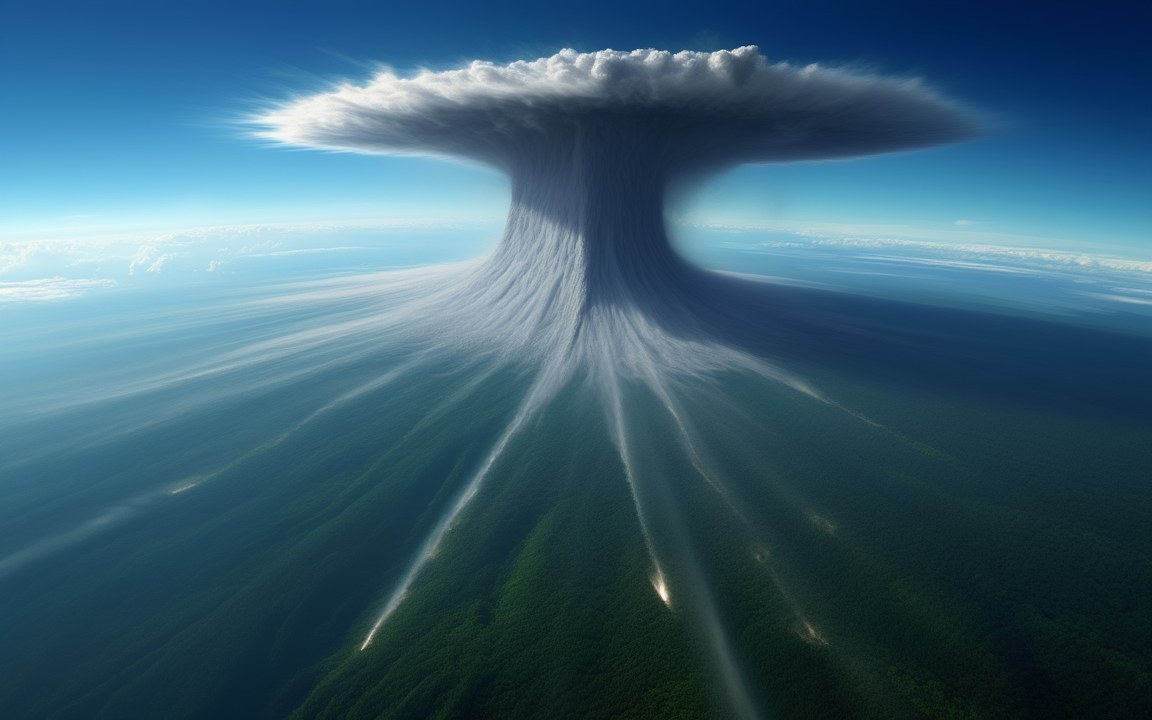
The usual account gives a main eruption of perhaps 9 to 14 days: a small fall of ash, then huge flows from a low fountain, with a column rising up to 32 km off the flows themselves. A 2023 study of a marine core near Toba complicates this. Caron and colleagues found at least 17 ash layers in three phases spread over about 50 000 years, with the main phase probably containing 6 eruptive events across about 10 000 years.
Even the season is disputed. Ash in the South China Sea has been taken to mean the northern summer, because only the summer monsoon could carry it there. Annual layers in Lake Chala in East Africa, published in 2026, point to the northern winter.
A short volcanic winter
Ice cores suggest about 100 million tonnes of sulfur. One model, using a larger amount, gives up to 3.5 °C of global cooling, gone within about 5 years and with no ice age to follow. Others give 2.3 to 4.1 °C, and evidence from historical eruptions suggests that the size of the aerosol particles may hold it below 1.5 °C whatever the sulfur. The world was already cooling, and a cold spell lasting about 1 500 years in the North Atlantic began at about the same time. Whether Toba sped it up is debated: ice cores show 110 years of faster cooling after a sulfate layer thought to be Toba’s. In East Africa the Lake Chala record shows modest cooling and a drought of under two years.
The bottleneck that did not appear
In 1998 Ambrose argued that Toba crashed the human population to a few thousand survivors. The idea is now largely rejected. In 2018 Yost and colleagues wrote that genetic analyses have not detected a bottleneck at the date of the eruption. The low point seen in people outside Africa falls near 50 000 years ago and is read as a founder effect of leaving Africa. Some African populations reached a milder low around 70 000 to 80 000 years ago, with no agreed cause. A separate bottleneck of about 1 280 breeding individuals, published in 2023, dates from 930 000 to 813 000 years ago and has nothing to do with Toba.
Archaeology points the same way. At Pinnacle Point and Vleesbaai in South Africa, Smith’s team concluded that people thrived through it. At Shinfa-Metema 1 in Ethiopia, Kappelman’s team found Toba’s shards within layers of occupation, and people turned to fish as dry-season rivers shrank into waterholes. India is less clear. Tools in the Jurreru Valley look much the same below and above the ash, though those above may be far younger, and the Middle Son Valley shows a major population decline. Neanderthals and Denisovans also outlived the eruption.
The lake in the hole
Lake Toba now covers about 1 130 km² and reaches 505 m deep. It is the youngest of four overlapping calderas, the earliest formed about 1.2 million years ago. Samosir Island in the middle has risen at least 450 m since the eruption.