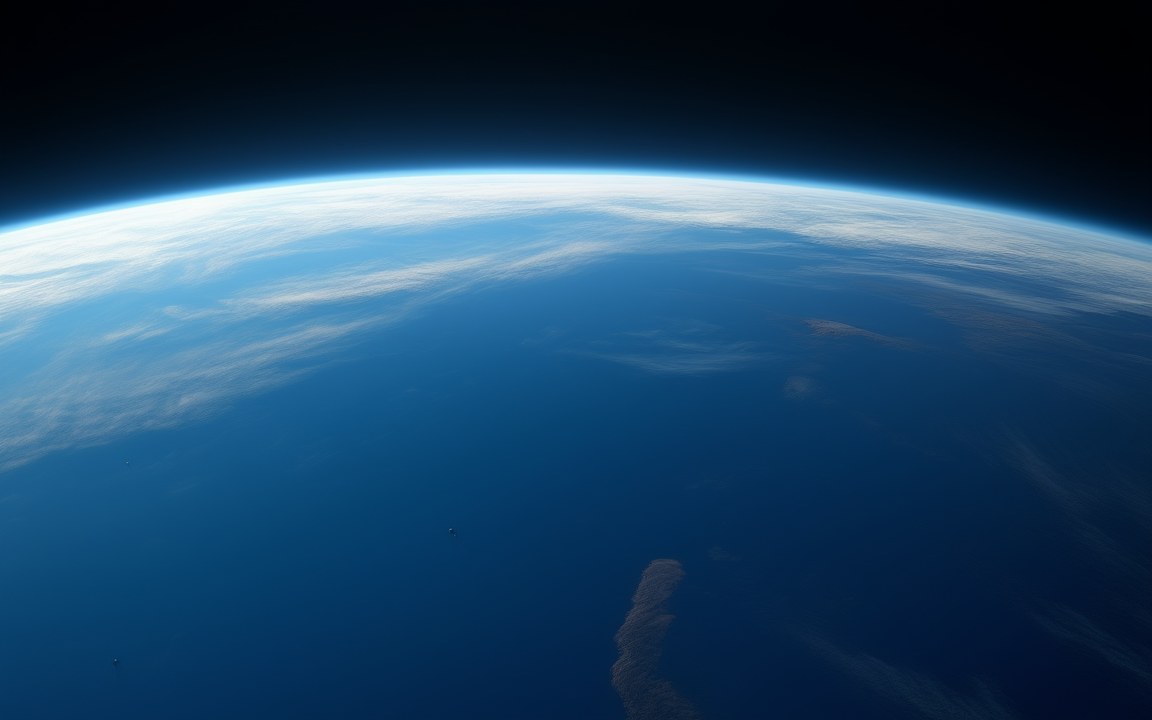
About 250 million years ago, most of the planet was a single ocean. Panthalassa, from the Greek for “all sea”, surrounded the supercontinent Pangaea and covered almost 70 per cent of Earth’s surface, a hemisphere-sized expanse of water much larger than the Pacific is today. The Pacific is its direct descendant, which is why Panthalassa is also known as the Paleo-Pacific or Proto-Pacific. Yet not one piece of its original floor survives where it formed. Much of what geologists know of it comes from computer models and from scraps of old islands that were scraped off onto the edges of continents.
An ocean without a floor
Ocean floor does not last. Old crust is recycled into the mantle at subduction zones, and almost nowhere on Earth is the seafloor older than about 200 million years. The one proposed exception, about 340 million years old under the eastern Mediterranean, is thought to be a remnant of the Tethys, not of this ocean. The oldest part of the Pacific Plate lies just east of the Mariana Trench. Panthalassa’s ancient floor has disappeared completely. That leaves even its outline uncertain: where it met the Tethys Ocean, which opened eastwards from inside Pangaea’s curve, so little oceanic crust is preserved that the boundary is poorly known.
Some traces lie in the mantle itself. Seismic tomography picks out slabs of sunken seafloor that mark where its subduction zones once were. In 2023 a team led by van de Lagemaat matched 135-million-year-old rocks from the mountains of Borneo, whose magnetism recorded an unexpected latitude, to one such slab. It belonged to a lost plate they named Pontus, once a quarter the size of the Pacific, which lay in a gap that reconstructions had filled with the Panthalassic Izanagi plate. It was pushed under the Australian and Chinese plates and was gone by about 20 million years ago.
Atolls in the mountains of Japan
The best clues are pieces that escaped subduction. In the Permian, atolls grew on seamounts near the equator, far out in the ocean. As Panthalassa’s floor was dragged under Asia in the Triassic and Early Jurassic, the seamounts and their old atolls were scraped off and stuck onto the continental margin as blocks of limestone. One survives in central Kyushu, in south-west Japan, as a body of limestone 2 km long and 100 to 150 m wide. Volcanic island arcs of the Triassic and Jurassic that formed out in the ocean are preserved in north-east Asia, in Japan, and in Wrangellia and Stikinia in western North America, and seamounts added to eastern Australia record the ocean’s volcanic hotspots.
Its warm shallows were home to fusulines, a group of foraminifera: single-celled organisms with chambered shells. In the Late Carboniferous and Permian they took up photosynthesising algae as partners and grew to giant sizes, the largest reaching 14 to 16 cm, depending on the source. The Capitanian extinction about 260 million years ago ended that. Only dwarf forms carried on, until the last fusulines died out in the Great Dying about 252 million years ago.
Older than Pangaea, mother of the Pacific
The ocean is far older than the supercontinent it surrounded. Its origins lie in the breakup of Rodinia, which by one account began about 870 to 845 million years ago; about 750 million years ago the western half of Rodinia started to rift apart. Panthalassa grew as subduction consumed Mirovia, the world ocean around Rodinia, which may have frozen to a depth of 2 km during the Cryogenian ice ages.
Nor did it ever close. About 190 million years ago, in the Early Jurassic, a new plate began to form near its centre, where the Panthalassic Farallon, Phoenix and Izanagi plates met. That plate is the Pacific Plate. In 2016 Boschman and van Hinsbergen argued that it was born not at a stable meeting of three spreading ridges, as earlier thought, but at an unstable junction of three transform faults, which opened a triangular gap in the crust. They suggest the setup was probably an accident.
Weather on a water hemisphere
Climate models suggest how such an ocean behaved. Huge subtropical gyres turned in each hemisphere, separated by the Intertropical Convergence Zone. Upwelling brought the coldest water to the surface in the east, along Pangaea’s western coast, while the warmest water extended west into the Tethys.